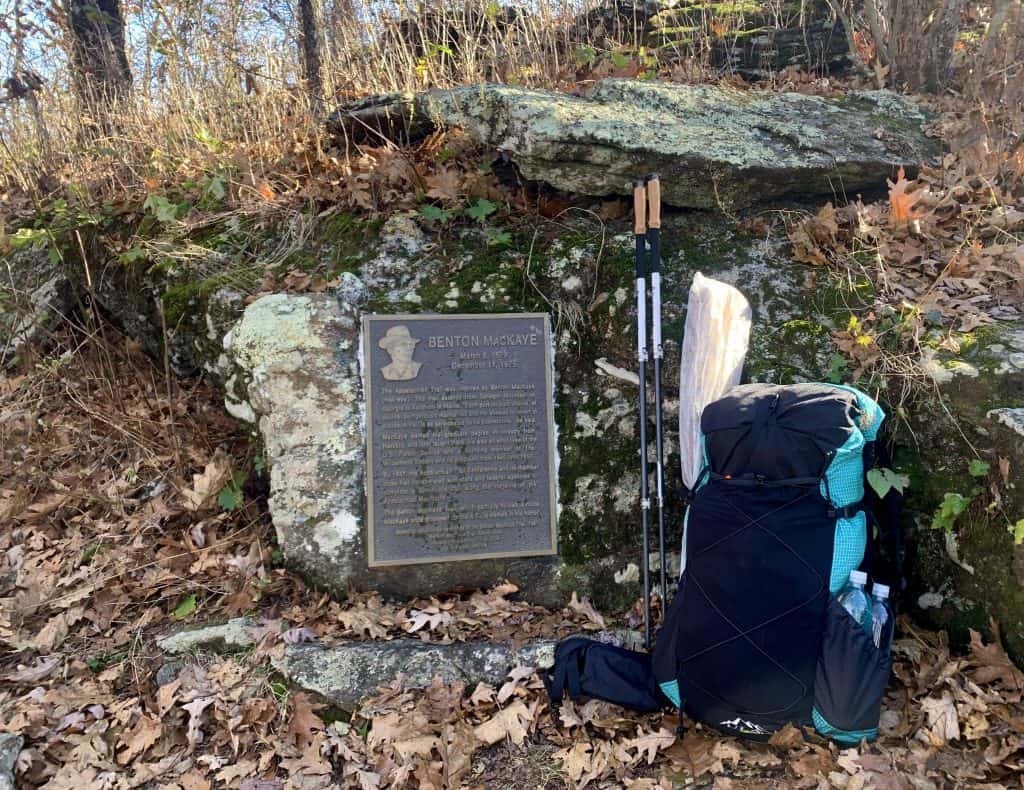
I started my hike of the Benton MacKaye Trail from Springer Mountain on beautifully warm and sunny morning in mid-November. The mile up the mountain on the AT to the Southern Terminus passed easily and gave me confidence that despite all the evidence to the contrary I was indeed in good enough shape for a solo thru-hike in late fall—so I was in good spirits when I paused at the small, unassuming monument marking the start of the BMT to take a few pictures and make a few small adjustments to my pack. The next 12 miles, however, taught me exactly how misplaced that optimism truly had been. I felt a slight but foreboding twinge in my knees before I even stopped for lunch, and by the time the sun had set and I had reached that night’s campsite my feet were throbbing, beaten raw by the added weight of a marginally heavier pack than I was used to, and a significantly heavier tummy.
I hobbled down an embankment in the deepening twilight to the water source marked in my guide, only to find a thin trickle just barely coating the creekbed. I had only ever experienced these woods in the spring and early summer, when snowmelt and heavy rains kept the streams and rivers fat with fresh water. It hadn’t occurred to me to bring a scoop. I couldn’t collect water here, and had to slowly trace the stream uphill in the failing light until finally I lucked into a small pool, just deep enough for me to submerge my bottles. I thought with irritation of the healthy stream I’d passed a couple of hours before without stopping to fill up, so confident that every water source would be lowing at least as well. At least I had enough to make my dinner by headlamp.
The sun set well little before 1700hrs; I had eaten and had everything cleaned up by 1730. Now I only had to kill the next 14 hours before the sun would rise and I could get started on day number 2. I had packed along a small tablet in anticipation of this problem, but when I tried to read I found that I was too tired to focus on the words on the screen. The underquilt kept the hammock surprisingly toasty, and even though the night was fairly chilly, I was uncomfortably hot. My hammock was also, frankly, too small for me, and I struggled to find a position that let me sleep for more than a few minutes before waking up with a sharp pain in my leg, or arm, or neck. I passed the long hours until dawn tossing and turning and only occasionally dozing.
The next day was bright and warm, and I soon found both my shirt and blaze-orange bandana (a nod toward hiking safety during peak deer season) soaked through with sweat. I hit a deep, clear river early on, but I only had two one-liter bottles with me, so I couldn’t carry as much as I needed to keep up with the amount I was losing to perspiration as I climbed mountain after mountain. Then too, I was using aquamira to purify my drinking water, which meant that if I wanted to drink water at the source (or “camel up,” in hiker speak) and refill before leaving, I had to burn precious daylight waiting for the drops to work on the first batch. There is always a debate in the hiking community over the necessity of water purification, but on this at least I tend to err on the side of caution. This far south, the woods are full of animal shit. I don’t care how clear any given water source looks: something has recently used it as a toilet. I don’t drink untreated water in Appalachia, but I also didn’t want to spend all day waiting for my water to cure. So I simply didn’t drink enough. It was a bad solution to a dumb problem, and I would be dogged by a dry throat the rest of the time I was on trail. My mouth developed a gross film that did not go away until after I was done, no matter what I did.
I pushed hard that day, but still didn’t make it to the water source by which I had planned to camp until well after sundown. I was moving so slowly, wearing myself out on the steep climbs, and the picking my way gingerly through the equally steep descents. The trail was nearly impossible to see, covered by a thick, undisturbed layer of newly fallen leaves, which came up to my shins and hid the uneven surface of the path beneath my feet. I created a great deal of noise as I walked, my footsteps making a sort of constant shuff shuff shuff shuff that I imaged could be heard for miles—if indeed there had been anyone within miles to hear it. Every so often, the BMT would briefly join the AT, and then I would find myself almost instantly surrounded by couples and families out with their dogs for an afternoon stroll on a clear and hard-packed trail. But then, after a few hundred feet, the paths would diverge and I would once again be shuff shuff shuff shuffing by myself off into the untrampled wilderness.
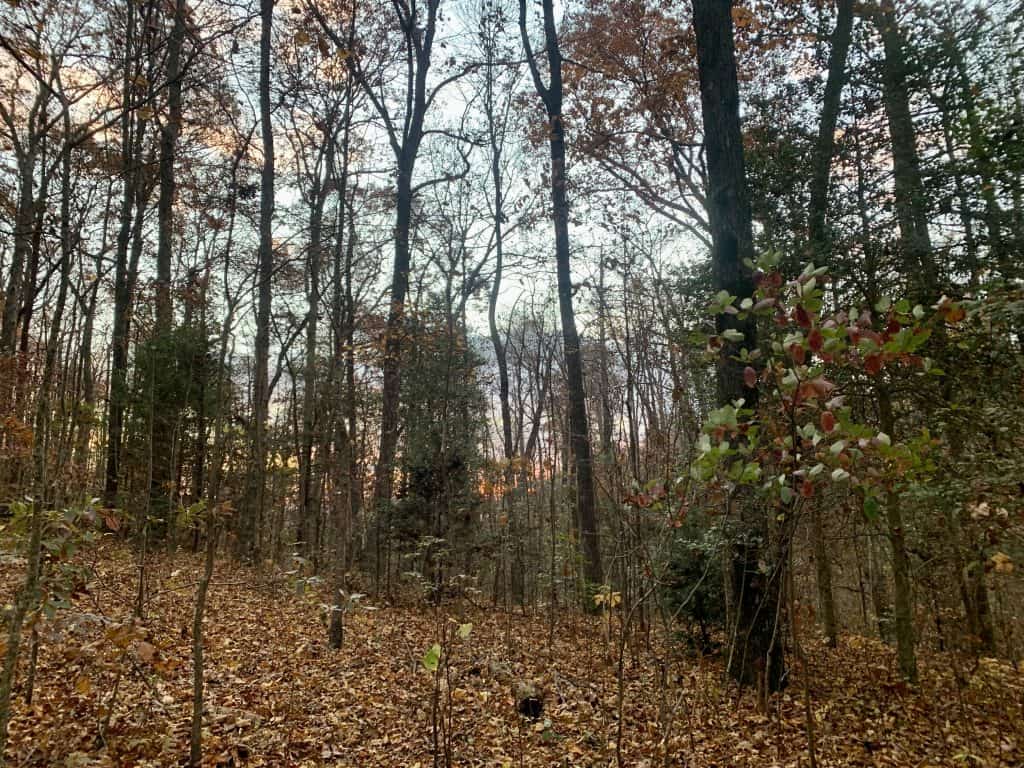
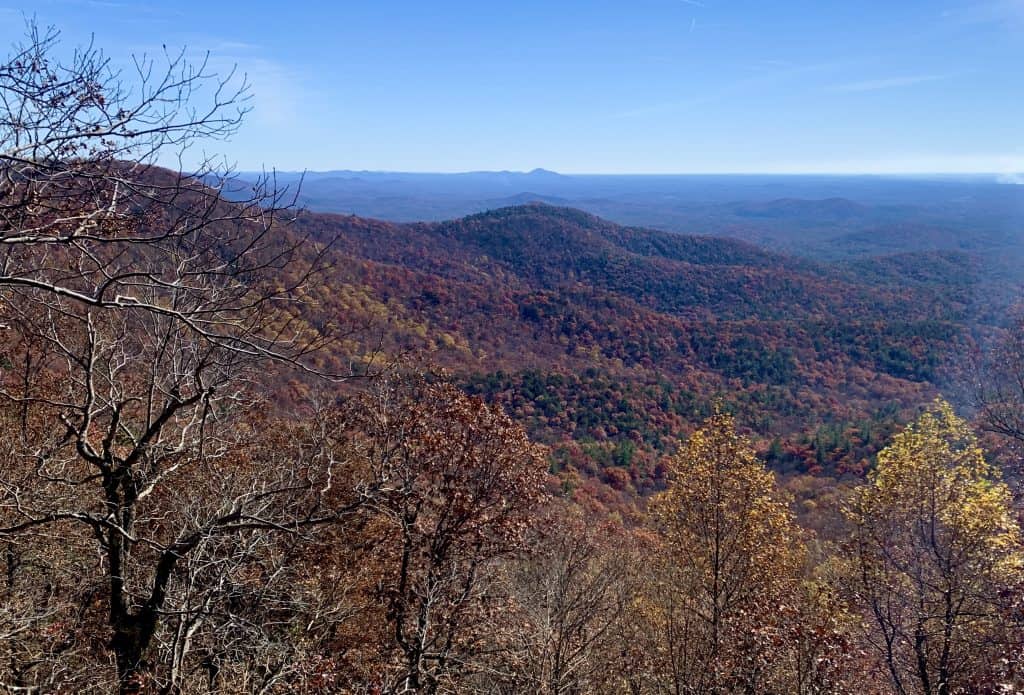
It was a beautiful time to be in the mountains of North Georgia. The mostly bare branches of the trees let in views from the mountaintops that would have otherwise been obscured by dense foliage. The sharp, rich smell of the autumn leaves permeated the air as their deep oranges and reds painted and remade the landscape. It was everything I had missed about fall in the United States in all the consecutive years of deployment to Antarctica. I was lucky to be where I was. It was a privileged position, to be sure, and I was keenly aware of that fact. But I was also aware how hard a time I was having appreciating it. After only two days my body was already kind of a wreck. Everything hurt, and not in the way I had come to accept during my time of the Appalachian and Pacific Crest trails. My feet, my back, and most especially my knees hurt in a way that suggested I was doing actual damage to them, something that could conceivably take a long, long time to recover from. And as I much I had longed for it, the solitude was already becoming overwhelming, more tedious than it was serene—a tedium sustainably compounded by the fact that most of the day was spent in camp, alone and idle, waiting for the sun to return.
As I considered the prospect of doing this for nineteen more days, I felt a gnawing dread that this was about as good as this hike was going to get. I hadn’t even hit any bad weather yet, pretty much the only guarantee of any long-distance hike. As I made camp that evening by the fractured light of the moon as it shone through the branches of the trees—re-hanging the hammock again and again and finding the line too slack every time until I finally strung it up over the stony remains of an old fire pit—I was on the fence about whether or not this endeavor was worth the effort. The Appalachians in autumn are truly spectacular, in a way that the spring and summer crowd never get to experience. I didn’t exactly love the idea of trading them for a bland fitness routine in the suburbs, having to drive for thirty minutes just to get an hour of exercise, surrounded on all sides by strip malls and the gated communities outside the perimeter of Atlanta. But at the same time I had to admit to myself that I was not in proper shape for and outing like this; and that the longer I did it, the more likely I was to get hurt in some stupid, ridiculous, long-lasting, and utterly preventable way. I was also, frankly, bored out of my fucking mind.
The breaking point came when I had finally gotten my hammock, tarp, and underquilt arranged just perfectly so and was shimmying into my sleeping bag for another long night. As I settled in, my weight shifted in just the right way and I was suddenly dumped out of the hammock and into the old, stony fire pit, face to face with the big-eyed field mouse that had been nosing around my pack, trying to get into my food supply. The mouse bolted, and I lay on my side for a moment on the rocks, leaves, ashes, and charred bits of wood. “Fuck this,” I said aloud, before picking my myself up and carefully, hesitantly trying once again to lay down for the night. What is the point of literally breaking yourself just to be bored and miserable? Or of being bored and miserable just to break yourself? I’d left both a funny, kind, and charming girlfriend and fancy new gravel bike behind for a few weeks so I could go have a grand adventure in the wilds of the American South or whatever, but the adventure kinda sucked. I wasn’t having a good time and I was possibly doing real damage to myself in the process, and things were only likely to get worse from here.
The next morning, I started a long traverse up a ridge until I came to a peak where I was surprised and delighted to find that I had cell service. I managed to call my dad and arrange to meet him at general store about ten miles up the trail from where I was. It turned out to be another high-effort, low-mileage day as I shuff shuff shuff shuffed up steep climbs and down scorching, exposed rockfalls. The water source I was counting on hitting around midday was completely dry, with only a few patches of thick mud left where pools of water would be in just a few months time. I was completely parched and slowly overheating when I stopped for lunch, taking shade on a wooded peak topped by a large antenna. I had cell service, and I was able to call Sean Meadow. She was surprised to hear from me, but was nonetheless supportive of my decision to bail. I had been feeling down on myself, questioning even then whether quitting was the right thing to do. She reminded me why I had come out there in the first place, and that giving up sometimes really is the best choice, even if it’s the hardest to make.
I met my dad in the late afternoon, desperately thirsty and once again soaked in sweat. He was gracious enough not to mention how badly I smelled, hugging me as I staggered up the country road toward the bridge. We crossed the river and I headed over to the general store, where I had originally planned to pick up supplies but which turned out to be on winter hours and was already closed for the day. Another good reason not to continue. I was out of thru-hiking shape in more ways than one, and the stink pouring from my clothes was bothering even me, (I can only imagine what it was like for someone who hadn’t just walked out of the woods), so we rode the whole way back to my parents’ house with the windows cracked. We stopped at a gas station where I bought a half gallon of diet coke in a refillable cup, and drank the whole thing in less than ten minutes. I had been hiking for all of three days and had covered all of 38 miles from Springer. I was exhausted, chafed, and limping. I really needed to get into shape if I was ever going to take on another hike of any distance; this just clearly wasn’t the way I was going to get it done.
I left Georgia shortly after thanksgiving to rejoin Sean Meadow and my fancy new gravel bike where I had left them in the wilds of rural Pennsylvania. As I waited in the airport, I was notified that the package my mom had shipped to New Zealand for me—that had been lost for months, that I had given up hope of ever recovering, and that had contained all of the gear I had spend so much time, effort, and money replacing—had finally been found and returned to my parents’ house. Now that all the new equipment had been made un-new and un-returnable by its brief but hard stint in the mountains on the BMT, my claim for reimbursement for the loss of my old stuff was officially denied, as the package had been returned to me. I had essentially spent many hundreds of dollars for nothing more than the privilege of spending those months stressed out by the indeterminable whereabouts of my high-end hiking equipment. It was my final kick in the ass as I headed North.
Oh well. It was only money, after all. At least I was now on my way to see my funny, kind, and charming girlfriend, and my fancy brand new gravel bike. In little more than a month, I would be on the Atlantic coast of Florida with the two of them, ready to start another trip the ups and downs of which I couldn’t yet possibly understand.