We were halfway through the Antarctic winter when the news came down that Covid restrictions were easing in New Zealand, and that, if we wanted to, we would be able to stay there as long as we wanted—or at least until our non-renewable work visas expired. Sean Meadow and I immediately started planning a whirlwind tour of the finest in kiwi hiking, picking out five or six of the country’s dozen “Great Walks” and planning a road trip to connect each one to the next. After 14 months with nothing more than the memory of trees to sustain us, we were going straight into the backcountry of one of the greenest, most beautiful places on the Earth, where the fresh moist air would heal our bodies as the walking healed our souls.
Except that we had left all of our backpacking gear in the states. The next step, then, was to arrange to have it shipped to Christchurch, where we would pick up on arrival. Thankfully, we’d each stashed our packs and related equipment in such a way that it was relatively easy for family at home to box it up and apply the pre-paid shipping label we sent them. That proved simple enough, and soon we were back to browsing the brochures published online by the New Zealand Department of Conservation, confident that our gear was working its way toward us across the Pacific. After a couple of weeks, Sean Meadow got a notice that her package was being held up in Kiwi customs. It was a bit of a hassle, but one that she managed to resolve pretty quickly, and with six weeks remaining before we’d even get to the country, her gear was there, waiting for her.
I expected something similar to happen with mine, but after another week and a half of waiting, the only notice I’d received was this: “Your item departed our USPS facility in JAMAICA NY INTERNATIONAL DISTRIBUTION CENTER [sic] on August 14, 2021.” I thought it was odd when the next communique I received from the postal service came 17 days later and was the exact same notice, but dated August 31: how could the same item depart the same facility two weeks after it had already left it, without ever having arrived back there, or anywhere else for that matter? When I got the same notification three more times in the first two weeks of September, it was clear to me that the postal service had lost my package.
This was not clear to anybody working with the USPS, however. Whomever I spoke with, I was told time and again that I had nothing to worry about. On September 9, I was reassured by email that the box had left the JAMAICA NY INTERNATIONAL DISTRIBUTION CENTER and was on its way. The person who wrote me on September 22 admitted that my package’s tracking history was certainly odd, but that the good news was that, as of that morning, it had departed the JAMAICA NY INTERNATIONAL DISTRIBUTION CENTER, so I could expect it to arrive within a couple of weeks. Two weeks later, the USPS announced that it was suspending all mail service to New Zealand as a result of transportation shortages in the United States arising from the surge in cases of the Covid-19 delta variant. Two weeks after that, I got a call from a woman who just wanted to let me know that I was my fault that my box had been lost, since I had mailed it at a time when the USPS had suspended all mail service to New Zealand as a result of transportation shortages in the United States arising from the surge in cases of the Covid-19 delta variant, but also that I shouldn’t worry as I could expect to see it soon at the return address, since it had just left the international distribution center.
It truly astounded me, this universal and unshakable faith in the postal service. In theory, we all inhabit the same Earth, in which the USPS is widely understood to lose things from time to time—so much so that it has two entire departments for handling lost package claims (one international and one domestic)—but not one person could accept that the tracking information in front of them could be anything but completely and perfectly accurate and true. Devout souls they were, as their faith in the system continued to hold firm as, even as it was again reported that my gear had just left the JAMAICA NY INTERNATIONAL DISTRIBUTION CENTER on October 14, again on October 24, and once again on October 28. The fact that it did so without ever having apparently gone anywhere was, in the manner of all true believers, easily dismissed as irrelevant.
As the box the USPS had lost (despite its continual insistence that it hadn’t) contained my backpack, sleeping bag, sleeping pad, tent, trekking poles, hiking clothes, rain gear, and other assorted backcountry miscellany—and I would therefore have none of that stuff while we in New Zealand—Sean Meadow and I abandoned our much-anticipated plans to spend a month the Kiwi backcountry and decided instead to rent a van. Which, in the end, was a lot of fun. It was also in all honesty probably for the best after 14 months of assembly-line buffet-style food for every meal, combined with limited options for exercise and the fact that on this deployment I had traded my usual half-pack per day of stale Camels for a steady stream of stale oreos and knock-off goldfish crackers. By the time we had boarded our flight North, my body had attained a particular state in which, to put it mildly, hiking had become a great deal more difficult than I remembered it being. We went on a number of day-hikes as we bummed around the South Island, and while every one of them was awe-inspiring and beautiful and always worth the effort, more often than not the man who returned to the van afterward was a stumbling, broken shell of the one who had set out up the trail earlier that afternoon.
My substandard performance on the comfortable, well-groomed walking paths of New Zealand did not exactly auger well for the thru-hike I had planned upon our return to the states; neither did the fact that the USPS ongoing bungling of my shipment meant that I would now have to replace all of my equipment in order to do it. By then, my box had been missing for three months, at least half of which time I had been struggling to convince the “Shipsurance” company to make good on the claim I’d made on my vanished gear, which I had taken the precaution to insure at added expense. With my semi-arbitrary start date looming, however, I was out of time. I had to start re-buying all the shit that the postal service had lost.
This seemed like a good opportunity to try out a few variations on my tried-and-true set-up, as I was essentially starting over from scratch. I bought a completely different pack, and instead of simply replacing my $700 tent and $200 sleeping pad, I decided to try using a hammock/underquilt/tarp system. This was not only a less expensive option overall (especially since I already had most of the gear), but would give me the chance to see whether this arrangement was anything near as comfortable as all the die-hard hammockers I’d spoken to always claimed. There were still lots of other smaller pieces I had to replace, however—from my rain gear to my water filter, and even my long-handled titanium spoon—so regardless of how my claim worked out, I would I would still have to spend several hundred up front. Thus it was with the hope that I was not spending a huge wad of money for which I would not be reimbursed (if not the confidence) that I readied my gear for a hike which I was also more hopeful than confident my body could handle.
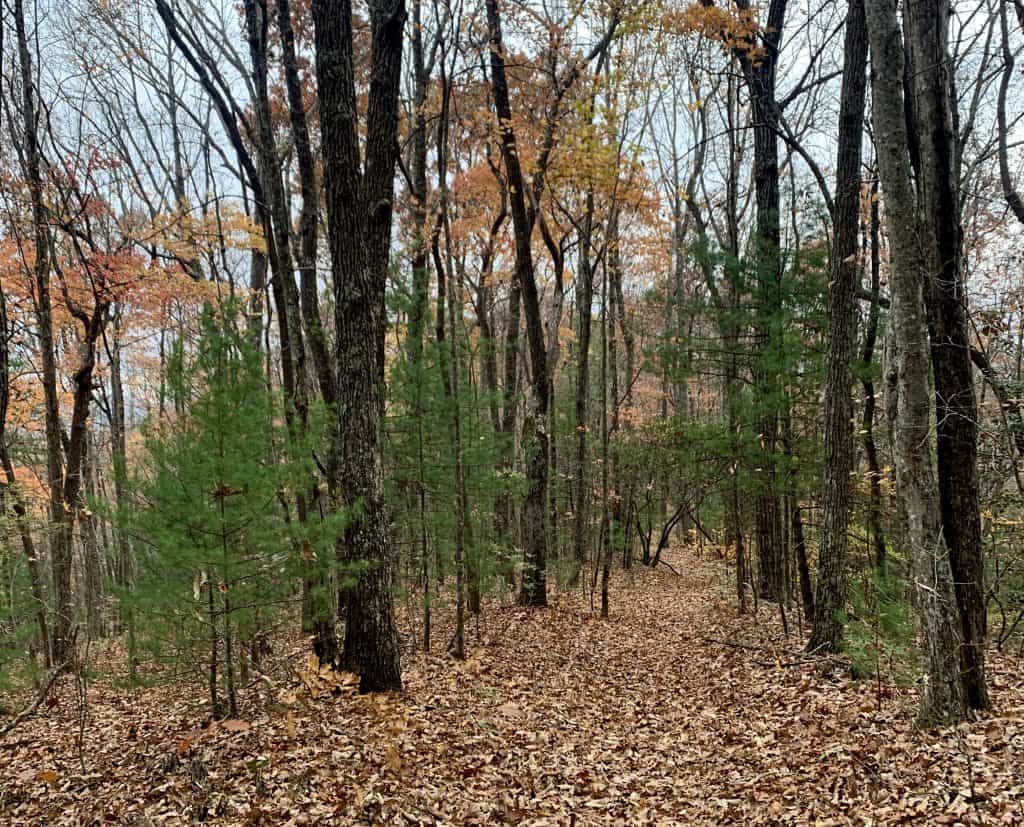
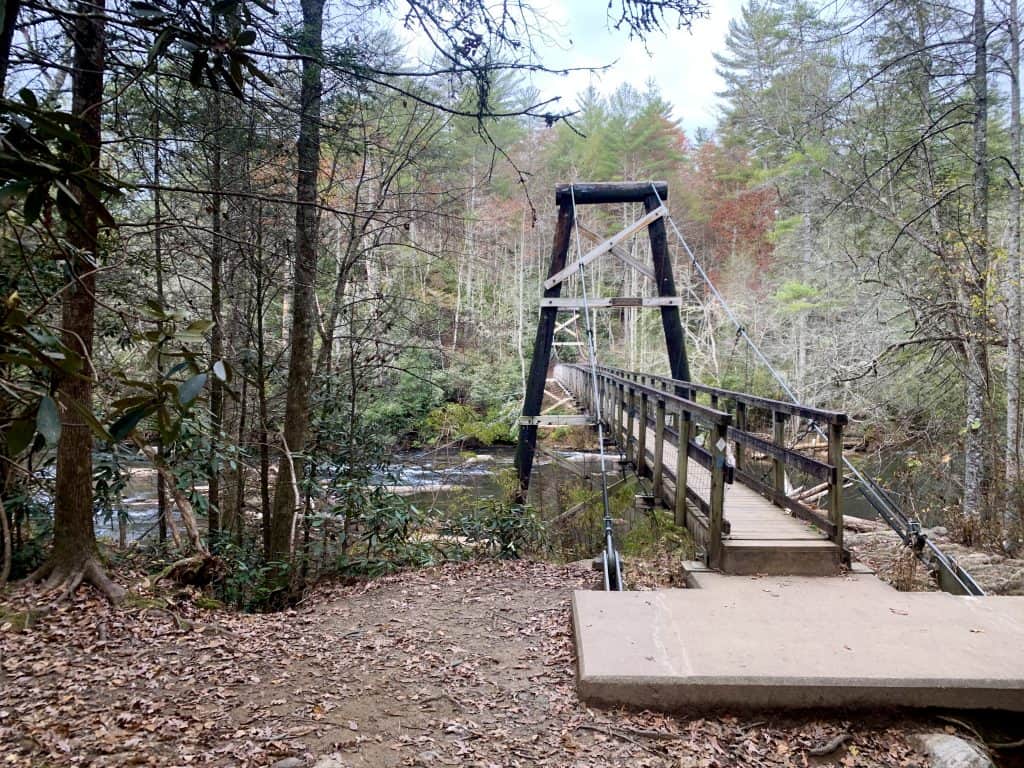
The Benton MacKaye Trail, named for the visionary who dreamed up the Appalachian Trail in 1921 while mourning the death of his wife, is a 300-mile long ramble from Springer Mountain in Northern Georgia to the Great Smoky Mountain National Park in Tennessee. In an effort to the keep the two trails distinct from one another, the southern terminus of the BMT is a few hundred feet down Springer Mountain from that of the AT, but they traverse the same mountains as they peregrinate the same forests, and they intersect repeatedly before almost (but not quite) meeting back up at the Northeastern tip of GSMNP. The terrain is basically the same, as are the ecosystems through which they pass; it is their character that sets the two trails apart.
The feel of the AT is determined largely by its fame: people have heard of it, and so people are drawn to it. In addition to the 3,000 or so hikers who attempt a thru-hike of its entire 2,190-mile length every year, approximately a million people visit various parts of the trail for section hikes, weekend getaways, and thousands upon thousands of afternoon walks through the woods. Over the years, the path has been beaten distinct and smooth into the spine of the Appalachian Mountains by the weight of tens of millions of feet, and while it is still pretty easy to find solitude in the AT’s backcountry, the trail can feel very crowded anytime you’re near a trailhead. There are shelters an average of every eight miles along the trail—rustic lean-to’s that don’t offer much in the way of comfort, but pretty reliably provide a nearby water source, a privy, a place to hang your food bag, and refuge from bad weather. The AT also passes through or near a long series of small towns whose residents are familiar with both thru-hikers and the culture they inhabit, and who are usually more than happy to give a ride to hiker looking to make a stop in civilization for a shower and resupply.
The BMT, on the other hand, has pretty much none of that. It is a wilder and rougher (and much shorter) trail, without shelters or privies or fame. The locals in nearby towns have frequently never heard of it, and hitchhikers (like unwashed transients with large backpacks in general) are looked on with suspicion and not-infrequently a measure of disgust. If the AT and the BMT were identical twins separated at birth, the AT would be the one raised in prosperity, given only the best in food and education and attention, and who grew up to be sleek, healthy, well-adjusted, and successful. The BMT would be the one that was raised by wolves. It is a lonelier, emptier, and often harsher trail—qualities that ultimately only make it different from the AT, but not worse. For a lot of reasons, such a trail could easily be the more desirable one of the two.
I wanted to do a shorter thru-hike. A fit hiker could tackle all 300 miles of the BMT in about two weeks; I figured I would need three. I had just spent a year and more in McMurdo Station on Ross Island in Antarctica, a desolate wasteland where nothing grows but the bellies of the contractors living off of the greasy starches served in the cafeteria. Even with a winter population of 136, the college-dorm style of living makes any bit of privacy an ephemeral dream; even when you feel like shit and need nothing so much as a moment to yourself, getting a meal without getting sucked into a half dozen well-meant conversations is all but impossible. The solitude of the Benton MacKaye would be good for me, I figured, as would be the immersion in the untrampled wilderness of this part of Southern Appalachia. It was the right-ish season for it: if not precisely the preferred weather of mid-spring, late fall promised at least an absence of the summer’s oppressive heat and a decent display of autumnal foliage. This hike would be exactly what I needed to reconnect with the world of living things and whip my widened ass back into shape. I hoped.