The following is the personal account of a single, long-winded individual’s experiences living and working in Antarctica. No part of it has been reviewed or in any way endorsed by the United States Antarctic Program or the National Science Foundation, or any other public or private organization, institution, contractor, or company associated therewith. The views expressed herein are the author’s alone, for good or for ill.
Day 35: 17 February, 75 miles today, 648 miles remaining to McMurdo, elevation around sea level, ambient temperature -23°C, the Ross Ice Shelf
Every day spent in the ice-carpeted canyon between McLean Peak and Mt. Beazley, it seemed, was unpleasantly windy. The bleary-eyed, fuzzy-headed consensus among the early-morning coffee crowd was that it was likely something to do with the topography, the cold air from the plateau being funneled through the valley and speeding up as the pathway narrowed. Or something. None of us actually knew what the hell we were talking about, though the theory we were batting around seemed likelier and likelier as the morning unfolded. The Leverett was writhing as hooked onto our loads and began our first inspection of the day, the wind slashing through our layers as fine powdered, saltatory snow whipped and thrashed across the ground. As we got rolling, the wind picked up, dropping visibility as the saltation became a cloud of blowing snow—but once we made the turn toward the north and the Tapley Mountains obscured our view of the route we’d followed down from the plateau, the wind died all at once.
The snow settled with the breeze, and we were treated to one of the most gorgeous days we seen all season. The sunlight, bright and brilliant, lit up the mountains, which stretch on before us in an endless line of sharp, dark spines and snow-decked alleyways. There were fata morgana* on the horizon, a sort of mirage not uncommon on the ice, that extends and distorts views of distant objects in strange, shifting ways—like looking at a distant landscape filtered through a slowly turning kaleidoscope. Talking to another operator while fumbling with the crumbling NRS strap we used to hold the stairs to the living mod in place, he gestured to the wild scenery before us. “This view,” he said, “Everytime I look up at it, I forget that I’m in a bad mood today.”
The descent from the base of the Leverett headwall to the Ross Ice shelf, though nearly a 5,000’ drop, is gradual. It’s actually extremely noticeable when you’re fighting your way up it with 168,000lbs of fuel dragging you back down hill, but on the way down the slope feels so gentle it’s easy not to notice it at all. One moment you’re staring at some new prominent, variegated peak off to the side, the next your GPS display says that you’ve plunged another thousand feet. As we rolled toward the afternoon load check, we slid at last off the glacier flowing over the craggy coast of mainland Antarctica, and onto the broad expanse of the ice shelf. We pulled up to the fuel cache we had dropped before making the climb on the way south—having learned the hard way not to leave our belongings on the ground, we had set it on a makeshift berm. Pulling this load free did not require hours of excavation, as the cache we’d left on SPOT 1 had done, but those toward the front of the caravan did need to pitch in to break it free. Or so it appeared from my position toward the rear. My load check complete, and with nothing to do but wait, I dozed off in my warm cab, while the mountains on the dwindling shore, not to be touched by human eyes for another nine months, stood guard.

*For years I have found it amusing to refer to these visions as fat morgans, despite the fact that nobody ever has any idea what the hell I’m talking about. I find the term fata morgana cumbersome and fat morgan funny, and everyone around me just shakes their heads and moves on with their lives.
Day 36: 18 February, 35 miles today, 613 miles remaining to McMurdo, ambient temperature -10°C, the Ross Ice Shelf
In the morning, the mountains were gone.
Despite years of life in the Antarctic that had better prepared me, I had been expecting the weather on the Ross Ice Shelf to be substantially better than it had been on the plateau. True, it was somewhat warmer—but a few degrees was, in retrospect, never going to turn any piece of Antarctica into a tropical paradise. In fact, the warmer air was much more unstable than the consistent mix of freezing temperatures and steady wind we’d seen while at elevation, and when I trudged my way from the living mod to the back of camp to empty my pee jug in the morning, I had to do it though a blizzard.
The snow came hard, driven by the wind until it was a blur outside the kitchen windows. I couldn’t tell how long it had been coming in like that, but the stairs to the kitchen had been buried up to the second step by the time I headed in for coffee. Thankfully, the drifting around the rest of camp was light, a lucky consequence of the way we’d happened to park our tractors relative to the wind, and the weather had pretty much blown itself out before everyone had gathered for our morning meeting. It felt like we had dodged a bullet; the storm had come and gone without really even inconveniencing us. And then we made it out to our loads.
The empty bladders we had filled with air at Pole, and then topped off about halfway down the plateau, had once more become flaccid and saggy as we drifted down to sea level. We’d had a discussion just that morning whether to reinflate them, again, or cinch down all of the straps and let them ride to McMurdo in their half-engorged state—but that conversation had come about half a day too late. The long, limp balloons had not thrived in the wind. Several had been blown loose of much of their rigging; some had had their rigging pulled off of them by accumulations of heavy snow, which was fast hardening into solid blocks. Every load was a mess, and it took the entire SPOT 3 crew about two hours to clean it up, clearing chunks of snow, resetting nets, and tightening down every single strap as the wind picked back up in fits and starts.
When we finally got rolling, the wind had settled into a hard, steady blow, picking up all the loose snow that had fallen the night before and driving it until it cut visibility down to a mile, then a half mile, then a quarter mile, until we could each barely make out the lights of the tractor ahead of us in the parade. Every so often, I would lose even that tenuous connection to the world around me and become completely disoriented. While I usually had music or audiobooks or podcasts going in the tractor, moments like this forced me to drive in complete silence, as simply staying on course required every bit of my attention. The sheets of sideways-blowing snow gave me immediate vertigo, and without a landmark of any kind it was impossible to tell which direction was which—a sensation I hadn’t really experienced since my second year in college, when my roommates and I would routinely celebrate the end of a night of heavy underage drinking with a few intensely ill-advised bong rips. Nauseating as such moments were, I was still able to recover quickly. Three months into the yo-yo journey to and from and to and from the South Pole, we were becoming well practiced at driving by GPS alone.
Even so, there’s a limit. The conditions after lunch continued to deteriorate, until we were all driving at the absolute outside bounds of our finite skill and experience. The caravan slowed its pace, and then slowed again. Still it felt like we were flying, all of us piloting rocket-driven machines screaming through the storm—until you happen to catch a glimpse of a trail flag inching by your window and remembered that, oh yeah, you’re only going about 5mph. I was following as close behind the next tractor as I could, the back of the load only just far enough away for me to stop in an emergency. The tractor itself—and the living human in the cab—was no more than 100’ away, but when I lost sight of it in the white out the sense of isolation was overwhelming, like I had been marooned on the surface of the moon. Over the next hour we tried again and again to push on into the swirling, living mass of wind and snow, but when one of the mechanics got turned around and lost, the SPOT 3 supervisor called it for the day.
Once the loads were dropped wherever on (or off) the trail they happened to be, the next hour was spent meticulously gathering each tractor, one by one, slowly building a tight convoy that crept, as one, back toward camp. Once we were a hundred feet away or so, the line came to a stop, and each tractor was sent, one by one, to find its spot beside the modules. The visibility was worse than ever—barely 20’ from the side of the kitchen mod I could only just make out its dim outline through the static and noise, and that was when I could see it at all. We moved at an absolute crawl, until each and every tractor was parked, safe and sound and buttoned up tight against the snow. Anxious to get back to McMurdo, still we were stuck, however long it might take for the weather to clear. We had left the mainland continent behind, but its fury had followed us onto the great frozen sea, and pinned us down. Defeated, for the time being, we layered our fragile selves from top to bottom for the short walk from the cab to the kitchen, and headed into camp to wait out the storm.

Day 37: 19 February, 62 miles today, 552 miles remaining to McMurdo, ambient temperature -16°C, the Ross Ice Shelf
Sometime after dinner, the weather cleared, and we had a good view of the loads we’d spent an hour returning to camp from, stretched no more than a quarter mile down the trail. It was fairly obvious which belonged to the mechanic who had gotten lost, since that one was way off to the side and parked at nearly a 90° angle to the rest. We had a good laugh about that from the warmth and safety of the kitchen while chicken tendies rested languidly inside our full bellies—but it wasn’t so funny in the morning when we had go dig the load out in the cold. It was a two-pack of empty fuel loads, the half-aired-up bladders particularly susceptible to the influence of the wind, which had quieted down from the day before but by no means had left us. The bladders had been parked broadside to the storm, and though they had been cleaned up and tightened the day before, now they were more of a tangled rats’ nest of nets and straps and blocks of snow than ever. Once the whole mess was pulled out of the mountains of powder that had blown in the day before, we set to work on straightening the whole thing out.
Which was when the call came in from one of the blade CATs, sent to start bumping all the loads on the trail forward and out of the drifts. The line from the engine to the external heater had failed, and the machine was hemorrhaging gallon after gallon of coolant onto the clean, white snow. The entire SPOT 3 crew was divided in half: one to clear and clean up the twin-pack load, and one to repair the tractor and shovel the spill into pretty much every last remaining empty drum we had on hand. It took hours to get both jobs done, leaving us to start the day’s miles around the time we usually would have stopped for the day’s first load check.
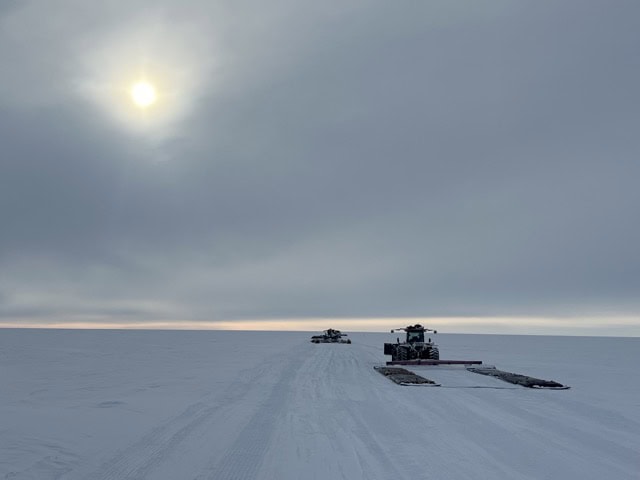
The storm had gone, but the uniform cloud cover had remained, leaving us with flat light from one end of the ice to the other. It’s hard to describe the experience of just existing in this weird, negative space, where objects stand out crisp and clean but the world itself is just gone—no ground, no sky, no distance, no perspective, just a stark, even white in every direction. It’s like the liminal space in movies used often used to show passage into the afterlife. It gives the impression that nothing around you is real; that everything is floating, brightly painted but imaginary, on an infinite blank page. Already cold through without a single mile yet under our tracks, we climbed into our tractors to finally begin the day—ten frozen souls, driving in a straight line from nowhere to nowhere, with nothing in between.

Day 38: 20 February, 82 miles today, 470 miles remaining to McMurdo, ambient temperature -12°C, the Ross Ice Shelf
We passed the halfway point without fanfare. As each tractor passed the unassuming 4×4 monument in silence,* I thought about the first time we’d hit this milestone, southbound on SPOT 1. The mountaineer had been in the Prinoth with the SPOT 1 supervisor at the head of the convoy, and had happily bellowed over the radio, “Tally ho! Tally ho! Tally ho! Halfway! Halfway! Halfway!” That had been three months earlier, when every inch of the trail was still new to most of us, but it had been a different traverse, a different energy, a different life. The 14 wide-eyed souls who had broken trail in late 2024 had been a different crew than the one monomaniacally focused on returning to McMurdo partway into 2025—the ten of us who remained still nominally the same people, but with over three thousand more arduous, hard-won miles on our backs. We were seasoned by the cold, hardened by the wind, and just fucking tired, and the only notable thing about the halfway point on the SPOT 3 return was that it was most definitively not the end of the trail. We still had to do this shit another 516.5 miles.
That was the job we’d signed up for. We might commiserate about the long days or the bad weather, but nobody griped. Ready as every one of us might be for the end of the journey, we were still in the thick of it together. When we’d passed through the Shoals, that heavily-crevasses corridor where the Ross Ice Shelf grinds across the tops of a series of deep, hidden islands, we had each found our own increasingly irreverent way of checking in and out, until my bunk mate, bringing up the rear, had finally reported, “314 is clear of the Shoals. Ten tractors and ten goofballs clear of the Shoals.” We could just feel the season coming to a close, and were ready for it. As we passed halfway and started our long, long line straight NNW, the clouds that had haunted us for days lifted—but only along the coast, as if the great Queen Maud Mountains had lifted up the curtain for one last peak at us as we left. Like the continent itself were saying goodbye.
As the day wore on, the sun found a thick patch of cloud overhead, and the light became dim—exactly as if it were setting. We were still too far south for that; the sun would continue to circle at this latitude for another few weeks before it would start to dip below the horizon. But up ahead in McMurdo, that process had begun. The year’s first sunset had come and gone. Each night the sun would slip behind the impassive Royal Society Range across the broad Ross Sea from the station, until sometime in early May when it would go down for the last time and the long, dark winter would begin. Already friends and acquaintances had packed up and left in our absence, with more scheduled to leave well before we would make it back. The town to which we’d return would be a very different one from the clamorous, continually vibrating community we’d passed through at New Year’s. It would be smaller, quieter, already well on its way to bedding down for the four-month night. We’d only be there a few weeks ourselves. McMurdo, our base of operations, our home, was, ultimately for those on SPOT 3, just another waypoint we’d pass on a journey with finite boundaries but seemingly no end.
*Except, of course, for the constant screaming roar of each Challanger’s massive engine
Day 39: 21 February, 100 miles today, 370 miles remaining to McMurdo, ambient temperature -17°C, the Ross Ice Shelf
Besides the quiet and solitude of the first, slow pint of coffee in a silent and empty kitchen, one of the great pleasures in getting up painfully early every morning is watching all of that come to a sudden, cacophonous end at 0630hrs. On trail, the first hard obligation each day is inspecting at firing up your tractor a half hour before the start of the morning meeting—and while a handful of people trickle into the kitchen for a subdued, leisurely breakfast before that, many don’t. Everyone who moves through camp in the early morning does so as if trying not to disturb a sleeping baby until half past six, when everything comes alive at once. Suddenly there are people everyone, and the air fills with noise as one Challanger after another explodes into thunderous life.
Colored in patches by novelty, trail life is defined largely by routine, painted in thick, unmistakeable outlines. Morning coffee, fire up the tractor, morning meeting, forget pee jug on the way out the door, run back to get it, load check, drive, load check, drive, load check, lunch, forget pee jug on the way out the door, run back to get it, etc., etc., etc.. Though its rare that I remember my jug on my first exit of any building, I have only twice made it all the way back to my tractor without it. This time, I was already lagging behind, everyone else ready to keep racking up the day’s miles, when I realized my terrible mistake. My sprint back to the kitchen was absurd, my thick, heavy boots in the soft snow reducing me to a kind of fast waddle, and I could hear the SPOT 3 supervisor on the radio, trying to puzzle out exactly who this blocky shape bumbling back toward camp might be. The stairs to the kitchen had already been put and strapped to the deck—by me—and as I approached I remembered seeing several other people clamber up through the railing rather than waste time pulling the stair back down. I was able to pull myself onto platform without issue, but was stymied by the door, which wouldn’t open enough to let me through so long as I was standing next to the prone aluminum staircase. This was when it finally occurred to me that everyone I had seen pull off this particular maneuver had been on the smaller side, and I would not be able to fold my body in any of the ways that might let me slide easily through the cracked door.
As I climbed to the top of the insubstantial railing, I thought about the myriad small injustices that come with height. Shorter people tend not to be shy in expressing the ways in which they feel they’ve been wronged by genetics, but every of their tall friends has noticed that they also never never hesitate to cram things onto shelves that someone else needs to labor to reach. If a longsleeve shirt actually covers my arms to the wrist, then it will always billow around my torso like an ill-fitting parachute, and I have yet to own a car that doesn’t leave me cramped and uncomfortable any time I actually, like, drive it. Even the operating station (seat) in my tractor feels awkward, the headrest sitting as it does between my shoulder blades, and the consistently worst part of my daily trail routine was having to wedge myself behind my tracks to chip out the ice in the narrow, low space at the back of the assembly. At 6’1” I’m not even excessively tall, but even so I can probably count on one hand the number of days since I went through puberty that I haven’t hit my head on a doorframe, cupboard, or shelf engineered by a society that has collectively decided to punish anyone with the impudence to grow over 5’9”. It is a short person’s world—the rest of us are just hunched over in it.
I did, eventually, manage to get the door opened wide enough to let me pass, though climbing safely back down the railing on long, gangly legs was a process in itself. Snatching up my jug from the berm in the bathroom and sliding easily(ish) through the railing, I speed-waddled back to my tractor, panting so hard when I made it up to the cab I had to wait a moment to check in over the radio. It was a clear, bright day on the ice shelf, the trail solid under our tracks. I had held up the traverse no more than two or three minutes—perhaps five at the utmost—and though for me it had felt endless, by the end of the day I was the only person who would even remember the delay. We had put triple digits on the board for the first time the entire season, a rare accomplishment that some operators might not see even in years of driving across the great Antarctic plains. 100 miles in a day. Everyone in the fuel circle was cheerful, buoyed by the calm weather and the astounding distance we’d covered since breakfast. We were racing to the end, ten ragged tractors and their ten ragged drivers, short and tall alike sprinting madly across the snow toward a finish line we still couldn’t quite even imagine.
