The following is the personal account of a single, long-winded individual’s experiences living and working in Antarctica. No part of it has been reviewed or in any way endorsed by the United States Antarctic Program or the National Science Foundation, or any other public or private organization, institution, contractor, or company associated therewith. The views expressed herein are the author’s alone, for good or for ill.
Day 12: 25 January, 52 miles today, 432 miles remaining to Pole, elevation 359 feet, ambient temperature -6°C, the Ross Ice Shelf
The crevasse specialist on SPOT 2 had been busy. She had scanned the length of the Leverett, making sure the new route was safe, and then proven that 30+ miles of new trail were harmless enough to let a fleet of farm tractors drive over them. As the long days in the Transantarctic Mountains with a group of five men wore on, though, she became increasingly driven to distraction. “If I never see another crevasse or another dude, it will be too soon,” she said, and began crafting furiously in the narrow, cramped kitchen. She had several projects going, but the belle of the ball was an old smartwool sock she had fashioned to look like Mark Twain, inspired by the SPOT 3 supervisor, who had for a time peppered his sitreps* with made-up Antarctic-themed quotes from the noted author. When we’d met on trail, she had quietly given the puppet to him. It wasn’t until several days later that he used it at the morning meeting.
I sort of doubt the high-pitched squeak he adopted as the puppet’s voice was a truly accurate impression of the real Mark Twain, but in fairness the real Mark Twain was probably bigger than a sock. He read the entire sitrep in that voice, flapping the puppet’s mouth in time with his as the hard blonde sunlight poured through the window over his shoulder. The effect was surreal, unsettling, and absolutely hilarious. Though the SPOT 3 supervisor was still a dude, the crevasse specialist would nonetheless have been proud.
The new trail left for us was terrible. In a few years it might be as good as any other stretch of the route to Pole, but the first thing we noticed when we turned onto it was that wasn’t really a trail at all. They had track-packed the line a few times with their Challengers, compressing the top layer of snow into a sort of thin crust, but without the years of compaction the rest of the trail had, this was little different than striking out across virgin snow. For the tractors in the front of the column, it was a flat, monotonous slog, like wading through mile after miles of thigh-deep water. In the back, however, the trail was a rutted mess of troughs, pits, ridges, and piles, like nothing so much as driving in the back of the convoy through Sastrugi National Park had been. The uneven ground was exceptionally hard on the fuel loads, the thick, heavy bladders pitching and rolling and tossing and thrashing this way and that. Any ring strap that had been weakened over the 600 miles gave out, and there was a sudden flurry of repair work that needed to be done.
It was shortly after replacing a bra strap** that I noticed a pool of liquid on the floor of my cab. This was pretty typical, as my padded, oversized boots tended to track a lot of snow inside the heated compartment, which would promptly melt. This was why I kept a couple of towels inside the cab with me. I threw one on the puddle, and didn’t think much about it until a while later, when I noticed the towel was soaked. Worried, I stuck a finger into the liquid and brought it to my nose. It didn’t smell like anything. I glanced at my pee jug, which appeared no less full than it had when I’d got back into the cab. It had to be water, then. But where was it coming from? As the tractor lurched its way through the soft, furrowed miles, I was focused almost entirely on my load. One of the skis on the CRREL tool seemed on the verge of giving out in the uneven mush—which, if it happened, could have catastrophic consequences if I didn’t catch it quickly. I moved my foot and my sock was instantly soaked. The pool of mystery liquid was still growing. Whatever it was, it was fucking everywhere.
When lunch was called, I pulled far off the trail in the hopes I could flatten my load out to secure some of the weaker points. Before the leaving the cab, I moped up what I could, then jumped down a fixed what I could reach. When I climbed back up, I found a fresh puddle on the floor of cab, realizing with a sense of mounting horror where it must be coming from. When I lifted the pee jug from its corner, a small but steady stream ran from a small crack at the base. Smelly or not, my tractor had been flooded with piss. My greatest fear had finally been realized.
Lunch was spend sopping up as much of the pee as I could manage with the towels, then expending most of the can of purell wipes I had on board to clean every surface it had touch several times over. My sock was still wet. So were my running shorts, my pants, and my gloves. I walked quickly and stiffly over the living mod, changing into a fresh set of clothes and tossing the ones I had been wearing atop the wadded towels I’d left to freeze on the snow outside. I found the spare gallon jug I had brought, grateful to have had at least the foresight to bring along a spare, then marched over the boxes of trash to dispose of the used wipes and the failed jug, and into the kitchen mod and started a load of laundry in the washing machine. I cleaned up in the sink, and stood for a moment, looking into the mirror. I still needed a shower, but at least clothes were dry and my hands were clean. This had been, so far, a miserable day, and I had lost pretty much the entirety of my lunch to the grossest job I could imagine, but the worst was over.
And that was the way it felt. We turned off the new trail in the early afternoon, getting back onto a surface that didn’t pitch the tractor around like waves on a stormy sea or threaten to rip the skis off the fuel loads. I was hesitant to christen the new jug, mildly traumatized by the events of the morning, but eventually I had to give in and use the thing. As the smooth miles passed, I kept a wary eye on the large plastic bottle, but it was in pristine condition, and showed no signs of leaks, weeps, or seeps. By the time we stopped for the day, I had all but forgotten about it. Fuel circle without my insulated gloves proved to be something of a challenge, the hot, slushy snow soaking every pair of work gloves I had with me. The air was far too cold for wet hands, so I did what I could, wringing out my gloves and flexing my hands to keep them warm. When we done, every tractor fueled and chipped, I climbed back into my cab to park it next to camp for the evening. In the corner, under the never-used, mint-condition plastic bottle, was a fresh giant puddle. My brand-new pee jug was leaking.

*Situation reports. Basically, SPOT’s official blog read by people in the NSF and ASC, including most of the bosses.
**The forward-most strap on each fuel bladder, so called because of the way it gets tucked around the bladder’s shoulder.
Day 13: 26 January, 62 miles today, 370 miles remaining to Pole, elevation 402 feet, ambient temperature -4°C, the Ross Ice Shelf
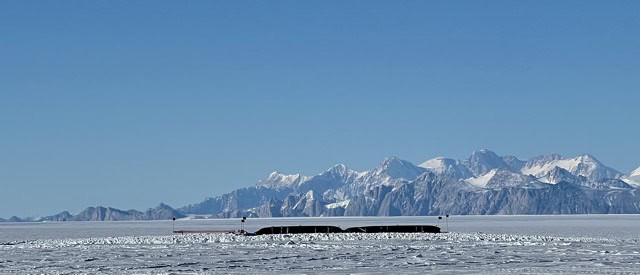
I tested the new new pee jug before putting it into service. Pulled from the small cache of miscellaneous public goods, I had filled it with water and let it sit overnight, willing to trust it with urine only after it proven itself with something less offensive. In the morning, there was no puddle on the floor, no beaded moisture on the base of the bottle, no drips to be found. I was newly showered, with a pile of clean laundry and a pee jug with integrity. As I stepped outside, I saw that the clouds had burned away, leaving a pristine azure sky and a truly stunning view of the Queen Maude Mountains. Great pinnacled nunataks rose from massive, sweeping glaciers, as fins of black rock pierced the snow caps of nearby peaks, and my heart lifted as I headed toward the kitchen. This, surely, was going to be a good day.
And so it was. I had rigged the extended antenna for the sat phone through the roof rack atop 308 before we left in the morning, and was able to spend the first hours of the day chatting merrily with Sean Meadow and with family back home in the states. The trail was firm and the driving was easy—and fast, for a mostly-fully-loaded traverse—and the alpine panorama buoyed my spirit every time I glanced up from the tractor’s display. There was a newfound pleasure in this dancing, delicate skyline: the joy of recognition. I remembered these peaks. I remembered these glaciers. I could point to many of them and identify them by name. I knew this distant, impossible place, and it welcomed me back. This landscape, hostile, alien, and remote, would always nonetheless be a kind of home to me, a place I would carry with me until I saw it once again.
We were approaching the foot of the Leverett Glacier, where we would leave a cache of fuel for our return to McMurdo. Having learned our lesson, we would not leave this fuel load on the ground to be buried in snow that would melt and refreeze into a block of solid ice, but would throw up a quick and dirty snow berm to keep it out of the drifts. This was a necessary precaution, but turned fuel circle into a frantic, confused affair, as two of the blade CATs were sent off to push up snow the moment they were filled. It’s hard to work a fueling operation in the field with fewer than five people; with only three it becomes a monumental pain the ass. You can’t see any task all the through before you have to jump to side and do something else: stop adjusting straps on the draining fuel bladder to clear the meter; stop chipping your tractor to run the hose over to the next vehicle to be filled. It’s the sort of chaos where something is almost bound to go wrong.
Not that the operators on berm detail were having a better time. They were far enough off into No Man’s Land* that we could only hear bits and pieces of their chatter on our underpowered handheld radios, but we were able to figure out quickly enough that the mounting bracket for the fire extinguisher had failed when one of them had hit a bump—and the extinguisher had discharged into the man’s closed cab. He was fine, but his tractor was an absolute mess of purple k, the surprisingly not purple multi-use powdered fire retardant favored by the USAP. We were wrapping up our slapdash fuel circle as the fire extinguisher drama was coming to a close, and were given new orders before we could disperse. We were to inspect every single fuel load, repairing frayed ring straps and making sure the most crucial tie down points had back up straps in place. I was standing next to one of the other operators, and we stared at each other, not saying anything for a moment. He and I had both been breaking our backs to make sure our own loads were ready for the climb up to the Polar Plateau—now we would have to work well into the evening to do the same for anyone else who hadn’t bothered.
It was galling, it was frustrating, it was distracting, and I stomped into my tractor and drove away from fuel circle toward the rearmost load—with my ice axe and my 3lb hammer still sitting on my tracks, where I had hurriedly left them as I’d run over to tend to something else. I realized what I’d done almost as soon as I stopped the machine, but by then it was far too late. I spent the next half-hour combing the site, digging through the tracks in the snow looking for my things, but they’d been buried so deep into the soft, white mush that I never really had a chance of finding them. These were the tools I used to clean snow and ice from my tractor, tools I needed and used every day, tools that would be essential once we began to cross the plateau, and I had lost them in the snow. My hammer and ice axe were gone.
*The catchall term for any area not on the actual trail.
Day 14: 27 January, 45 miles today, 325 miles remaining to Pole, elevation 3662 feet, temperature -12°C, the Leverett Glacier
I gave the hardened snow around the previous day’s fuel circle one final, desperate search before we left—going so far as to carve deep ruts through the thin crust and into the powder with my tractor in the hope that I might churn up one or the other of the tools I’d lost—but it was to no avail. That left me precious little time to check my load before starting for the day, and I was already concerned that the trough one of the plastic sheets was sitting on might have been damaged from the way the fuel bladders riding on it were forcing it to flex over the edge. I was trying to kick snow from the HMW when both of my feet suddenly slipped behind me and I slammed knee-first into the plastic with a loud THWACK! For a moment I lay still, facedown in the snow I still hadn’t managed to clear. I still had a lot to go over before climbing into 308’s cab, but now that I already prone it was quite calming to stay where I was for a few extra seconds. In all the months working on and around huge sheets of low-friction plastic, this was the first time I had completely eaten shit. I though for a moment of the SPOT 2 supervisor, who had said, “That HMW has taken out more SPOT personnel than every other risk factor combined. More people have NPQ’d* because of that stuff than for any other reason.” I stood up, brushing the snow from my front and testing out my knees. Maybe I was lucky, after all.
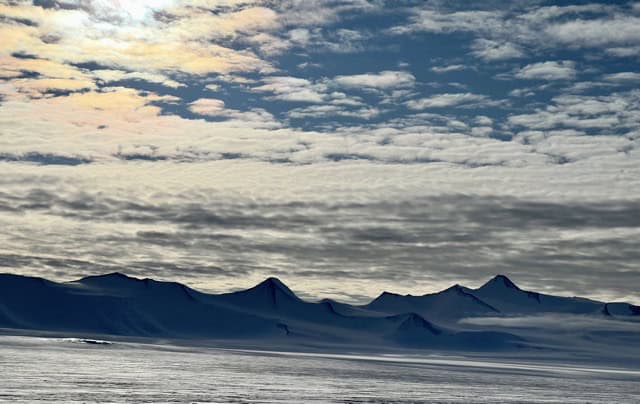
We started the day with gorgeous weather, coming into a stretch of trail that I was seeing with fresh eyes. When we’d passed this way on SPOT 1—in both directions—we’d lost the view to a tightly woven blanket of clouds. Dominating the landscape was Mt. Gould with its serrated crown of five pointed peaks. On a previous traverse, one of the longtime mechanics had seen this stunning, picturesque mountain and, assuming nothing in a place this remote could possibly have a name, declared that it should bear his own. But why settle for a single peak—or even a quintuple one? As our caravan crested a short rise and the full breadth of the Tapley Mountains came into view, I jumped onto the radio to welcome SPOT 3 to the newly-christened Bodhi Range.
We were heading uphill, leaving the open plains of the Ross Ice Shelf and beginning our ascent up the Leverett Glacier. The bladders strained against the tail nets, setting toward the back end of the plastic, and at load check everyone had new straps to repair. Though we were hewing close to the old trail through this section of the climb, SPOT 2 had chosen to reroute us some forty feet to the east of the established, compacted route for some mysterious and terrible reason. The soft powder bogged down the lighter machines, thrown side to side as they slipped out on the loose fluff, or else were buried into until the tractor that had cached its load on the ice shelf below could come to tow them free. A thin bank of clouds coalesced in the sky ahead, and then we headed up into it. The haze didn’t blot out the mountains so much as blur their edges, making it feel as if we had just driven into a pastel painting. The wind picked up and temperature dropped as we trundled higher and higher atop of river of flowing ice. By lunch, it was already too cold to keep wearing running shorts as my sole undergarment, and I headed into my bunkroom to add a full base layer beneath my work clothes. It was late January, a full month after the peak of summer. Already the plateau was likely to be colder than it had been when we’d left it, and the ice shelf would not be nearly so warm and welcoming as it had been on this southbound leg of the journey. This was effectively the end of our summer, and the beginning of the long, frozen road ahead. It would only get colder from here.
*A requirement for deployment to Antarctica is to be physically qualified, or PQ’d, a process involving an invasive medical screening before you even leave the US. When injury or illness renders a person not physically qualified—which usually means that, on top of everything else, they have to leave the continent—Antarcticans say that they have NPQ’d.
Day 15: 28 January, 17 miles today, 308 miles remaining to Pole, elevation 5,033 feet, ambient temperature -5°C, the Leverett Glacier
After all the fuss about how we would never again experience the sensation of warmth, the day we climbed the Leverett turned out to be quite mild. In fact, it was spectacular. There might have been a light chill in the air, but as we made our way way toward the glacial headwall* the wind was perfectly still. It was a glorious late summer day, and as we rolled up the gentle slope I couldn’t take my eyes off the arches and curves of the surrounding glaciers as they gathered and flowed over the mountains and tumbled over cliff sides in jumbled icefalls. We took a long, early load check as the first couple of tractors stopped to inspect the Beazley Crack, a crevasse across our path named for the imposing rock face that is the Leverett’s most prominent landmark. SPOT 2 had filled in this fissure in the ice with nearby snow and planted a pair of 4x4s on either side to measure both spread and shear of the crevasse over time—and while the rest of checked the straps on our fuel loads and opened the vents on top of bladders to bleed off the air that had expanded inside as we’d climbed halfway up, the SPOT 3 supervisor and the mechanic foreman took measurements to see how much, if at all, the monuments had moved.
We pressed on through the morning until at last we came to one of the last few flat (or flattish) spots before the steep climb to the Polar Plateau. With camp in place, we took an early lunch before pairing off to take the first set of fuel loads up the Leverett headwall. This was where we would make our first run of the new trail blazed by SPOT 2 in their month-long effort to find a safer, easier route up the glacier, and we were all curious to see what they had managed while we were away. Prior to our ascent on SPOT 1, the supervisor had written out a meticulous guide to each small part of the climb, detailing the steepest sections and where we would encounter side slopes that could potentially pull our loads out of our control. The new route was nothing like that. Though some parts of the climbs were steeper than others, the grade was far more consistent than it had been along the old trail, and the side-hilling was gone altogether. SPOT 2 had done a phenomenal job. The ascent up the new route was almost easy, and though I was I focused on my tractor’s numbers, the load, and the rope tying me to my climbing partner, still I found that I had enough spare attention to enjoy the scenery as we rose ever higher. There is a strange feeling that comes with scaling a steep, blank face with nothing but the sky beyond—it’s not quite vertigo, but also not quite not vertigo—that makes driving a tractor feel like flying, even at only 7mph. And so we soared up the valley and onto the broad plains above it and beyond.
It was cold at the top, below -20°C, and once again I was surprised at the thinness of the air. I’d only just recently spent a month on the plateau, of course, but the difference in the atmosphere at this elevation and the air back at the start of the sharp climb was stark. I hadn’t felt any change at all as we rolled up the 5,000 feet from sea level to the flat shoulder where we had left our camp, but the last 2,000 feet to the great East Antarctic Ice Sheet left me winded just walking down the steps from my cab. We unhooked from the bladders, saved the new route in our GPS tracks, and headed back down for the night. A strong and steady wind had picked up while we’d been away, which slammed the tractor door closed each time I tried to push it open. We’d been blessed with idyllic weather almost the entire trip thus far. As I headed into the kitchen to start dinner, I looked up the the rolling hills of ice above, the green flags marking our new route flapping fiercely in the wind, and quietly hoped our luck would continue to hold.

*While this term technically refers to a bedrock cliff uphill of a glacier’s head, at the Leverett its used more to mean the point where the ice sheet narrows and cascades down the valley between Mt. Beazley and McLean Peak like a staggeringly massive waterfall flowing at a staggeringly slow pace. At least, as I understand it.
Day 16: 29 January, 41 miles today, 267 miles remaining to Pole, elevation 8,325 feet, ambient temperature -23°C, somewhere on the Polar Plateau
It was cold as shit in the morning. The wind from the evening before hadn’t let up, but was hanging around camp to make sure every one of us was frozen through by the time we finished our checks on the second batch of fuel loads. And just in case any of us had accidentally been comfortable while working outside in the breeze, it had buried every exposed ring strap in a foot and half of drifted snow. After pulling my load ahead a quarter mile to clear out what I could, I set about checking the straps only find that I’d lost three of my backup loops since our last stop the day before. It was with enormous relief that I climbed into the cab and cranked the heat all the way up once everything was secured.
My perspective changed once I was inside the tractor and finally starting to thaw. Aside from the brutality of the wind, it was another pristine day on the Leverett, and as my climbing partner and I began the ascent, I sat back in wonder, taking in everything I could. Every pass through the valley revealed something new, some feature of the local topography or glaciology I hadn’t noticed before. The way the oblique morning light hit the meandering cliff on our right side made the broken blue glaciers of the icefalls shine with a pale translucent turquoise. My climbing partner and I generally didn’t speak much over the radio except to coordinate gear shifts and engine speed, but finally the landscape drove us, momentarily, to break the silence. “It’s fucking stupid how absolutely beautiful this place is.” “Yeah. There are…there are no words for it.” “Yeah.” “I’ve been coming down to the ice a long time. Seen a lot things. This is the most beautiful place on the continent that I’ve seen.”
The second climb over the new trail up the Leverett went as smoothly as the first—almost. Everything was rolling perfectly according to plan over two gorgeous, if uneventful, hours, until the pair positioned in front of camp made a call on the radio just as they were coming to the lip of the Polar Plateau. “So, um, we took the fuel pump off of the back of this load to work on something. And. Well. We just realized we never put it back on.” My heart sank, and through the rear window of my climbing partner’s tractor I could see him pulling his hair in sympathetic panic. This was a fuckup any of us could have made, one that was likely to cost several hours of driving time to remedy. “Hold on,” the SPOT 3 supervisor said, “are you saying that the pump is still at the bottom of the climb?” “Yes.” There was a long pause, every ear in every tractor pinned to the radio. “Well, I guess you’re going to have to go back and get it.”
Arrangements were made for that pair to drop their load just at the point where the grade flattened out, where one of the rest of us could pull it up to the spot the rest were staged. While they were gone, we checked all the loads and bled the bladders of the air pockets that had expanded even since we’d opened the valves 3,000’ below. The generator was fueled, and the mechanics worked on a few of the projects that had been on their dance card for the evening. The two tractors and the fuel pump were back in time to catch the end of lunch. All told, we probably lost less than an hour of actual productive time—and while the two fellows were embarrassed by their mistake and apologetic, the rest of us were just relieved they’d noticed when they had, and not 30 miles down the trail. We were ready to begin our second crossing of the plateau by 1300hrs.
It had been a while since I had driven a tractor in the cold. Or so it seemed. I fought all afternoon to manage the air intake temperature, while trying every HVAC setting and fan position to keep the windows from icing up—only to lose two of them to the frost anyway. 308, whose perfectly tuned engine was a steady, melodious growl on the ice shelf, sounded now as if someone had thrown a fistful of heavy bolts into its inner works. There had been light saltation over the hardpack snow as we started rolling once again, the fine grains of dry snow slipping over the surface in thin, fast streams as the wind gathered its strength. An hour later we were in a full scale white out, the grand curves of the Watson Escarpment* disappearing into the haze. Pockets of blowing snow erased the back of the fuel load 50’ ahead of me from view while the sun still poured down on us from an empty, blue sky. For hours we drove in a sort of quasi-isolation, unable to see even the floodlights of the tractors immediately in front of us or behind. We veered on and off the trail, keeping more or less on the proper bearing marked on our GPS displays, but sometimes well over a hundred feet to the side of the next flag marking the route. The world around each tractor was reduced to a claustrophobic bubble of undulating snow, as the Polar Plateau, in its own, special way, welcomed us back to the hard part of the journey.

*the enormous geological feature holding back the ice on this small part of the great East Antarctic Ice Sheet, of which the Leverett and its surroundings are but a small part.