The following is the personal account of a single, long-winded individual’s experiences living and working in Antarctica. No part of it has been reviewed or in any way endorsed by the United States Antarctic Program or the National Science Foundation, or any other public or private organization, institution, contractor, or company associated therewith. The views expressed herein are the author’s alone, for good or for ill.
Day 07: 20 January, 36 miles today, 706 miles remaining to Pole, elevation sea level, ambient temperature -6°C, the Ross Ice Shelf
The mechanics had stayed up late the night before installing a new track tension sensor in tractor 309, a blade CAT driven by one of the SPOT operators who had wintered in McMurdo before coming to work on traverse. Track issues on that machine had cost us several hours on SPOT 1, and even though SPOT 3 had not yet been forced to stop, it was clear that those hadn’t been resolved. It was hoped that this swap would take care of the problem once and for all. What the mechanics didn’t know was that in the process, a fairly generous amount of oil was spilled somewhere in the track assembly—and when the vehicle was run the next day, that oil would coat the inside of the track until the drive wheel started spinning without purchase, causing the tractor to turn violently to the left without warning.
309’s operator was toasted, worn thin by nearly a year on the ice, and having a tractor with unreliable tracks only compounded his latent anxiety—but he was also damn good at his job, and when his giant bladed machine turned suddenly out of his control, he wrangled it to a quick and safe stop. The entire convoy came to a halt, and while a pair of mechanics went to investigate the problem, the rest of us did an early and extended load check. There were a lot of old back-up straps tied onto my plastic sheets, leftovers from SPOT 1 that had been added as a failsafe in case the ring straps gave out. Now, several of the backups had become ratty and worn, in far worse condition than the straps they’d been there to understudy. With time on my hands, I set about slowly, awkwardly, and with great fear in my heart, cutting the tangled mass of fibers free. Nobody on SPOT likes using a knife anywhere near the bladders, and I held my breath each time I pulled mine from its tidy little sheath and set to sawing off a fuckered strap. I returned to the cab with a thick bundle of frayed webbing, but the mystery of 309’s left track was still being investigated, so I settled back with one of the classic dystopian novels I had brought along to prepare myself for my eventual return to a different home country than the one I had left back in August.
The mechanics did not find the oil in the track: they found the unspeakable black sludge that it had become once it had started to burn from friction and then been churned with melting snow. 309 would not run in a straight line until this mess was cleaned out, and the day was already bleeding away like a fuel bladder stuck by a careless knife. The solution they hit on was to tie a series of absorbent pads to the small bogie wheels with paracord and run the machine until they were saturated. They would repeat this process until all the gunk was pulled off the track and the last round of pads stayed clean. The operators pulled into formation for a long lunch, since the best help we could offer was to stay out of the way until the mechanics were done. By 1330hrs, 309 was handling like it was new off the lot, and we were finally ready to start rolling south once again.
The weather had started to turn, a frigid wind blowing a long parade of thin clouds that cast zebra-striped shadows across the ice shelf. Fresh, fat flakes of snow began to fall, spit wildly across the trail in the breeze, and visibility dropped to a mile, then a half mile, until I couldn’t see beyond the blurred outline of the camp modules toward the front of the caravan. We had been visited by a pair of skuas the day before, which had caused some consternation and debate over the radio, since these were sea birds and by that point we were some 300 miles from the open ocean. That confusion had apparently been shared by the gulls as well, as we passed a red marker flag that had clearly been torn to shreds by them in what we could only assume was an attempt to turn the frayed and faded thing into a meal. We made what progress through the blowing powder as we could, but the morning’s side quest had cost us quite a bit of time, and by the end of the day we had fallen behind where we had been at the end of the first week of SPOT 1. We had no competition on the trail to the South Pole but ourselves, and we were losing.
The snow lightened as we came to a stop for the day, but the wind persisted, and a dusky shadow hung over the horizon to the south. The clouds before us were thick and foreboding, promising bad weather to come. In a few hours, the political wave that had been building since the election would crest and begin its long, destructive sweep across our homeland. There was darkness ahead, even out here in the great nowhere—and with no way to avoid it, we would all be headed directly into the storm.

Day 08: 21 January, 47 miles today, 659 miles remaining to Pole, ambient temperature -8°C, the Ross Ice Shelf
The big news at the morning meeting was that SPOT 2 had finished all the trail maintenance they’d set out to do and were pushing to get back to McMurdo, making such good time that they’d narrowed the gap between us to only 140 miles. “So if they pull 80 miles today,” the SPOT 3 supervisor said, “and we do 60, we should be able to camp together tonight.” He said it with such confident ease that it sounded entirely reasonable. 80 miles days had been common for this stretch of trail on the SPOT 1 return, and SPOT 2 was by now light, fast and furiously driven to get the hell back home. But SPOT 3’s best day thus far had been 60 miles; it seemed that for us to make the meet up absolutely nothing could go wrong.
As we pulled our tractors away from camp, and headed toward the fuel loads, it was clear right away that the trail conditions would not be in our favor. The eight massive black bladders in each load set on four even more massive sheets of black plastic always popped against the white background, making them easy to see even at a distance. But this morning they were muted, camouflaged by a couple of inches of fresh snow that left only a few patches of black poking out here and there. I struggled to back onto the CRREL tool—I was used to using the tracks I’d left the day before to line up the machine, but these had been erased by the dusting we’d received overnight. It was a game of inches, moving the machine a hair this way or that, then climbing down from the cab, walking around to the back of the tractor, seeing how much closer I’d gotten the hitch to the tongue, then walking back around and climbing back up to try again. By the time I had the load secured and had started my load check, everyone else was ready and waiting on me.
The newly fallen snow was light and soft, the sort of frosted miracle people write songs about. It plays hell with a vehicle towing a load, however, and most of the Challengers in SPOT 3 spent the entire day fighting it. Every time we pushed to go a little bit faster, one of the tractors would lose traction, their tracks spinning uselessly through the fluff. For some reason, the strip of trail immediately beside the flag line was almost completely uncompacted—while that was usually one of the more reliable place to drive, here it was one of the worst. The supervisor called over the radio that anyone not struggling in the conditions should hug the edge of the trail to help compress it for the future. I dutifully veered over to the left, but it was hard to maintain a clean line through this granulated sugar. I kept getting pulled off to the side, and gave up the effort as more harmful than helpful after my load had mowed down its fourth or fifth flag that day. It was clear even before lunch that we were not going to make the meet up.
SPOT 2, however, was flying across the powder. They were carrying just enough fuel to get them back to McMurdo, and even while we were bogged down up to our bogie wheels in mush they were able to make up the difference. By the time we stopped for fuel circle, both convoys had already been able to hear each other over the radio for a good hour. As we finished filling our tractors and headed up to camp, we found a second row of skied, modular buildings parked across the trail from ours. The effect was remarkable, transforming two isolated mobile camps into the main street straight out of any small town in America. We met in the middle, chatting in a loose circle in the middle of the loneliest road on the planet. The wind had died down during the afternoon, and the warmth held in place by the blanketing clouds compounded the odd feeling that we were meeting our friends in some quaint town square.
We retired to our separate camps for dinner, but once I had my fill I headed across the street to deliver a long delayed Christmas present I’d been entrusted to hand off. SPOT 2 had been in the field for 51 days. The last people they had seen outside their crew of 6 had been us, when we passed them one afternoon on the SPOT 1 return. More than a month had passed since those brief few hours, and though they wore the days and miles and solitude on their faces, they were nonetheless cheerful and hospitable, offering me a warm, soft cookie fresh from the oven with a scoop of ice cream the moment I walked through the door. Their long excursion was coming to a close, while we still had a long, cold way to go. We wouldn’t see this crew again until we returned to McMurdo somewhere in the impossible distance ahead—some of them we wouldn’t see at all, scheduled as they were to leave the ice altogether shortly after their return to the big city. But for an hour, we could sit across the same table, telling stories from the trail and laughing together as the ice cream melted into the soft crust sitting atop my borrowed plate.

Day 09: 22 January, 49 miles today, 603* miles remaining to Pole, ambient temperature -3°C, the Ross Ice Shelf
We had carried a few items out for SPOT 2—though by the time we met them they were less than a week away from McMurdo. They were happy enough for the raw onions we brought them, more or less indifferent to the drums of premix for their snowmobile, but absolutely overjoyed at the new toilet seat for their incinolet. Theirs had been broken for weeks, with nothing to do but wait for us to get a new one out to them. When describing his winter at the South Pole, a friend had once said to me “having plenty after a time of deprivation is the greatest drug in the world.” If I hadn’t experienced that same phenomenon myself, I would only have had to see the look of ecstatic euphoria on the snow doctor’s face as she clutched the new toilet seat to her chest to understand what he had been talking about.
The SPOT 2 supervisor and mechanic came over for our morning meeting to walk us through the work their team had done since we’d last seen them camped at the base of the Leverett. They had rerouted the trail up the glacier, making a path that was more direct, safer, and with none of the sketchy side-hilling that made hauling long loads through the area such a challenge. They had also forged a new route through the Shoals which avoided the slick blue ice and saved five miles. All told, they had cut seven miles from the trail, which would save precious hours for traverses down the road. For this year’s SPOT 3, it would mean miles of fresh, uncompacted snow, ready to swallow any tractor towing heavy load—a single hour of hard travel traded, instead, for a several grueling days of work. But at least the road was shorter.
With the new route plugged into our GPS boxes, we were ready to resume the journey south. An ocean of fog had rolled in overnight, so thick you couldn’t see one end of camp from the other. I ran across the clouded street to say goodbye to the friends who hadn’t joined the crowd in our packed kitchen. Some of them would be waiting for us when we eventually returned to McMurdo, but some would have long since left the continent. I was about to walk out the door when the snow doctor exclaimed, “Oh! You need a tractor cookie!” She ran over to the pile of tupperware containers where the leftovers of the previous evening’s dessert were waiting, handing me a large cookie wrapped in a paper towel. It was still soft and chewy, and despite its size it was gone before my tractor had made it through the area where we had been camped. SPOT 2 was ready for us as we passed, each person standing outside their camp with an armload of snowballs—but as I was driving out at the far end of our camp to flatten out with my load some of the ruts we’d left, my tractor was, unfortunately, out of range. A minute later, and our brief companions had vanished into the fog, and were gone.

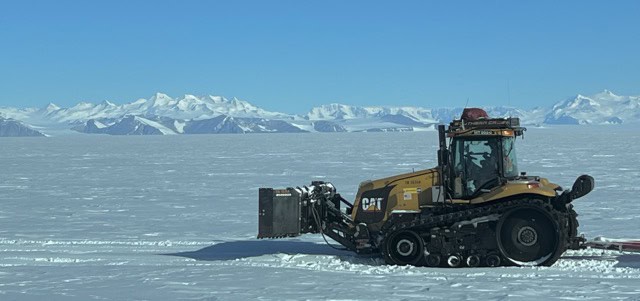
SPOT 3 (right) with 11 Challengers and 11 people
*With the new route, total mileage was adjusted from 1,040 to 1,033.
Day 10, 23 January, 61 miles today, 542 miles remaining to Pole, ambient temperature -6°C, the Ross Ice Shelf
At the end of each morning meeting, the SPOT 3 supervisor would close by saying, “Does anyone else have anything for the group?” A moment of awkward silence would follow before he would dismiss us: “All right, then. Let’s make some miles.” This morning was different, however. One of the operators had one small suggestion for the crew, and the floodgates opened. Everybody had something to say, but it was my contribution at the end of it all that seemed to make an impression. “I think in general we’re doing a pretty good job of coming to a quick stop at load check,” I’d said, “but every so often there’s a long pause in there where I assume someone is trying to close a gap in front of them. I just want to remind everyone that if you take a couple of minutes to stop, that’s a couple of minutes everyone behind you doesn’t have to check their load.”
This was true. The 1000hrs load check, for example, started at 1000hrs, when the first tractor came to a stop, and ended at 1015hrs—unless someone had found a problem with their load that was taking longer than 15 minutes to fix. My load in particular seemed to have a broken ring strap every other day, and it was frustrating to have the time I was allotted to repair it cut short. The crew responded by running with it, and when 1000hrs rolled around, the cascade of rapid-fire radio calls came in almost on top of one another. “Tractor298iscomingtoastop.” “307stopping.” “309isstopping.” “290slowingtostop.” “310stopping.” And a process that usually took about 90 seconds when it went smoothly was over in fewer than 10. Which turned out to be pretty nice, as I found myself with two fucked up ring straps to repair.
The day had begun overcast and gloomy, the light somewhat flat—though not so bad as to lose all definition in the trail, only most of it. I had been wearing my blu-blockers for days. I was starting to reflect on the way all my recent memories were literally tinged with that barf-tinted hue, as if the greenly orange light had been a natural phenomenon and not something I’d done to myself in effort to see where I was going, when I noticed something strange on the western horizon. The clouds there were sharper than clouds are usually supposed to be, resembling more a pile of teeth than a pile of cotton balls. The light grew harder, and shadows in the trail revealed the furrows and ruts that defined its breadth. The clouds began to thin, and as I was freed from my orangely green prison, the inkling I’d had blossomed into joyous realization. Mountains! These were the glorious peaks that heralded the Antarctic mainland, a buffet of dark, rich cakes that had been crumbled rather than sliced, but were nonetheless iced meticulously and elegantly. We had found the coast. In a few days we would be clear of the ice shelf entirely. SPOT 3, while still lagging behind where SPOT 1 had been 10 days into the journey, was still making progress.
Day 11: 24 January, 58 miles today, 484 miles remaining to Pole, ambient temperature -8°C, the Ross Ice Shelf
For 1,033 miles, the trail from McMurdo to South Pole is marked with a green flag every quarter mile, with red flags used to mark old camp sites along the way.* That’s well over 4,000 flags that need to be maintained, replaced as they slowly become buried in the snow or as the fierce wind makes them whip themselves into oblivion. Occasionally, one might be cut down by a wandering fuel load which had been allowed to drift just off the trail by an inattentive operator, but this came to a total, we were told, of usually no more than four or five per year. SPOT 1 + 3 had, so far, killed something over two dozen. “This is unacceptable,” the SPOT 3 supervisor said in the morning meeting. The man might sometimes speak with brusque impatience when there was work to be done, barking questions and commands in the confusion and noise, but this was the harshest actual criticism we had thus far received.
He wasn’t wrong. In an environment where visibility frequent dropped below a quarter mile, those flags were an essential part of our guidance system. GPS, which had become a proven and reliable technology in places with a fixed map, gave us in the field an approximation, at best, of our route. All permanent** ice is in constant motion—though the movement is imperceptible to our senses—and even the tracks we had recorded in our devices on SPOT 1 were already off the route by a couple hundred feet in some places. Every operator relies on the flag line in a whiteout. SPOT 2 was the crew responsible for replacing any missing markers along the trail, and now that we had passed them, any flags we annihilated on the way to Pole would just be gone when we returned.
The great Queen Maude mountains, which we had only glimpsed the day before, we gone in the morning. A low ceiling of clouds had settled over our patch of the ice shelf, hanging so close to the ground as to give the impression that we were driving across some impossibly wide indoor space—an vast airplane hangar with walls hidden just over the pale gray horizon. Maybe it was the weather, maybe it was simply the fact that we had already made this trip once already this season, or maybe it was that the most excitable member of our crew had been the mountaineer who had left us Pole once the route had been proven for the year, but the SPOT 3 caravan was muted as we the 4×4 post planted to mark the trail’s halfway point. “Oh hey, look at that said,” the mechanic foreman said on the radio as he passed the marker. Nobody replied.
It was just a few miles later that we turned off the trail that SPOT had been using for the last 20 years onto the new line SPOT 2 had made. This route was shorter and straighter than the old one had been, but it was fresh. The compaction left by a convoy of tractors pulling fuel a handful of times each year doesn’t sound at first like it would even be noticeable, but in truth the difference is stark. Leaving the old trail for the new was like driving off an untended dirt road and into a muddy field. The entire caravan immediately bogged down, and suddenly every tractor was on top of the one in front of it. Over the years, this section of the pathway to Pole would become as firm and relatively dependable as the other nine-hundred something miles, but for now this area was an untrammeled wilderness. The thin crust left behind when SPOT 2 had track-packed the route for us was broken through by the first tractor that passed, leaving every subsequent tractor to wade through a bottomless pool of soft flakes. This would be our lives pretty much until we reached the Polar Plateau. The hard part of the journey had come early.

*This is done to avoid setting up camp—and, specifically, gathering snow to make water—in an area where a bunch of tractors have parked.
**In the sense that it has been there for millennia, even if it is now on a course to have melted out within centuries.