The following is the personal account of a single, long-winded individual’s experiences living and working in Antarctica. No part of it has been reviewed or in any way endorsed by the United States Antarctic Program or the National Science Foundation, or any other public or private organization, institution, contractor, or company associated therewith. The views expressed herein are the author’s alone, for good or for ill.
Day 01: 14 January, 33 miles today, 1,007 miles remaining to Pole, elevation sea level, ambient temperature 0°C, the Ross Ice Shelf
I gained 10lbs on SPOT 1. The regimen of jumping jacks I’d implemented toward the end had been too little and too late to overcome the sedentary life I had adopted when running through the mush had proved to be an enormous hassle with little actual aerobic benefit. I briefly considered picking up a pair of yak tracks from McMurdo Central Supply so I could try running in the slick, compressed tracks left by the skis on the camp modules, but I quickly forgot that plan when I learned that the station had acquired several new sets of cross-country skis that I could check out for as long as I liked. God and/or nature had thus far thwarted every effort I had made to use a pair of skis since my family moved away from Maine when I was 8, but one conversation with an operator on one of the science traverse teams was all it took to send me straight into the converted office crammed with costumes, instruments, and sports paraphernalia, all available for issue. I had no idea what I was doing, wandering the stacks of skis and poles and making my best guess as to the sizes I needed, but in the end I left with a set that looked like it should work—and with the only pair of boots that fit my monstrously oversized feet.
I was excited to go all in on this new sport, but would have to wait to try this set-up out. McMurdo had gone through its yearly melt while we’d been gone, and the station was a dustbowl of fine, volcanic rock—a small island bare stone in a vast ocean of ice and snow.* So I ferried my gear out to SPOTSA one day while we were filling bladders, and strapped everything behind the ladder to the upper bunk in my tight, narrow room in buoyant anticipation of the evenings I would spend flying across the soft snow blanketing the great Antarctic wilderness. SPOT 3 was going to be a 2,000-mile celebration of adventure, solitude, and physical activity, a mediation of man and motion and the elements—and one that would keep me fit if it fucking killed me.
The day we actually left for Pole was warm. The wind was entirely absent as we stood outside the SPOT office waiting for the shuttle that would take us to our waiting camp, ringed as ever by its fleet of tractors, parked a mile past the ruined, half-melted sea ice transition on the McMurdo Ice Shelf. We milled about the small deck, shielding our eyes from the bright, blazing sun as it beat unfiltered against our bare faces. It was a good day for an expedition, the mountains across the frozen sea standing sharp and clear in the distance. No longer the untested band of ramblers who had left on SPOT 1 still wet behind the ears with lingering snowmelt, the SPOT 3 crew was focused, sure now of our mission and ourselves. When we were finally deposited out at SPOTSA, we wasted little time getting our last few odds and ends in place before a tight formation of dull-yellow Challengers was rolling alongside the snow road toward our fuel loads, parked just beyond the skiway.
This was my first time hauling fuel. As I found my load and pinned it onto my hitch, I was struck almost immediately at how shoddy it seemed—the nets keeping the bladders from shooting off the back were half out of place, and the straps running over the top were all either too tight or too loose. I had felt at the time that we had been conscientious and methodical when setting the rigging for these over the past couple of weeks, but this one looked as if we had done the job blindfolded. When we stopped for load check at the edge of the Shear Zone, I found several broken straps that had to be replaced. The supervisor laughed when we found ourselves re-rigging half of the load we used to pull from at fuel circle. “Welcome to SPOT 3!” he said, “Everything is worn-out and broken at the start, and it only gets worse from here!”
Even so, our progress on the first day wasn’t bad—though several of the tractors in the convoy had a difficult time pulling their full loads through the warm, soft snow. Even as the open crevasses through the Shear Zone threatened to swallow the skis on the CRREL tools, we passed smoothly through that treacherous corridor, and were well clear of the area and onto the Ross Ice Shelf by the time we’d stopped for the day. The weather was, if anything, warmer, the curves of Ross Island softly lit by the honeyed light of the evening sun. I was eager to get my skis on and see what I would be able to do with them, almost frantically changing out of my work clothes in a flurry of fleece and wool and charging out onto the ice with my new skis and poles clutches awkwardly against my chest. I set them carefully down just outside of camp and tried to set the toe of the boots into the bindings. I couldn’t. I tried again. I still couldn’t. I was decades out of practice, but had a reasonable understanding how the mechanism worked; this was not the step I had expected to be flummoxed by. I sat down on the snow, took off one of the boots, and brought one of the skis to my face, determined to figure out how the one fit exactly into the other. They didn’t. The bindings didn’t match the boots—though they were close enough to look as though they would. It was something an experienced skier would have caught right away; something even a novice with better sense would have thought to check before committing irrevocably to a set. But I hadn’t, and now I was stuck lugging a bundle of useless fiberglass sticks all the way to Pole and back.
I sat for a moment and looked into the horizon, my one bare sock soaking in the damp snow as the empty boot sat abandoned a top the shiny unused skis. This was not the start I’d wanted to my second trek to the South Pole, but once underway there was no turning back. SPOT 3 had begun.

*Which is, after all, why the 1902 Discovery expedition established its camp there in the first place
Day 02: 15 January, 51 miles today, 956 miles remaining to Pole, ambient temperature -4°C, the Ross Ice Shelf
SPOT 3 seemed to take us by surprise. SPOT 1 had been the culmination of months of planning and preparation, and the first day on trail had been a momentous event in itself—a milestone that had loomed large on the calendar and overshadowed anything that might lay nearby. But even the night before we left on SPOT 3, the thought of spending six weeks in a mobile camp crossing the plains of Antarctica seemed impossibly distant, a vague idea that was probably happening to somebody else. The warm, quiet room, the soft sheets, the weight of Sean Meadow’s head resting on my chest, these things were real. And then, suddenly, they were gone, leaving me only the memory to carry with me to the South Pole.
The entire crew seemed out of sorts our first morning on trail. It was as if the previous day hadn’t happened, and we’d all gone comfortably to bed in McMurdo and had woken up somehow out in the middle of nowhere, disoriented and confused. We struggled with the basics of the camp routine, those muscles stiff and unreliable with two weeks of disuse. Where are the plates, again? Where do we keep the peanut butter? When do I fire up my tractor? Where the hell is my pee bottle? When you share a tight space with ten other humans, you learn to move through it with a sort of deliberate economy. Every step has a purpose; no gesture is wasted. This morning, however, we all just sort of wandered around, lost in a room barely big enough to contain all of us at once.
We stepped outside to a world swallowed by fog. I’ve never been clear on the meteorological implications of fog in an environment that rarely sees temperatures above freezing, but it isn’t uncommon in McMurdo. And like fog anywhere else, it seems to creep in during the thin hours of the night, and burn away as the sun strengthens throughout the morning. This far north, though the sun still never sets, it nonetheless follows a sort of wide arc, reaching a high point in the northeast around noon and a nadir in the southwest at midnight. It is noticeably colder at night, and the quality of the sunlight is different. The endless snow takes on a golden cast, even as the sun still hangs several degrees above the horizon—the way it might an hour before sunset on an early summer day somewhere else.
The fog followed us for the first part of the morning, but had cleared by the time we stopped for the 1000hr load check. My load was still a half-ordered mass of loose nets and rotting straps, but it did feel like I was slowly getting ahold of it and dragging it back into place. We had a clear view of the volcanoes of Ross Island in the north, the distance making dead Mt. Terror look almost as massive as the great squat form of active and steaming Mt. Erebus. To the west, the low form of Minna Bluff crawled across the horizon until it disappeared behind the rounded cone of Mt. Discovery, now clear of the shrinking form of White Island. Soon enough we would lose these landmarks, the topography of home. We had to bask in their sight while we still had the chance.
It didn’t last long. Though the bright, piercing sunlight was hot enough that I spent the lunch hour in the running shorts I’d taken to wearing in my tractor, we drove in the early afternoon straight into a wall of clouds which had grown from the southern horizon like a crop of bad news. A slight, almost imperceptible breeze picked up as we motored on, and when we stopped for our 1530hr load check, the brilliant, balmy weather was wiped clean. The difference was stark, and nobody was quite dressed for the change. SPOT 3 had left McMurdo at the very apex of summer, but would return as winter came to reclaim its native land. It was well and truly cold—but this was only the beginning of a long and difficult journey. We were traveling the same route, but in many ways SPOT 3 would be on an entirely different trail than the one we’d already come to know.

Day 03: 16 January, 50 miles today, 906 miles remaining to Pole, ambient temperature -3°C, the Ross Ice Shelf
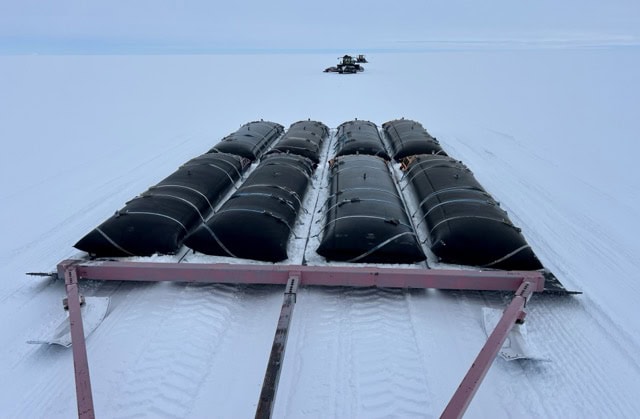
I had never pulled a full fuel load before. In practice, it wasn’t much different than hauling cargo—but then again 308 was by far one of the heaviest tractors in the fleet, decked out with counterweights and thick steel plates on the idler wheels that made it look like some kind of siege engine directly out of the Iron Age. A lot of the other Challengers were struggling with eight full bladders at their back, while I cruised blissfully along toward the back of the pack. The hardest part for me was remembering how much wider the fuel load was compared to the cargo sleds; I had brushed against a few marker flags crossing the Shear Zone, but hadn’t yet to my knowledge taken any out completely. I didn’t fully understand what problems to watch out for, and so kept a close eye on this octet of grotesquely plump, 20,000lb leaches, which writhed and flopped continuously under their loose bindings. The straps were only guardrails—only there to keep the bladders from sliding off the plastic—and cinching them down tight would bow the plastic sheets beneath, making them far more likely to crack rather than flex as they slid over uneven terrain. But the constant movement was nonetheless disconcerting.
It also meant that the load needed regular adjustment to account for the ways in which each bladder had shifted since the last load check. The tail nets, set to keep the leeches from sliding backwards off the plastic, were the only piece of rigging that was kept tight, and yet these were proving to be the hardest to keep in place. The bladders were constantly damp with a thin patina of diesel, and another thing I was scrambling to figure out was the line separating a worrisome leak from the numerous known weeps along the seams of each sack. It took me until the morning of the third day to decide that the wet, oily mess around the hose fitting at the ass end of one of my eight unruly children was an active leak and not the leftovers from a spirited filling session—even then, it wasn’t until lunch that I was able to get ahold of a wrench big enough to secure the fitting and stop the slow, steady seeping from the bladder’s back end.
I had forgotten to check the cooking/cleaning schedule when we got back on trail, and was caught off guard when I learned that I was the day’s house mouse. Camp chores are always something of a mixed blessing: your tractor is the first to be fueled, and you get to skip the remainder of the fuel circle, but then you’re under the gun to get everything cleaned up and filled before the rest of the crew comes into camp for dinner. Usually this isn’t a particularly big deal, but at fuel circle I had parked 308 cockeyed on soft snow, and then misjudged when to stop the boiling river of fuel pouring into the skewed tank. The resulting geyser of diesel soaked my boots, which were still steaming with fumes when I parked at camp, climbed down the steps to the ground, and watched my flashlight fall out of my pocket and hit the ground. This was a piece of gear I used every single day to inspect my machine, and since I didn’t have a spare I really couldn’t afford to lose it. But as I crawled on my belly under the tractor, I couldn’t figure out where it had gone. I checked the ground from one end of 308’s underside to the other, looked in and under the tracks, but it was nowhere to be found. I fired the machine back up, rolling it back a good 20 feet, but still couldn’t find the damned flashlight. It had vanished, somehow, into the snow.
It wasn’t until long after I had given the up the search, and was walking across camp to wash my hands so I could fill up the snow melter after cleaning the incinolets and checking with a dipstick how high we had already filled our first urine barrel, that I saw a thin black tube poking slightly out of the snow, some ten feet behind my tractor. The soft mush, compressed by the Challenger’s weight, had already started to harden into ice, and I had to claw beneath the surface to break it free. Wherever it had fallen, I had clearly run it over when I’d moved the tractor, but it seemed none the worse for all of that. If only I could be so resilient, I might actually make it back from SPOT 3 in one piece.
Day 04: 17 January, 47 miles today, 859 miles remaining to Pole, ambient temperature -2°C, the Ross Ice Shelf
Despite a flurry of cold weather toward the end of the second day, the start of SPOT 3 had been exceptionally warm. It’s hard to overstate the influence of solar gain, especially in a part of the world where the hole in the ozone layer lets through a lot more of the sun’s radiation than much of the rest of the planet ever sees. While cloud cover can often blanket the region, trapping warm air close to the ground, the haughty, relentless sun beats against the surface-layer snow, softening it like a stick of butter in the microwave. While this sultry summer warmth might permit the odd SPOT operator* to prance about at lunchtime in nothing but a t-shirt and a thin pair of running shorts,** it nonetheless makes for absolutely shit road conditions. Though by this point in the season the trail had been packed twice by SPOT 1, and once each by SPOT 2 and Heavy Science Traverse, in the incessant heat it was like trying to drive through a field of confectioners’ sugar. 308, with all its plates and counterweights, was actually handling itself fairly well through the mush. Many of the other tractors, however, spent the entire day slipping and spinning their tracks.
There was nothing to do but to press onward, however awkward the progression. It was important to keep a bit of distance from the tractor ahead, so that when it spun out, inevitably and without warning, you had time to slow. As this happened over and over throughout the caravan, it created a kind of yo-yo effect across the entire column, such that you found yourself constantly either slowing down to avoid a collision or speeding up to keep from losing the group up ahead—but never able to hold a constant speed for any length of time. There was little to see, at any rate, but the tractor ahead. The recent snowfall had buried the ridges and waves that had once given the ice shelf definition and character, and now we were surrounded by an unbroken, featureless table of white. Set below the empty sky, it was like sitting in the hallway of some administrative building with nothing to distract you from the blank ivory wall but the strip of pale blue paint some manager had once decided would make the place appear cheerful.
The cold weather would come, and we would trade comfort for speed. Until then, I would continue to sit in the cab dressed like I was headed to the gym, an ad hoc curtain hung with binder clips over the rear window to keep the worst of the sun from my skin. Our mileage would drag, as would the hours we spent crawling through a flat an empty world made from whipped potatoes—but whenever the opportunity comes in this life not to wear pants, you must take it, and run with it as long as you can, into the shin-deep fields of powder, into the endless, empty horizon, into the literal end of the earth.

*me
**rumors persists of operators in the past who were known to do load checks in their underwear—though for me this always raises the question where the hell did they clip their heavy VHF radios?
Day 05: 18 January, 57 miles today, 802 miles remaining to Pole, ambient temperature 6°C, the Ross Ice Shelf
The heat wave, such as it was, continued. While reports came in from McMurdo of regular townsfolk ambling around the station in shorts and sandals—and not just the usual idiots with something to prove*—hoping to catch a glimpse of the roving pack of adelie penguins lured into town by the open water just off Hut Point, SPOT 3 pushed on into the tide of soft, warm snow through which we would wade for 500 more miles to edge of continental Antarctica. It was a slow, often tedious drive, and my effort to alleviate some of the boredom through a regular series of beverages only resulted in a pee jug that was alarmingly full by lunch time. But at least it was something to do.
We were nearing in on the 1000hr load check when those toward the front of the caravan spotted something in the distance. The flipside of an unobstructed view over flat, open ground is that you can see things long, long before they’re close enough to resolve into recognizable objects—even the binoculars I kept in my cab were of little help, as they only amplified the regular bouncing of the tractor until it was impossible to focus, and anyway, the heat lines radiating from the surface of the snow completely distorted anything more than a mile away into a wavy smudge. So it wasn’t until we were almost on top of them that we recognized that we had just come across the traverse crew from Antarctica New Zealand, heading back to Scott Base** after a month camped out in the field.
The rest of us checked our fuel loads while the SPOT 3 supervisor and the mechanic foreman went on ahead to parley with the kiwis. It’s not unusual for field crews to barter goods when they meet on the trail, something like the way the pioneering era of the American West is often portrayed, but the New Zealanders were on their way home and weren’t interested in anything we might have to offer. It was just as well—I’d seen what they kept in their pantry when they’d stopped by the Shear Zone camo earlier in the season, and the trade off for their sleek and comfortable camp modules was a diet of dehydrated disappointment. We were better off holding onto whatever treats we had ourselves.
The kiwis parked just off the trail to let us pass, two of them standing dutifully on the roof of their living mod and waving for the full ten minutes it took for our long, lumbering convoy to plod by. They seemed cheerful enough for a foursome on their umpteenth day living on top of each other in middle of nowhere, beaming at each of us in turn as we passed by. Every man in his beaten, cumbersome Challenger was a homecoming queen, waving happily at the only other living beings for two hundred miles who cheered us on as one of them filmed the entire procession. This brief, surreal encounter carried us through most of the warm, sunny day—all the way to the waypoint designated as South +100, where a 55-gallon drum had been left some number of years before and never reclaimed. No one on any of the USAP traverses had any idea where it had come from, and if the kiwis had been responsible for it they had each been sworn to secrecy. Its origin was one of the enduring mysteries of the trail. Long ago, a member of the SPOT crew had written a message on the barrel’s side in grease pen, and though the paint had faded with several years’ exposure to the cruel Antarctic sun, we were still able to read as we passed the words given to the ages, a koan given for us to ponder as we crossed the great white void:
“Who am I? Why am I here?”

*me
**Just down the road from McMurdo