The following is the personal account of a single, long-winded individual’s experiences living and working in Antarctica. No part of it has been reviewed or in any way endorsed by the United States Antarctic Program or the National Science Foundation, or any other public or private organization, institution, contractor, or company associated therewith. The views expressed herein are the author’s alone, for good or for ill.
Days 34-39: 08-13 December, 0 miles traveled, elevation 9,301 feet, Amundsen-Scott South Pole Station
The giddy high of our arrival at Pole carried us through the afternoon, as we settled in, showering, starting laundry, picking up mail that had been sent ahead from friends in McMurdo, and raiding the tiny station store for souvenirs, toiletries, and booze. We had arrived, we discovered, on the day of the annual carp shop party. Depending on the year, this can be an elaborate affair with all variety of games, amusements, and activities—or it can be just a big cookout at a small building in Summer Camp where most of the station shows up and gets hammered. This year’s leaned toward the later, but there was live music tucked into back end of the shop, and that was more than enough for me. It was sloppy, unrehearsed, and loud, and it was exactly what I didn’t even know I’d needed. I bopped up and down in front of the makeshift stage with a small mass of Polies until we were sweaty and exhausted, each of us lost in the joy of unfiltered human noise.
The next morning, I was struck for the first time how strange it was to step out of the living mod and onto the white expanse of the Polar Plateau, only to see stuff everywhere. We had parked camp maybe about 100’ from the ceremonial South Pole, a shiny spherical bauble set atop a round post painted in red and white stripes like a barber’s pole and ringed by a half-circle of flags of the signatory nations to the Antarctic treaty. The station itself was almost as close, just a minute’s walk from door to door. This being the busiest season for the USAP since the start of Covid, we were not offered rooms inside the building itself, filled to capacity as it already was—though we were given the option to move into a heated and carpeted quonset hut in Summer Camp, where we could have tiny, but private, rooms. There was some appeal in that, and three or four of the SPOT mechanics made the move, but most of us figured that if we were going to stay in a structure without internet or plumbing, we might as well stay in the one where all of our clothes and bedding already were. Camp was a lot closer to the station, anyway.
Living in a bunkhouse outside the main building made Pole feel a bit like the world’s most inconvenient hostel. We had to walk outside across fucking Antarctica just to brush our teeth, empty our pee bottles, or get a cup of coffee, which only exaggerated the numerous difficulties inherent to life in what is, essentially, a fortified field camp. Amundsen-Scott’s uniquely terrible toilet paper is the stuff of Antarctic legend: one ply, rough like the pages of a pulp paperback, and yet stiff as cardboard. Water use at the station is highly rationed, as the process of melting the ice sheet for human consumptions is difficult and extraordinarily energy intensive. Showers are limited to two minutes, and residents are permitted only two per week; and the restrictions for laundry are stricter still. But the station is not without its charms and amenities. There is a greenhouse, entirely hydroponic and lit by electric grow lamps, and capped off by a couch at one end so you can sit and marinate in the moisture and the smell of growing things. It is the only humid place I’ve ever encountered on the continent, and is one of my favorites by far. The lounges are cozy, and the galley is, too, and though the kitchen at Pole doesn’t have McMurdo’s regular access to fresh veggies (occasional fare from the greenhouse notwithstanding), its cooks are free from the constraints of having to prepare standardized meals for a thousand people—there are fewer choices at dinner, to be sure, but the food is generally more thoughtfully, even lovingly prepared. The music and craft rooms rival their counterparts at far more populated McMurdo, and though the gym is small, every piece of equipment in it works. The shock of workout room full of functional machines alone would leave any McMurdan gasping for air, though simply running on a treadmill at elevation would do the same. I was surprised each morning as I huffed and panted how poorly I had acclimated over the past couple of weeks on the plateau, and was determined to hold my own beside the well-adjusted Polies breathing easily on the machines around me.
Once we were clean and at least a tiny bit refreshed, we got back to work, the operators and mechanics going their separate ways—at least for the time being. The mechanics headed into the VMF (Vehicle Maintenance Facility) to work whatever healing magic they could manage on the fleet of overworked Challengers, while the operators teamed up with the South Pole fuelies to empty all the diesel we’d brought into the massive network of underground (i.e., undersnow) storage tanks where it would be protected from the elements* for the coming year. This was a relatively straightforward process, though there was an endless string of details to manage along the way. But basically, the fuel loads were parked on a slope, with the hose coupling valve on the downward side. The bladders were connected through an octopus of hoses to a pair of manifolds, a large diesel pump, and on to the tanks in the fuel arch a few hundred feet away. The bladders were drained until only a couple hundred gallons or so remained, at which point two people would squeegee the remaining fuel toward the open valve by running a pair of push brooms over the top, while two more held up the downhill corners, all to direct every last possible drop toward the sucking hose. Once a bladder was emptied of fuel, the hose was taken off and replaced with a leaf blower that filled the thing full of air, like the world’s largest and most disappointing party balloon. This was to give the bladder enough shape and mass for the straps to keep it in place during the return journey. When all eight bladders in a fuel load were drained of diesel and plump with air, that load was taken off and the next one brought in.
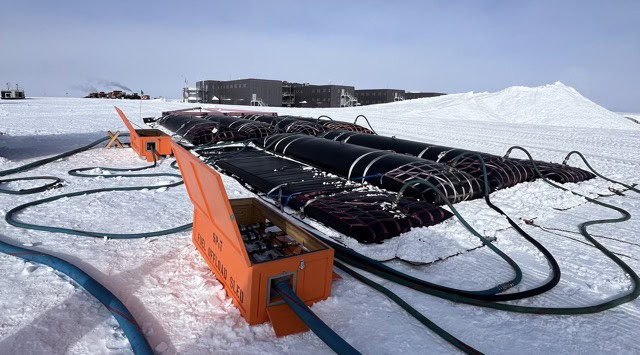
(station in the background)
The operators on SPOT 1 were exceptionally lucky. The ambient temperature held steady between -25°C and -30°C, which is fairly mild for Pole. The wind was slack and calm, and the fierce and beating sun felt almost warm in the still air. Add in the demanding physical nature of the work and it hardly felt cold outside at all, though of course it was—you’d be focused on your work for an hour, and be surprised when you stepped inside the Fuelie warm-up hut for a sip of coffee to find an inch of ice in your beard, condensation from your breath which had frozen into a mass of interconnected icicles. The hardest part for me was the footing, or rather, the constant, unending search for it as we walked over and around the bladders throughout the day. HMW is incredibly slippery, and now we had set this slick working platform on a hill. A full bladder makes for a firm, relatively grippy surface with just a bit a give, like walking across a firm bed of jello, but one that is that is half-empty (or more) is like trying to walk across a kiddie pool full of jello that hasn’t quite set—your feet sink to the floor, and the rubber laps at your ankles, grips the soles of your boots, and trips you as you try to step across.
A 3,000 gallon-capacity bladder with maybe 1,000 gallons left in it is worse for walking than the HMW, but it makes for an ideal place to steal a few precious moments of rest. Laying supine across the top of one feels surprisingly, but comfortably, like floating on a tranquil sea. I took advantage of these rare, small breaks whenever I could, flopping over backwards with my arms and legs spread across the rubber below, buoyed by the slow lapping of the fuel beneath my body. I’d close my eyes for a breath, for two, for three, and then open them and look intently into the clear blue dome spread out above me. I could be anywhere, in those moments: a beach in Samoa, perhaps, the steady drone of the diesel pump mimicking the sound of the gentle surf washing endlessly against the sand—or even the sensory deprivation tank I’d once paid too much to lie in for an hour, and in which I had promptly fallen asleep.
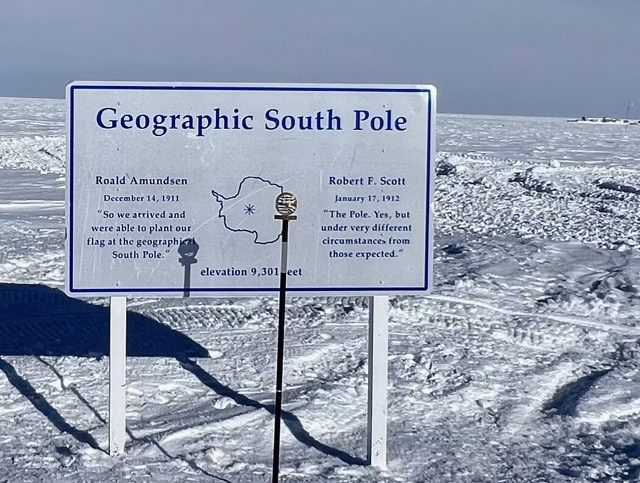
While the workday on trail was a consistent 12 hours or more, at Pole the SPOT crew was treated to the 10-hour standard USAP shift—and even a couple of days off. Much of this free time was spent catching up on personal chores and keeping in touch with people back in McMurdo or the States, but we all found time to be sightseers in this most foreign of locations, visiting both the ceremonial South Pole and the Geographical South Pole,** and taking any tour offered to us. This was an opportunity afforded to very, very few, after all. The tourist camp managed by Antarctic Logistics & Expeditions (ALE) a half mile down the way charged its visitors over $62,000 to camp by the South Pole for a week—the very same thing we were doing for free. We’d have been fools not to take advantage of the chance to see whatever we could while we were there.
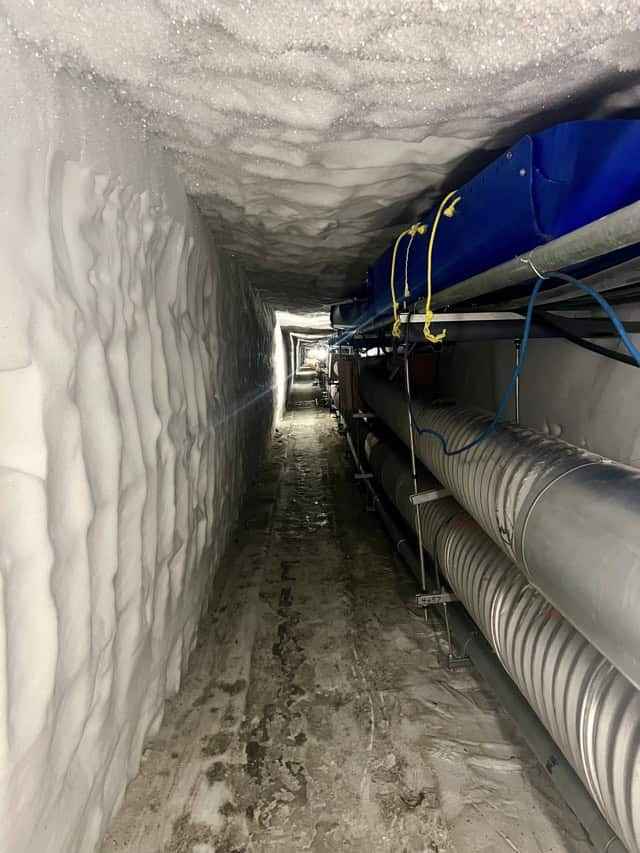
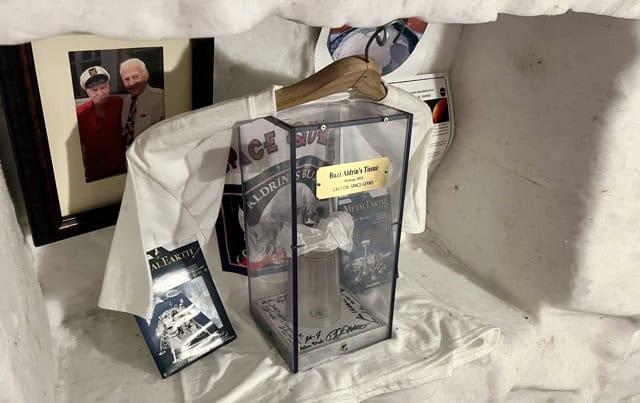
On our first full day on station, we were guided through tunnels dug through the firn, carved as part of the system of rod-wells from which the station melts its water, and deposits its sewage once the hole under the ice has become too large to be useful for harvesting. The tunnels, running for a half-mile 40’ beneath the surface, are bowed from the pressure of the Ice Sheet’s continual movement, and have to be re-widened with chainsaws every few years lest they eventually become crushed. I’d been on this same tour when I first visited Pole in January of 2019, but it’s a unique enough experience to be worth another look. Not only a marvel both of engineering and brutally hard work, the first few hundred feet into the snow are also a secret museum of sorts, with exhibits displayed in small windows cut into the hardened snow—trophies and memorabilia from seasons long past, each with a story handed down across generations of Polies, and related to us by our erstwhile, rapidly-speaking guide. My favorite then—and still–was a kleenex used by Buzz Aldrin on his visit to the station shortly before he was medevac’d back to McMurdo with acute altitude sickness, set tastefully on a plastic cup turned pedestal and protected by a plexiglass box.
The tours we went on for a handful of the major science projects weren’t quite as eccentric, but were no less interesting or unique. The facilities themselves are a sight to behold, even before you step through their doors—whatever image pops into your head when you read the phrase supervillain’s secret south pole lair is probably already accurate enough to get the idea. It’s like a moon base you can walk right into, one filled with charismatic professorial types and cute grad students from around the world, all of them so, so incredibly eager to tell you about their work and the crazily advanced sci-if tech they use to do it. We visited Ice Cube, a colossal neutrino detector that uses a matrix of sensors placed a mile and half into the ice with a massive hot water drill. We saw the gigantic South Pole Telescope, as well as the BICEP3 and MAPO telescopes, all of which use sensors supercooled to less than 1° above absolute zero to scan for details of the origin of the universe in the cosmic background radiation. We may have understood only a fraction of what the researchers told us about their work, but could easily have listened to them all day. Meanwhile, on our last afternoon in town, our camp was opened up to the locals for a tour that was a great deal less technical and decidedly less sophisticated. We were getting the better end of the bargain, by far—while we gawked at the futuristic marvels our sweat and struggle had helped to support, the Polies could peek into a series of bunk rooms every one of which, despite whatever homey touches the individual residents may have added over the years, were nonetheless all permanently baked with the smell of stale farts and wet socks.

We had left McMurdo with almost a quarter million gallons of fuel, burning through nearly a third of it over the long days we travelled south. As the last bladder was squeegeed dry, the counter on the Pole fuelies’ pump quantified our achievement: 163,000 gallons delivered across the world’s largest, coldest, deadest desert. With the last drop of diesel pumped safely into the Polie tanks, it was time to head back to McMurdo. Before we left, though, I wanted to revisit a place that had fired my imagination ever since I’d first seen it on my first visit to Pole, quasi-insensate and confused after staying awake for several days trying to catch the flight across the continent: the End of the World.
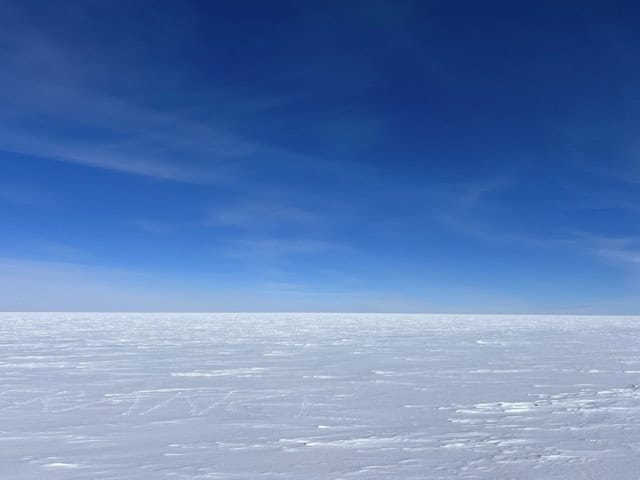
The End of the World is nothing more than the spot where Fleet Ops dumps the built-up snow they remove from around station, but it marks the end of the townsite and the beginning of the great Antarctic wilderness beyond. I loved it for its solitude, its distance from the hustle and bustle around the dark gray spaceship beside the geographic pole, the window it offered into the open emptiness beyond. I also loved that you could casually say, “I’m walking to the End of the World” and people would know what you were talking about. I set out early on our last day at Pole, well before most of the station had sat down to breakfast. The sun was a proper furnace in the still air, with sporadic, rainbow’d sun dogs ornamenting a halo around it, and it wasn’t long before I unzipped my coat and took off my mittens to cool off. There was no sound but the shallow chugging of my breath and the squeaky crunch of my oversized boots on the groomed snow as I passed row after row after row of berms holding decades of old equipment, small buildings, materials, and debris, put in storage until someone might eventually figure out what to do with some of it. Eventually, the lines of piled snow parted and I came to a wide, flat pad—a sort of groomed platform where trailers full of snow would be dumped over the side and onto the untamed plateau 40’ down. As I walked to the brink, I could see evidence that someone had recently been beyond the edge. There were footsteps in the snow below, meticulously spelling out a single word in 20’ block letters: FRANCE.
I puzzled over this cryptic message for a moment or two, but was inevitably drawn into the great solitude that lay before me. I had come here to force a sort of moment of zen, half expecting that a mystical experience with a set-up this contrived would never work, but the power of the great void is overwhelming and impossible to ignore once you’ve walked right up to look it right in the face. The silence was absolute, and I stared into the unimaginable distance until I vanished into it myself. This great nothing was the place from which our small crew had come into this small and strange outpost on the edge of human existence, and into which we were about to return. We had been here in the company of friends and strangers for a bright and brief time, and now that time had almost passed. I stared into the immense snowy eye, lost in a stream of thoughts that seemed to flow right through me, as world around held its cold and bitter breath. It was a moment of perfect stillness, broken at last as the sound of a loader’s backup alarm drifted on the gentle air all the way from the bowels of the townsite and pierced my senses, bringing me back to my perch at the End of the World. I was still here, after all, if only for a moment, and noticed for the first time that I had become chilly. A slight breeze was blowing in from from the open wasteland, and at last I could feel the cold. I zipped up my coat, donned my fuel-stained mittens, took one last look at the long horizon, and started making my way back to the slowly waking station.
(literal)
*For reasons beyond my understanding, the temperature under the snow remains a constant -58°C year round. Though the surface sees substantially warmer temps in the summer, in winter it gets well below the point (around -75°C) where diesel starts to gel and become less a useful fuel and more of some kind of gelatinous, frigid gunk—hence, the bother of pumping fuel under the snow.
**Since the East Antarctic Ice Sheet is in continual motion, the marker for the actual Geographical South Pole is moved about 32’ during a ceremony held each New Year’s to keep it more or less accurate, while the ceremonial pole remains where it is in Amundsen-Scott Station’s front yard