The following is the personal account of a single, long-winded individual’s experiences living and working in Antarctica. No part of it has been reviewed or in any way endorsed by the United States Antarctic Program or the National Science Foundation, or any other public or private organization, institution, contractor, or company associated therewith. The views expressed herein are the author’s alone, for good or for ill.
Day 31: 05 December, 26 miles today, 43 miles remaining to Pole, elevation 9,413 feet, the Swamp (aka the Marsh)
There is no personal space on traverse—almost. The rooms in the living mod are each about 8’x6’, with two extra-long twin-size bunks and a single dresser dominating the space. There is really only enough room for one person to stand, so when one roommate is digging around for a pair of socks, the other has to be lying down. Fawlty Tower is more spacious, but holds four people, and the only door opens directly to the Antarctic wilderness, with all its wind and midnight sun. What little communal space there is is always in high demand. During the whole of SPOT 1’s journey to the South Pole, I was alone in the kitchen a total of four times. Three of these where when I was cooking, and so was excused from fuel circle to get food ready for the crew. Only once did I have that module to myself in the morning, and this despite rising at the savage hour of 0430. It was more serene than I’d have imagined, this strange stillness, this wondrous solitude, and I admired the quiet way the sunlight slashed the room into even sections as it pierced the windows. The peace was brief, however. In less time than it took a pot of fresh coffee to finish brewing, one of the mechanics could be found across the table stirring hot water into his oatmeal, while another was down the hall firing up the incinolet.
The one sanctuary each person has is the cab of their tractor. Though the glass box doesn’t offer much in the way of privacy, it’s nonetheless the only private space anyone has, and is treated as sacrosanct by every member of the team. Everyone, including the mechanic foreman and the supervisor, asks permission before entering another person’s cab, every single time. It is poor form to mess with anyone’s personal belongings or to readjust the seat while driving their tractor over to be fueled while they are working in the kitchen. The tractor cab is treated with more respect on SPOT than a dorm room is at McMurdo.
My cab was sparse, at least compared with some. I didn’t keep extra coats or workout equipment stuffed into the corners or hanging from the panels—though I did keep a spare pair of sunnies on a hook tucked in the corner and a small box under the jump seat with a reserve buff and set of gloves. My tractor snacks weren’t scattered across every available surface, though I could see how that approach might maximize munching convenice, but tucked away in a compartment behind the jump seat, or else stowed in a small hinged box I built before we left and bolted onto the rail running above the right-hand controls, or hanging in a small yellow pouch I’d tied beside it. There were no decorations, per se—notwithstanding the cheap flag I’d taken an embarrassing bit of effort to install atop 308 that had been repurposed into a makeshift curtain to keep the glare of the sun off my display panel after it had been ripped off of its 2×4 pole by a light Antarctic breeze. The effect was an ambiance that was largely utilitarian, but I liked the sense of space it gave me, uncluttered and roomy. The only really personal touch was a picture Sean Meadow had given me of the two us, taken the weekend before I’d left, which I’d tucked into the corner of the rearview mirror. It wasn’t much, maybe, but it was home.
These tiny homes were becoming increasingly difficult to keep clean. The soft, billowy snow of the Swamp (aka the Marsh) was sticky, and tracked over absolutely everything. I’d return from a load check covered from head to foot in loose powder, my boots caked thick no matter how much I stomped on the grate outside the cab door. A few minutes in the heated greenhouse, and all this snow became great pools of water soaking my clothes and running across the small, rubber-matted floor. We were inching ever closer to our goal, forced to keep running the tandem playbook devised earlier in the week by this honey pot of fluff, an ocean of soft down seemingly without a bottom. We’d been on trail for a month, long enough that it had become hard to picture life outside this narrow, constrictive routine, but one day soon everything would change. We just still couldn’t quite say yet when that would be.

Day 32: 06 December, 29 miles today, 14 miles remaining to Pole, elevation 9,299 feet, the Swamp (aka the Marsh)
There were moments, when I caught the scent of the incinolet, that the first part of the complex smell to penetrate my consciousness was the burning paper. It was only after the part of my brain conditioned by fond childhood memories of weekends spent in lonely cabins in the forests of New England responded with the thought ooooh! campfire! that the reek of burning shit would hit me.
Life in the last 100 miles to Pole, aka the Swamp (aka the Marsh), found its own particular rhythm. After caching one full fuel load below the Leverett for our return and a diminished one in Sastrugi National Park when 303 died, we were down to eight—though each of these was pretty full. No tractor seemed to be able to pull these through the soft, sticky snow faster than about a mile per hour on its own, so each morning eight of them pulled four bladder sets in tandem for about an hour and half, dropped them off, drove back to the remaining four, and pulled those up to rejoin the others. This process was then repeated in full in the afternoon.
The camp train, which now included the dead tractor, was also pulled in tandem; 308 was the only Challenger pulling a load on its own. The cargo sleds dragged through the fluff, but nonetheless rode more easily than pretty much anything else, and while I usually fell behind camp, it wasn’t by much. The Prinoth had only one sled behind it, but I knew from experience how heavy that tool shed was, and that little tractor couldn’t manage much more. We moved at a crawl compared to the teams toting fuel, but we only had to travel the distance once. We left later than the rest of the crew, moved slower, and still arrived earlier than they did. That left us plenty of time for chores.
Those us without fuel loads—the operator and the mechanic towing camp, the mechanic who had been driving 303 before it became dead weight, the supervisor, the mountaineer, and I—checked each of the fuel loads (as well as our loads) at each stopping point, so all the others had to do was drive. We kept the generator filled, set up fuel circle, and generally kept camp stocked and cleaned. Those of us with still-functional Challengers drove our own vehicles, while the supervisor and mountaineer traded off behind the wheel of the Prinoth. The only person without a tractor was the mechanic who had been in the cab of 303, who spent his mornings riding inside one of the camp mods. Sometimes he cleaned, sometimes he made cookies for the rest of us, but mostly he just hung out and waited for the train to come to a stop. Module riding is it own unique pleasure, in limited doses, but the novelty wears off quickly, and what you’re left with is hours and hours of boredom, confined in a narrow space you can’t leave. Thus it was decided that the mechanic would ride in the mods in the morning, and switch out with whomever was assigned as the day’s cook in the afternoon.
I had hoped to make it to the South Pole before my turn came around once again on the calendar, but our progress across the Polar Plateau had been leaden, and on the last full day before we arrived at our destination, that duty fell to me. This did come with the perk that I could spend the second half of the day riding in camp—the only difficult choice remaining was whether to ride in the kitchen mod, with the wifi and the food, or living mod, with my bunk. I opted for the latter, leaving the banded clouds and fierce sun dogs of the wider, snowy world for the warm, dark luxury of my tiny bedroom. It was sumptuous indolence as I had rarely known, so it seemed, to be treated to the first nap I’d had since the day we were held down by storms; the relaxing, gentle swaying of the building only occasionally interrupted by a sudden, jolting bump.
Once camp had skidded to a stop (and all the loads were checked and readied for tomorrow’s haul), I walked to the kitchen to fix the last supper we would eat in the wild Antarctic before our return to the quasi-civilization of Pole. The occasion, I decided, called for a feast—an impression largely informed by the fact that the bags of pre-cooked meatballs I’d found in the freezer came only in sets of 50. But I ran with it, carving up a massive 2lb slab of tofu for the vegetarians on the crew, emptying the last can of marinara from our stores into one pot while improvising a spinach/garlic/goat cheese/cream sauce in another. There was garlic bread and some sort of kiwi-made pumpkin tortellini, mountains of seasoned asparagus, and to cap it all off, a perennial traverse favorite, premade banofee pie—a popular New Zealand confection made with (as the portmanteau would suggest) banana cream and toffee. It was a true glut of food, and while it wasn’t surprising that there were leftovers at the end of the night, there really wasn’t all that much to save.
I’d made a huge mess in the process, of course, and even though I cleaned most of it as I went along, I still had a tower of dishes to wash before I could call it a night. I don’t mind washing up, usually, but the amount of water I was using to clean up was truly obscene by field camp standards. It had been worth it, to share in such bounty in the midst of the vast, open nowhere, and I had eaten my fare share of the night’s abundance. There were no scales with us on trail, so I had no objective measure for how the rich food on which we subsisted was affecting me. I hadn’t bothered with exercise since we’d climbed onto the plateau—the cold and the elevation made even walking up the six stairs to the kitchen an ordeal—but I had noticed that my clothes, at least, weren’t fitting any tighter than they had when we’d left McMurdo. Strange, I thought, I’m eating like some grotesque medieval lord and doing absolutely nothing to work it off, why aren’t I twice this size by now? As I finished up the dishes and dressed to go outside, that thought carried me down the hall and out around back of the kitchen mod, where I clambered onto the raised platform beside the snow melter, and shoveled furiously for the next 20 minutes to fill it back to the brim.

Day 33: 07 December, 14 miles today, 0 miles remaining to Pole, elevation 9,301 feet, Amundsen-Scott South Pole Station
We caught our first glimpse of the South Pole at breakfast. Looking out the forward (i.e., south) facing window in the kitchen, it was possible to make out a tiny bead of sunlight resting just atop the horizon—something tall and reflective otherwise just out of sight. A spirited debate followed this discovery, the more incredulous fellows around the table insisting that we were still well too far away to actually see any part of the station at Pole over the flat plains of snow. But then, what was this little bright ball plainly visible in the distance, almost too small to see, but nonetheless clear, and distinctly, wildly foreign to the native landscape?
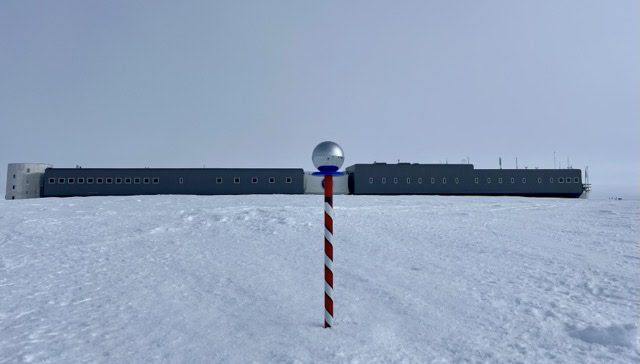
As we began the final leg of our journey, that beacon never diminished, but slowly grew as we covered the final miles south, and we could plainly see after an hour or so that what we’d been looking at was the massive aluminum dish of the South Pole Telescope. As we motored on, the rest of the station began to rise from the ground, like toast from a toaster, but in extreme slow motion—in what is perhaps the world’s most awkward and ill-suited metaphor. The station itself is a long, dark gray rectangle, but is surrounded by several large, high-tech projects that exist almost like satellite camps. As we drew closer, we could begin to make out the clusters of jamesways and quonset huts where much of the local population works, and some of the itinerant population sleeps (and where SPOT would be offered accommodation, should we choose not remain in camp). As we stopped to chip our tractors and gather for one last meeting before our long-awaited arrival, we could see the row of storage berms—only the barest fraction of which were unburied by the endless drifts of snow. This scientific sprawl goes on for miles, and reminds you as you approach over the plateau what a gargantuan and bizarre undertaking the whole thing really is.
After working out our approach onto the station grounds, we returned to our tractors. As I split off from the group to head over to 308, I was startled by the huge, rolling BOOM that broke the stillness of the air like thunder. This was a firnquake, a phenomenon I’d heard about but never experienced wherein layers of compressed snow that have yet to be crushed into ice, or firn, collapse beneath the surface. There is no evidence from the top but the sound, but that much is sharp and distinct. I looked wildly around, but nobody was close enough to me to have heard it. As I climbed up my tractor’s steps, it happened again—CRAAAACK-BOOOOOOOOOM, the sound reverberating through the layers of snow and air and swallowing the solitary world around me as stood there, dumbfounded.
The trail to Pole crosses over the skiway about 3 miles from the station itself, which in an unofficial sense marks the outer boundary of the station grounds. It’s certainly the first time we had encountered anything along the route besides the flags left by previous traverses to mark the trail—though the only thing that really distinguishes the groomed skiway from the surrounding ice sheet is just more flags. Still, the flags marking our way around the far side had been accidentally placed 100’ or so farther from the compacted edge than they were supposed to be, and after the camp and cargo loads had breezed across, the fuel loads became trapped in the untamed snow, one after the other.
While the tractors which had pulled their bladder sets single-file into the tiger trap at the end of skiway reorganized to bring them up in tandem to the staging area just outside the main collection of jamesways and cargo lines known informally as Summer Camp, the SPOT camp and cargo load were brought up to their own parking areas. The arrival of SPOT 1 is a big to-do at Pole: aside from the occasional airplane, pretty much no one visits the station, and the sudden appearance of a convoy of tractors from McMurdo brings the locals out the way the arrival of a traveling show might have in any of the boom towns of the Old West. A cluttered mass of big reds crowded the balcony overhanging the station’s main entrance as people gathered to watch us roll slowly in, while others bundled tightly against the uncharacteristically mild cold drove out in vans and on snowmobiles to photograph our arrival. It felt almost as if we were celebrities—albeit greasy-haired dirtbag ones, who hadn’t taken a shower longer than 90 seconds in over a month—met by paparazzi and (admittedly tiny) throngs of adoring fans straining to catch a glimpse as we drove by. I dropped the cargo load next to the lines of cargo built for flight on one of the sporadic LC-130 skier planes, and drove up to help the tandem pair pulling camp who had gotten stuck bringing the train around the pad immediately in front of the station.
When we had camp arranged in place, just a snowball’s throw from the ceremonial pole, set in view from the station’s public spaces and half-encircled by the flags of the signatory nations to the Antarctic Treaty, I was sent to bring back the last fuel load, left three miles back on the other side of the skiway. The Polie Fleet Ops Supervisor flagged me down from his Sno-Cat I as ripped back out town at a screaming 12mph, explaining as we met on the steps of my tractor that he had seen the tangled morass of sunken Challengers at the end of his skiway and had hastily reflagged the proper route. “Follow the fresh tracks when you come back with your fuel load. If you go the way the others went, you’re going to get stuck just like them.” But when I got to the crossing, all I saw was a giant fucking mess of rutted and ruined snow. There wasn’t anything for it but to continue on to the last, abandoned bladder set, hook up to it, and try to find my own way back across. This would be the first time I had ever, in all the miles we’d come, pulled a fuel load on my own. I knew these weighted sheets of slick plastic behaved differently than the ordered, well-mannered cargo load on its twelve massive skis, but I kept forgetting how much larger they were. Every time checked my mirrors, it seemed, I was about to take out another flag with the oversized load—most of them thankfully getting only barely nicked as I pulled the load away from the flagline at the last second, the bamboo poles popping back into place as if they were loaded on springs. I picked my lane in the mass of ruts crossing the skiway, and plowed across to the other side, barely loosing any speed at all. I came up the trail alongside the skiway, dropped the load in line behind the others, and drove up to camp, as a handful of stragglers took pictures of my unburdened tractor.
The rest of the team was waiting for me in the kitchen mod. The SPOT 1 supervisor wanted to go over a few of the station’s rules, reminding us that we had returned to a kind of civilization—a small hamlet that might be in the absolute middle of nowhere, but which was well connected with all the big bosses back in the States. But he had something a bit more personal on his mind, as well. “Each and every one of you has accomplished something truly spectacular,” he said. “More people have been to space than have done what you have just done. We had a very challenging go of it, but every one of you jumped in to make sure we made it here. And now the hard part’s done—the road we’ve compacted on the way here will carry us back, along with everyone else who comes after us this year.” We were done driving, for the day, for the entire trip to Pole, so he offered up a congratulatory toast and passed around a bottle of boutique Irish whisky. It had taken us all of 33 days to make it this far—just one day of shy of the record for all-time longest traverse to Pole, set just the previous year. It had been a hard-fought slog across the Polar Plateau, and in that moment, every one of us—even those who had been in this exact spot before, listening to a similar speech after making the same journey—was overwhelmed with the scale of what we had just done together. We were giddy, high with the accomplishment of a goal that had been to far distant to truly conceive at the outset, and with the feeling of having done it alongside one another. We filed out of camp and into the blinding sunlight of the polar summer, like children leaving school on the last day before summer vacation, and headed toward the entrance to the station.