The following is the personal account of a single, long-winded individual’s experiences living and working in Antarctica. No part of it has been reviewed or in any way endorsed by the United States Antarctic Program or the National Science Foundation, or any other public or private organization, institution, contractor, or company associated therewith. The views expressed herein are the author’s alone, for good or for ill.
Day 21: 25 November, 14 miles today, 207 miles remaining to Pole, elevation 8,451 feet, Sastrugi National Park
It was late when the SPOT 1 supervisor and I had finally replaced the exploded paulstra pad on the kitchen mod, and I was cold. All I wanted to do was climb under my blanket and sleep, but first I had to sit on my bed a thaw with my hand the wad of ice that had frozen my buff to my beard. Usually, I would crumple into my bunk and fall asleep immediately, toasty and comfortable under my single thin comforter, but this night I couldn’t get warm. Even after I could once again feel my feet, I still lay in my dark, polyester cave, wide awake and miserable. My roommate and I usually kept the small wall-mounted heater turned low, but after a couple of hours I was ready to resort to unthinkable measures: I cranked the heat on the small unit, which kicked on right away. Two minutes later, I was asleep.
My alarm went off only a few breaths later, or so it seemed from the dim fog of exhaustion. The pace and the cold were starting to wear on everyone—and everything. The tractors, built to work the fields during the growing season of a more temperate land than this, weren’t doing any better than the people. They protested the bitter temperature loudly each morning, and several needed a good bit of time and attention to fire up at all. Half of them leaked, their rubber seals shrunk from the cold, and yet another tractor’s cab had lost a blower motor from constant overwork. But the gemstone blue skies in the morning still held the promise of adventure and rare, isolated beauty, streaked with high, striated clouds. We could see mountains in the distance behind us to the north. They’d been there all along, of course, but had been obscured by blowing snow for days.
There is a kind of tunnel vision to life on trail—this is just as true on SPOT as it is thru-hiking. It’s hard to see much of anything but the path ahead of you. Though life outside of this journey becomes no less important, the edges are blurry and the center is faded and insubstantial. It’s like trying to grasp ahold of something in a dream. It’s hard to plan for the future, hard to keep up with the news back home. You feel the tenuousness of the threads tying you to what you still consider your real life, look at your patchy and sporadic communication with the people you love, and question your worth as a partner, a family member, a friend. This single-minded focus on moving ever forward puts you into a sort of survival mode, and it is understood among every person in the wilderness with you that everyone has to do whatever they can to keep it together—insofar as they’re able—physically, mentally, emotionally. This is how I justified to myself eating a plateful of cookies for lunch. Whatever it takes to get through, you have to adapt to the environment. If you refuse, you’ll only end up nearly giving yourself contact frostbite when you grimace through the pain and manipulate a metal buckle with your bare hands at -30°. The fierce burning in your fingers over the next hour will remind you: cookies for lunch is always the better path.
We were barely an hour into the afternoon’s drive when the call came over the radio: one of the fuel loads had lost a ski. Each of the fuel loads comprises eight 3,000gal bladders secured atop 4 70’ lengths of slick plastic. Each of these is shackled to a triangular steel frame called a CRREL tool, which is pinned on one point to the tractor towing it and rides atop one ski at each of the others. The rough terrain of Sastrugi National Park was hard on everything—people, machines, buildings, cargo—and the paulstra pad holding the CRREL tool onto its left ski had ripped apart. The young first-year mechanic driving this load had seen the ski give way, and had the presence of mind to stop before the bladders could run it over and possibly rip open, but it would still need to be repaired for the caravan could go any farther. I was in the nearest crane CAT, so I was dispatched to lift the CRREL tool so the remnants of the old pad could be removed and the ski reattached with a new one. But the crane was at first unresponsive, which was surprising as it had worked smoothly just a week or so before. That had been on the ice shelf, however, and nothing on the plateau is ever a given. It took two mechanics to figure out to run the hydraulic oil through the crane’s cylinders, and when they explained to the foreman what they’d had to do, the look of dumbfounded amazement that came over his face was not reassuring. “That shouldn’t be possible,” he said. Even with some function perhaps impossibly restored to the crane, it still didn’t behave the way it was supposed to—and I had to find the right, counterintuitive combination of controls to get it to do what I needed. But in the end it worked well enough to get the job done, and 90 minutes later we were back on our way south, leaving the mystery of the crane for another day.
Our progress through SNP was, thus far, painfully slow. Even without losing a ski, we were stymied again and again as one tractor then another got stuck in a mire of sugary powder, or else spun out on the polished ice on the surface. On the shelf, we had been on track to match, or even beat, the 22-day traverse record to pole; now, if things didn’t improved, it looked as if we could conceivably tie for the longest. The supervisor was ready to try anything that might help us get clear of this mess, and late in the afternoon hit on the idea of pulling the tandem team towing the camp mods and staging them at particularly difficult sections as ready and waiting tow trucks. When the rest of the crew was through, they could zip back to camp and easily pull it up to the back of the convoy. It was a novel idea, and seemed to help, but nothing was going to end our struggle with the sastrugi but finally getting through to the other side, and we had barely started our way across this minefield of ridges and drops.
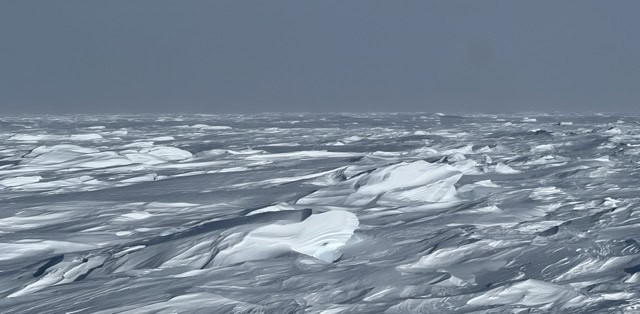
Day 22: 26 November, 12 miles today, 195 miles remaining to Pole, elevation 8,693 feet, Sastrugi National Park
When I stepped outside the living mod, I was hit with a blinding white out. The sun was out, though dulled by the wall of snow blowing thirty feet high, and when you looked straight up you could see the cloudless blue sky above. Each small crystal caught the fierce, unfiltered sunlight, and walking to the kitchen was like walking through a hall of mirrors lit with 500w bulbs. The tractors were steadfast in their refusal to adapt to the endless cold of the polar plateau, and several could not be started at all—308 among them, whose coolant heater had failed once more, causing the troubled seal to shrink and leak enough pink glycol onto the snow that none showed in the vehicle’s sightglass. The mechanics set to work, while the rest of us, lacking any skill that would prove helpful in the moment, finished breakfast.
The new plan for day assigned me as one of the designated tow truck drivers. Previously, the person behind the stuck tractor had been responsible for pulling them free, but since the cargo load was attached by a simple cable bridle—a soft hitch—it was much faster for me to free myself than anyone towing fuel. The work began immediately, as soon as all the tractors were running and hooked up to their loads. Several couldn’t break free on their own power, so I was dispatched to pull them as far up the column as I could. Once the convoy got underway, the Challengers in the lead got into trouble before those in the back had even gotten rolling, so I had to leave my cargo behind and shepherd them through the loose snow. After I was finally able to start pulling my own load, I made it only about a half mile before I had to break off and start towing the blade CATs up front again. At this point, my train of cargo sleds was blocking the last few tractors, even though I’d left it as far to the side of the trail as I could. When I was back on it, I tried to tow it off the trail to make room for the rest of the convoy to pass, and got stuck myself. At the same time, two of the tractors in the lead reported that they were bogged down once again. We were almost at our 1000hr load check, and we hadn’t made it a mile.
Another, newer plan was devised, though I missed most of it while working to tow one of the stragglers around the stuck cargo load. What was eventually relayed to me was that a small party, including me, would refuel the generator early, after which half the loads would be parked where we were and the rest would be tandem pulled south until lunch. For reasons still obscure to me, I was left to run the fuel pump—a job I hadn’t yet learned to do. The pumps used on traverse are powered by a tractor’s hydraulic system, plugged into a box at the vehicle’s back and controlled by a small paddle about the size of a wheat thin. Though the speed is adjustable, the pump is set to put out about a gallon per second, so if the person running it misses the signal to cut, the result is what is known in the field as a diesel volcano. This was a disaster I was anxious to avoid, so I might have run the pump a little slower than was standard, but the process turned out to be pretty simple.
With the gen fueled, we doubled up on five of the fuel loads and set out. Pulling in tandem isn’t terribly difficult, but requires a constant stream of communication to coordinate engine speed and gear changes on one dedicated radio channel, all while coordinating movements with other teams on another. It’s nobody’s favorite way to drive, but it felt good to be making some sort of progress at last. For once, we weren’t stopping for half the caravan to be pulled out of the soup, though it did mean we would have to three times the distance—once with the first set of loads, once back to where we’d left the other half, and then once more with the rest. but we found a groove, and even when my door froze shut I was able to work it free after only a few minutes’ effort to break it free. My bunkmate was driving the lead tractor. It was also his birthday, and anytime anyone remembered that fact, they found an excuse to hail him on the radio: “Birthday boy, birthday boy, copy?” A long pause. “Go ahead.” “Hope you’re having a good one up there.”
When we stopped (a few minutes early) for fuel circle, the storm that had been forecast to hit us days before finally rolled in. The wind had been gathering strength for an hour, and by the time I bundled up to leave the cramped sanctuary of my cab it was blowing with enough force to knock a grown man sideways. My USAP-issued goggled had proven to be all but useless, fogging up and then freezing immediately when tested by any but the mildest weather—so I was reduced to pulling my hat down and buff up until I was staring at the wind-scoured world through a small slit between the two, like a knight riding into battle in a helmet made of wool. The snow was small and sharp, and turning toward the wind was like getting a facefull of sand. Even if the day’s fuel circle had gone according to plan, it would have been a rough one.
There are a handful of tools use to chip the ice from the tractors at the end of the day, and ultimately it’s up to the operator which they prefer. Some like the weight of a shovel, some use a flat spade or a weighted chipper bar—but the most common tool, and my own implement of choice, is the humble ice axe. Part pick, part shovel, part axe, part spike, it gives the user a wealth of options when it comes to clearing the day’s accumulation from the underside of a Challenger. But it comes with its own set of drawbacks: it’s light, so it is often helpless against the more robust blocks of ice that can grow on the inside of a vehicle’s tracks, and it can be a bit awkwardly shaped for some of the tighter, harder to reach spaces between the wheels. It can also, it turns out, pierce through a full fuel bladder when the person holding it slips and falls in the midst of an Antarctic windstorm.
Accidents happen, of course, and this was far from the first bladder on SPOT to suffer a puncture. There is something of a protocol, in fact, though most of us present had never seen it put into action before. The first step was to stop fueling the tractors, and then transfer as much diesel as necessary to a nearby, nearly-empty (and intact) bladder. Once the pressure was low enough on the wounded piece, and fuel would no longer be forced out of the holes, we resumed fueling to continue draining the thing as much as possible while wasting as little time as we could in the elements. As the bladder emptied, we folded and rolled it up, which would have proved a challenge on a fair day. As it was, it was kind of a mess—at one point, while kneeling on the extremely slick HMW plastic, trying to lift one corner of this heavy rubber water balloon, I found myself blown from one end of the sheet to the other by the wind. Only on the other side was I able to find just a bit of traction in the snow accumulated against the bladder on the other side.
It was not an experience any of us would have chosen to have, but I think these were the people each of us would have had it with. Everybody stayed calm, everybody pitched in, everybody did what they could to keep everyone else’s spirits up. It was a hard job, complicated and rendered into compacted discomfort by the weather, but as the ruined bladder was strapped into place and the last hose was decoupled and stowed for the night, we felt the quiet fellowship that comes from sharing misery in pursuit of a common goal. The weather, already thoroughly shitty, took a sharp dive as we packed up fuel circle and made our way over to camp. The mountaineer, acting as the night’s cook, had been in the kitchen this whole time, and fussed over every one of us as we filed indoors and fought our way out of our iced-locked parkas, mittens, and buffs. “How are your fingers? Your nose? Your cheeks? Are you warm enough? Are you feeling okay?”
He was only doing his job, and while he could make a good case that a single frost-nipped nose was one too many, it was nonetheless impressive that that many of us had worked in those conditions for that long and suffered nothing more than that. We tucked into dinner, eating the ravenous gluttony of the frozen and tired, putting away great platefuls of lasagna and shepherd’s pie before realizing that my bunk mate had slipped outside to shovel a clearing for the living mid stairs. He came into the kitchen to find the hot food gone—on his birthday—but with half the packed kitchen scrambling over each other to make him a steaming buffet of leftovers. He sat at the head of the table, the ice melting from his eyebrows as one person then another placed a freshly heated dish before him. I never did ask, but I could guess that maybe if this wasn’t exactly the birthday dinner he would have chosen, but hopefully these were the people he’d have chosen to have it with.
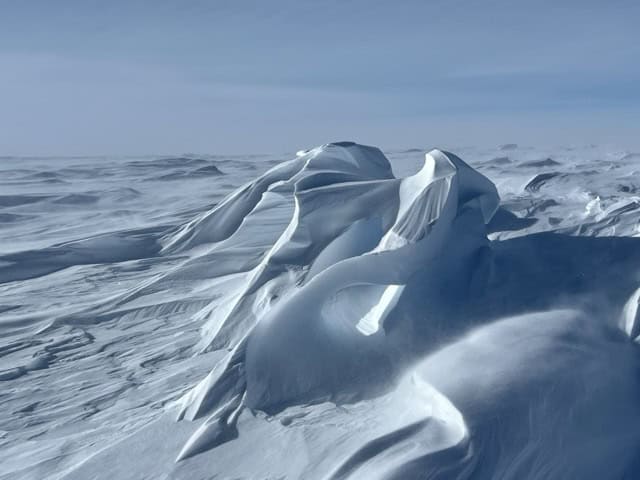
Day 23: 27 November, 7 miles today, 188 miles remaining to Pole, elevation 8929 feet, Sastrugi National Park
McMurdo divides its weather into three categories: conditions 1, 2, and 3. This rubric is utterly unhelpful in determining how nice a day it is before you head outside, since con 3, which broadly speaking means good weather, can still be miserably windy and cold. A -40° day, with low winds and good visibility, is still a con 3. The weather conditions are used, rather, to set parameters for safe travel. Con 3 allows unlimited movement around the area, con 2 prohibits outdoor recreation and requires a radio check-out with central dispatch for all work-related travel, and con 1—which is defined as a windchill below -100°F, or sustained winds in excess of 55 knots, or visibility below 100 feet—requires that everyone remain in whatever building they were in when the condition was declared.
I’ve seen what con 1 weather in McMurdo looks like—anyone who has ever overwintered has, even in a mild year. SPOT does not use system. Sheltering in place is a luxury. When the shelter in question requires a multi-person, multi-tractor dance to fuel so it can continue to provide heat, and has to be moved even in the worst weather to keep it from being buried in damaging drifts, hunkering down simply isn’t an option. Work and life continue on traverse even in the nastiest weather, because they have to. Work just happens a lot more slowly and carefully, and life is just a great deal more unpleasant.
When I stepped out of the living mod in the morning with a full pee jug in my hand, it was instantly clear that we were in the middle of a con 1 storm. The living mod sits in the middle of the camp train, which is maybe about 200’ long on the outside, and both ends of camp were gone, swallowed in a sideways waterfall of constant blowing snow. The u-barrel I needed to pour my jug into was riding on sheets of plastic at the very back of the train, so I began to pick my way cautiously over the drifts. I was once again trying to use my issued goggled, but they were opaque with fog and ice in seconds. I kept stumbling, slowly, over drifts I couldn’t see, some already three feet high. The friction of millions of dry ice particles pelting everything outdoors at high speed charged anything the least bit conductive with a considerable charge of static electricity,* and each time I touched a tractor or a building or a handrail for balance or to help feel my way around a drift, I was given a painful shock through my liner gloves and insulated mittens. As I made my way around one tractor with an impassable drift at its front counterweight, I was shocked no fewer than a dozen times.
Later in the morning, as I was giving 308 its daily inspection, my heart sank when I saw the oil level had plummeted to the fill line on the dipstick. Filling the engine oil, though not the worst chore by any means, is still time consuming and a bit of an annoyance, even when the weather is fine. In these conditions it would be a time suck and a pain in the ass. I slowly, carefully made my way over to the generator room, where the gallon jugs of oil were stored to keep them warm enough to be pourable. The ramp had been left up to prevent it from getting buried, so I had to climb up to the platform above the skis to get inside. I returned to the tractor in much the same slow, awkward fashion with the oil and a funnel, but found that the rubber plug sealing the fill tube had frozen solid and wouldn’t come out. I had to go back to the gen mod to retrieve a heat gun—a thing sort of like a portable hair dryer, but, like, manlier—and walked back through the storm to blast the stopper with heat until it was pliant enough to remove. With the plug out, I was ready to pour the oil, but realized the gallon I’d brought with me had been sitting outside for too long and would be too viscous to pour, so I brought it back to the gen mod, along with the heat gun, so I could exchange it for a warm jug. Once I finally had warm oil, an open fill tube, and a funnel in place, I could, at last, start the long, tedious process of emptying the bottle. The oil flowed easily into the top of the funnel, but started to cool and slow once inside. After the jug was finally empty, I pulled the funnel, wrapping it up in a rag to catch any of the excess that would start to run out once the residual oil had thawed, and tried to put the plug back in, only to discover that it had frozen solid once more. Again, I stumbled my way across the drifts to fetch the heat gun. The stopper took longer to thaw than it had the first time around, but after several minutes I was able to squeeze in place and screw it tight. Finally, finally, I could start the multi-step process of firing the engine and setting it to warm up. By this the time I made my way over to the kitchen mod, I was ten minutes late to the morning meeting—in the middle of a con 1 storm—and as I climbed the stairs, the door opened, and the SPOT 1 supervisor stepped out in his full Antarctic kit, coming to look for me.
The rest of day proceeded with the same agonizing torpor, even as the storm broke and weather improved from god awful to shitty. Several of the other tractors hadn’t started at all, and all the mechanics were working feverishly to bring them up, while the rest of us set about pulling all the loads in tandem from the drifts and move them a half mile up trail. It was well into the afternoon before we were ready to start moving the caravan south, but as soon as we tried, tractor after tractor got stuck in the soft powder and broken icy crust. A third of the Challenger fleet—308 among them—were cut loose from their loads to serve as tow trucks, but even that many couldn’t keep up with the demand. By 1500hrs, we effectively hadn’t gone anywhere. Determined to make as much with the few hours left of the day as he could, the supervisor ordered the crew to reunite the tandem pairs we’d used the previous day, and to start pulling the loads forward one half at a time. It was painful, having to cover the same ground three times just move the entire convoy forward once, but at least we were moving, at last. We probably weren’t even halfway through SNP—a truly disheartening thought—but if nothing else, we were at last making some sort of progress.
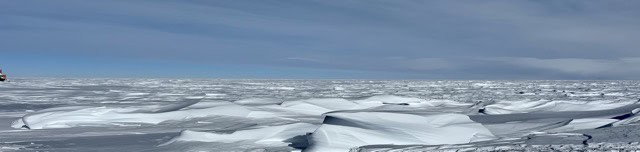
*this is exactly how lighting works, after all
Day 24: Thanksgiving, 16 miles today, 172 miles remaining to Pole, elevation 9,095 feet, Sastrugi National Park
Everything had become an ordeal. Every morning, several tractors failed to start, leading the bleary-eyed mechanics to swarm over them like ants on a fallen lollipop as those of us with more functional machines sat in the cab, trying to coax their frost-choked engines to turn over without dying after a few violet sputters. Only once the cylinders were all firing in something approximating a steady rhythm could we start the drawn-out process of slowly, gingerly running cold hydraulic fluid through the engine block to warm it up. Then we could unplug the battery and glycol warmers and fight to wrap the stiff, rock-solid cords so we could hang them up for the day. This was life on the plateau, and just as it does anywhere else on Earth, eventually the ordeal began to become routine.
We started the day in tandem, towing half the loads to a predetermined spot where we’d fuel the gen and have lunch, driving back to other half at a break-neck 10mph,* and then driving those up to meet their friends. We did a load check when we came back with the second round, looking up occasionally to watch the blade CATs roll sedately back and forth in front of the camp train, smoothing a pad for it from the rough carved snow in a slow-motion ballet. We had to break through this rut, this exhausting grind of low-mileage days, but nothing we tried seemed to get us very far. At least the blowing snow had subsided a bit, allowing us to see approaching hazards before we found them with our tracks—though we were still penned-in on all sides by a dim white haze that hid the horizon from view.
In the afternoon, we returned to pulling one load with one tractor—except for the camp train, which would be pulled in tandem all the way to Pole—and I was again assigned tow truck duty. I had kind of hated that job the last time I’d done it, but I soon realized it was more the fact that it had required me to leave the thin comfort my cab to hitch and unhitch from my load in a nasty storm over and over again. The weather, though still cold, was much finer than it had been in days, and once I’d abandoned the cargo I was kept far too busy to go back to it. No sooner had I popped one Challenger free of one sugary mess than I had to whip around and pull out another. You have to drive with care on the trail, lest you rough up the fuel loads too much on the uneven ground or tear the path into a morass of powder with your tracks. But if you’re driving off the trail, untethered from any load and unworried about creating a tiger trap for someone behind you to fall into, all bets are off. I raced from one stuck tractor to the next, carving sharp ruts in the hard packed snow as I dodged the sharpest sastrugi and flew over the rest. At one point, I got a call that the tandem team pulling camp at the back of the caravan had momentarily split to bring my load up for me so I could keep helping out the rest, zooming across the eerily carved landscape with a sort of measured abandon.
In the end, though, I did have to go back several miles to bring the cargo load up to the place where we’d be camping for the night. I raced back at a bone-thundering 13mph, the jostling in the cab so intense that I struggled to downshift as I came up to the camp-towing team. They had broken their train apart in an attempt to reconfigure our two loads into something that could be towed by two entirely independent tractors—which would have left me free to act as tow truck full-time. It was a worthwhile idea. If it had worked, it would have significantly increased the number of miles we were able to do in a day, even the worst terrain, but each combination of components they tried resulted in at least one load too heavy for one tractor to pull. The mechanic foreman, who was one of the camp towers and whose idea this had been, was frustrated. He’d tried to make the convoy faster, and his attempt had instead cost us a few miles that day. It seemed a gamble worth taking, to me, a good idea whose real-life value couldn’t be known until it was tested, but he was disheartened, and was uncharacteristically glum the rest of the day. We rigged our loads back as they had been that morning, and headed south to join the rest of the crew.
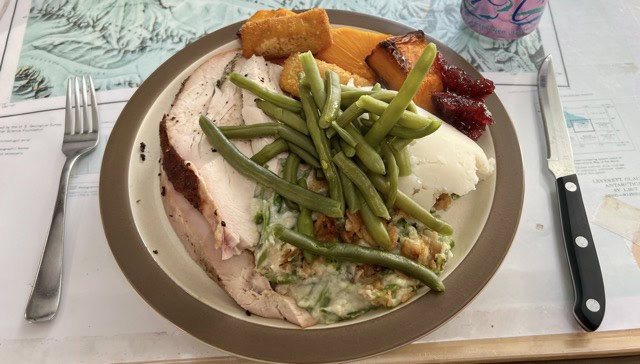
We arrived at the campsite halfway through fuel circle, where we jumped into place, fueling and chipping our tractors quickly in the golden afternoon light. For the first time since we’d climbed onto the plateau, it seemed, it wasn’t horrendously windy, I was horrendously tired, and there were no horrendous repairs that needed urgently to be done. I treated myself to the first hot shower I’d taken since we’d left the Leverett, luxuriating in the steaming water and sipping from one of the few cold cans of la croix I’d brought from McMurdo. Clean, dry (and with the snow melter freshly refilled), I sat down to dinner with the others. A large turkey, which had been brining in a pot in the shower since Monday,** had spend the day riding in the smoker strapped to the kitchen mod’s deck. The evening’s cook had pulled out all the stops, serving pumpkin, mashed potatoes, croquettes, green bean casserole, and two kinds of pie. He even set out packs of soda he’d been storing under his bunk. We sat together at our narrow table, stuffing our faces and laughing together. It was a true feast, a bastion of camaraderie and warmth in a monumental wilderness otherwise defined by its loneliness and cold.
*Practically literal, considering the terrain
**The supervisor, asking us to move it elsewhere in the kitchen mod while cleaning ourselves, had said simply one morning, “Please don’t shower with the turkey.”
Day 25: 29 November, 24 miles today, 148 miles remaining to Pole, elevation 9448 feet, Sastrugi National Park
When you spend an hour of every day fueling tractors, coupling hoses, uncoupling hoses, draining hoses, filling and emptying jerry cans, it’s no surprise that your work clothes come to reek of diesel—your mittens, especially. What you don’t think about are the myriad small adjustments you make with those mittens to your hat and buff while working in the elements to keep the wind off your skin. At least until you put these items back on over your head/onto your face while groggily getting dressed in the morning, and you are shocked into full consciousness by the smell. The obsession for most of the day is a mix of miles and time, but ultimately those numbers work in the service of fuel. The South Pole (overland) Traverse—and thus your life while you’re on it—is all about diesel, a fact of which you are savagely reminded every time you slide your infused wool garments over your nose.
We had gone back to single tractors towing every load but the camp train, the soft hitches* unhooking from their loads to tow hapless others as needed, and we were finally making progress. When the last continuously struggling vehicle was swapped off its fuel load, replaced with one of the heaviest Challengers in the SPOT 1 fleet, we really only needed to do any towing through small, occasional soft patches, and were able to spend most of the day actually driving. It was an odd feeling, rolling over the jagged terrain for a whole hour without pause, the constant chatter on the radio suddenly quieted. This unreality was only heightened by the massive halo circling the sun, a completely circular rainbow that hung in the sky all day as we motored south, awesome and immense. Adding to my sense of vague displacement was another rough night of sleep, which gave the edges of my perception the dark corona of a dream. Perhaps I was still acclimating to the elevation, a process that can take weeks before your body returns to a sort of baseline. In any case, as I waited in my warm cab after finishing my 1530hr load check, I kept dozing off, waking abruptly when somebody ahead in the caravan jumped on the radio to discuss a problem they were having with their fuel load.
The tail net holding one of their bladders in place had ripped apart and gotten dragged under the bladder itself, which was now working its way off of the aft end of the sheet of plastic on which it was riding. How exactly this had happened wasn’t clear—though since we had taken fuel from that bladder for the tractors, the straps holding the net in place might not have been as tight as they were when it was full. What was clear, at least after a few people struggled for several minutes to pull the damaged net out, was that bladder would need to be emptied before it could reset on the plastic and properly rigged for travel. The supervisor called an early fuel circle to drain as much as we could directly into the tractors, but we still had to rig the wayward bladder to another to get rid of the last 400 gallons.
Squeezing every last drop from a 3,000gal sealed rubber tube is a process, one that needs at least four people to do properly. This is what we would do once we got to Pole, and started actually delivering our payload into the station’s storage tanks, but this was a preview of the job ahead. Two people use push brooms to sort of squeegee the diesel toward the coupling on the bladder’s ass end, while two others hold up the corners on either side it, so all the liquid is directed toward the hose. Once the bladder is drained, it’s reset on the plastic, the netting is put back in place (or completely replaced, in this case), and the straps are tied back on their rings and loosened. Once the bladder is ready, a leaf blower with a fuel coupling screwed onto its face is attached to it and the thing is filled with air, giving the bladder enough of a shape to strap and net onto the plastic. It’s a strange, highly specific procedure, worked out over the last 20 years—a reminder to everyone new to SPOT how unique and absolutely bizarre this job really is. The last bladder we’d had to drain was damaged, destined for the trash once we’d returned to McMurdo—but this one was still in good shape, so we blew it up and tied it down, and then continued on our way down the trail. We still had a ways to go before we would be clear of Sastrugi National Park, but the end was in sight. In another day or so, we would crest the long, gradual climb across the ablation zone and pass into an accumulation zone—a stretch of notoriously soft and treacherous snow known as The Swamp, the last great obstacle on our path to Pole.

*A hard hitch is a steel frame with a hole large enough for a towing pin; a soft hitch is either a bridle made of steel cable or thick tow rope. Hard hitches have to be backed onto with the tractor precisely, while soft hitches are easily brought to the back of the vehicle and set in place—hence the preference for tractors pulling with soft hitches for use as tow trucks. It’s just faster for them to get on and off their loads.