The following is the personal account of a single, long-winded individual’s experiences living and working in Antarctica. No part of it has been reviewed or in any way endorsed by the United States Antarctic Program or the National Science Foundation, or any other public or private organization, institution, contractor, or company associated therewith. The views expressed herein are the author’s alone, for good or for ill.
Day 11: 15 November, 53 miles today, 474 miles remaining to Pole, elevation at sea level, Ross Ice Shelf
We had been driving in a straight line for a week and a half, ever since we had made the last turn out of the Shear Zone 500 miles back. It sounds boring. Maybe it is, but there is also a refreshing simplicity to crossing the broad, uncrevassed middle of the Ross Ice Shelf. Anywhere close to a coastline is a potential hazard, but otherwise point your tractor in the direction you want to and drop it in gear. This would be a landmark day, in part because we would pass the halfway point on our road to the South Pole—but mostly because the louie we’d hang beforehand would conclude the longest, straightest, easiest stretch of the entire trail.
Making a turn with an entire traverse is something of an art. The tractors with their loads in tow can’t drive straight from one waypoint to another, but have to change course so gradually it might as much as a mile to complete the turn. These wide arcs aren’t marked, only the point where the two lines converge is flagged, which leaves the caravan to sort of guess where the more solid trail actually is, lest any of the tractors get bogged down in snow that hasn’t been track-packed over the course of the last twenty summers. Everyone slows down from the screaming speed of 7mph and approaches the curves at a crawl. Turning is a delicate business.
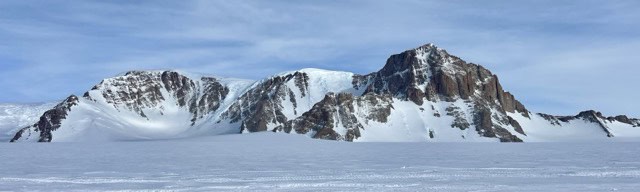
We had a clear cobalt sky all day, with a fiery overeager sun to match. The mountains continued to parade along the mainland coast, and I took great joy in watching as new features appeared the farther along we crept, even as the sun cooked me alive in my little greenhouse. I’d borrowed the sat phone from the kitchen that morning, and after a few confused tangles and dropped phone calls, figured out how to rig the antenna to the roof of the cab. I chatted merrily with family back home, shouting over the roar of the engine as I watched sharp ridges give way to massively, flowing glacier fields pockmarked here and there with mountain peak islands.
As we neared Camp 20, a waypoint named for the number of days the proof-of-concept traverse had spent at that site trying to find a safe route south, the tractor ahead of me took a sudden, violent turn to the left. One of its tracks had broken through to a soft patch of snow, and as the operator struggled to ride it out, he found himself pulled inexorably off the trail and into more soft, unsupportive powder. I slowed to a crawl, keeping an eye on him and getting ready to stop so I could help pull him out and back onto the hardened trail, but he managed to save himself all on his own. I would surely have foundered, or panicked and done some idiotic thing to make the situation worse, but he calmly drove himself out and went on his way. I could only hope to handle myself half as well when my turn eventually came.
Day 12: 16 November, 60 miles today, 414 miles remaining to Pole, elevation 313 feet, Ross Ice Shelf
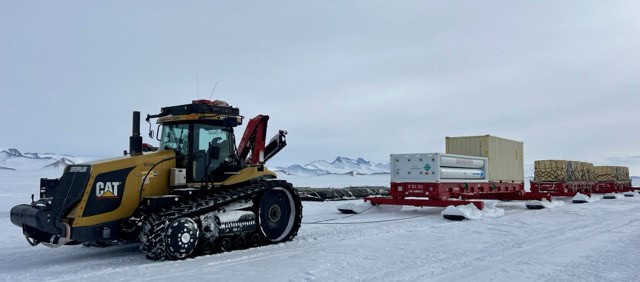
We were making incredible progress. The first 700 or so miles of the drive to the south pole are the easy part, so it was still quite possible for us to get bogged down along the way—but the record for fastest ever traverse from McMurdo to pole was 22 days, and we were already 60% of the way there on day 12. It was mostly luck, of course. The majority of us were brand-new to motoring across Antarctica and had little idea what we were doing at the best of times. We’d had some warm days, but so far the surface snow had held. There had been no need to battle our way through a mire of tractor-snatching mush, at least not yet, though we were all but promised difficult days ahead, as the high-intensity sun baked the land even as the air stayed crisp and cold.
As our route veered toward the east, we entered the first heavily-crevasses area we’d had to contend with since leaving the Shear Zone. This region is known as The Asters, named for the waypoints that mark the trail, which are turned named after the radar satellite that was used to map the crevasse fields and find a safe path across. For the most past, this section of trail looks much like any other—though the mountains and massive flowing glaciers along the coast provide a stunning, arabesque backdrop out of your southern-facing window—but one section in particular is passed with particular care. Known as The Shoals, this 10-mile stretch is the home of some of the most treacherous crevassing on the entire trail, as islands hidden beneath the ice push it up and apart as if flows above them.
The route through this mess, though it took a staggering amount of resources, effort, and time to find, is actually pretty stable. But the margin is thin, and once again we were required to keep our edge kits—the full complement of climbing/rescue gear we were issued at the start of the season—in the cab with us as we made our way across. If we needed to get out of the tractor for any reason we would need to be roped up, so pains were taken to avoid having any reason to do so. We took an early load check to make sure everything was secure before starting through, and traveled in a tighter formation as we passed. “The trail here is safe,” we were assured, “but stay on top your course and don’t wander off to the side. There are crevasses just 50’ off the flag line that will swallow your tractor whole.”
In many years, the blue ice of the shelf’s heart is exposed across the southern miles of the Asters. This sounds like an incredible sight, though it is apparently an absolute nightmare to drive across, something nobody who has done it recalls with any fondness. So it was with only the tiniest bit of disappointment that I noted that the winter’s heavy snows had buried that slick, polished marvel under a thick blanket of highly drivable snow. It was a day without major incident, the second-longest of the trail thus far even with the Shoals crossing. It was another day of cloudless, constant sun, and one where I finally lost the battle to keep the cab at a reasonable temperature. Stripped down to my long johns and t-shirt, with the door open to the elements and the fans in the cab spinning on high, I was still sweating onto the towel spread across the seat, which I had almost chosen not to bring. The wind outside was gentle, but still had enough edge to it that I needed to be fully dressed in my outdoor gear whenever I stepped out for load check, but the inside of that glass box was a sauna I couldn’t control. At some point in the late afternoon, I was talking with the mechanic foreman, who drove the first tractor at the front of the parade. We were trying to determine how far the caravan had stretched and whether we might need adjust speed to tightened it back up, when he became decided chatty. “Now that I have you on the radio, how are you doing?” he asked. I was nonplussed, not sure how to respond to this question broadcast across everyone’s radios, with the entire traverse listening in. I fell back on simple honesty.
“I’m hot as balls,” I replied, “How are you doing?”
Day 13: 17 November, 55 miles today, 359 miles remaining to Pole, elevation 1,226 feet, Leverett Glacier
It is forbidden to pee on Antarctica. This is why everyone without access to a flush toilet—or a close enough approximation—has to use a designated pee bottle. The preferred vessel on SPOT 1 was the gallon jug, as you could easily spend half the day in your tractor, a mile or more from the nearest place to empty your receptacle, and the standard USAP-issue liter nalgene would be of insufficient volume for your output if you were the least bit hydrated. And as we approached our climb up the Leverett Glacier to the polar plateau, we were all strongly encouraged to hydrate in the hope that it would ease our acclimatization to altitude. These jugs we emptied into a u-barrel* via an extra-wide, yellow funnel that was moved to the next barrel when the current one was full. These 55-gallon drums would be sealed and eventually shipped back to the US for eventual disposal, but first we had to tote them all the way to Pole and back. The day we finally left the Ross Ice Shelf, we learned that we had overfilled our most recent u-barrel.
It’s actually incredibly easy to do. Liquid holds heat surprisingly well, and a big-ass drum full of body-temperature pee takes quite a bit longer to freeze that you’d suppose. The problem, of course, is that if you a barrel to the tippy-top with a noxious liquid composed mostly of water, it will expand as it freezes, and start blurping out the bung on the top. Once started, this grim and terrible process cannot be stopped, let alone reversed. You have to wait for the whole nasty mess to freeze solid before you can do anything productive about. Being proactive where he could, however, the SPOT 1 supervisor assigned checking the current u-barrel’s fullness level as one of the rotating house mouse chores to be completed at the end of every work day.
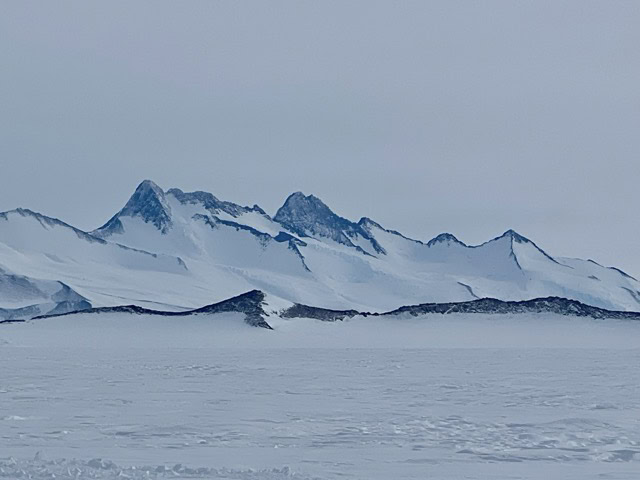
The morning came softly, with a low, fuzzy ceiling of clouds obscuring the sharp, pyramid points of the nearing mountains. Even decapitated, the Transantarctic Range was becoming ever more majestic the closer and more detailed it became. As I took a moment to admire the view at load check, I noticed that I could make out the blue ice of several of the glaciers, peaking out from the blanket of white covering the rest of them. The massive, dark rock faces had definition and character, streaked with shadows and veins of snow. After lunch, once I had rigged the antenna for the sat phone atop my tractor and (after a confounding bit of effort) managed to call Sean Meadow back in McMurdo, all I could talk about was the scenery. How was everyone getting along? Fine, but you should see these mountains. How was the food? Good, but I’ve never been this close to glaciers like this. Did I feel like I was getting a handle on the job? Sure, but the way the low light makes these peaks pop is just astounding. Still, it was good to hear all the news from the big city, to hear a voice that wasn’t coming from the radio or talking about ground speed or engine load. We hung up when we ran out things to talk about, but almost as soon as we did all hell began to break loose.
It started slowly. The Ross Ice Shelf is fed by glaciers as they flow off the mainland, in exactly the same way that rivers flow into the sea. Unlike its liquid cousins, however, the ice shelf rises along with the sea bed as it approaches the Amundsen Coast, coming down from the mountains in long, rolling hills. The first hill was subtle, and I wouldn’t have guessed we were on an incline but for the fact that my load suddenly felt heavy and sluggish in a way never had before, like I was dragging an anchor behind the sleds. At the same time, the snow became weaker, and by the time the tractors toward the back of the convoy came through the trail had been torn to powder by the those in the front. We stopped for an early load check at one of the last waypoints on the ice shelf, where one of the fuel loads was left behind as a cache. This was the fuel we would use to get ourselves back to McMurdo, so there was no need to burn any extra just taking this set of bladders to Pole and back—but it also freed up one of the tractors to act as a tow truck. Our easy, fast days of travel had ended; as I jumped from my steps onto the snow to check my load my boots sunk down to the shin. This transitional zone, this quasi-delta, offered all the traction and support of whipped potatoes.
The climbing intensified as soon we we resumed rolling, the hills becoming steep and sharp, but snow offering no better purchase than before. I was keeping up, but only just, and my anxiety that I might fall behind drove me to follow behind the tractor ahead of me closer than I might have otherwise. So when one of the Challengers up ahead got stuck, it sent a wave of sudden stops back through the rest of the caravan. Parked at the back, I knew that, if I could get my load moving at all, it was unlikely I would get very far. Indeed, as the empty tractor came to tow the mired tractor, several of the fuel loads were able to get around them and make their way up to the crest of the hill, but when I tried I made it only about a hundred feet before I, too, was sunk in place. The front of the column pushed on, and once they cleared the top of the hill we lost comms with them, and every transmission had to be relayed by somebody in the middle. Up ahead, more tractors were getting stuck on the next rise, as our designated tow truck drove madly between us. It was a kind of beautiful chaos.
In all, there were three major climbs as we made our way onto the base of the Leverett, and I got stuck on every one. Far from being frustrating, it was actually ridiculously fun—a challenge, a chance to experiment and play with the endless combination of gears and engine speeds available to me, and all in a landscape that looked like an oil painting come to life, the color so fresh it seemed it would smear if you touched it. The mayhem brought home just how strange and unlikely this thing we were doing actually way, how far beyond the norm our routine had become. Every time the tow truck came to aid, and we tied his tractor to mine with a rope as thick as man’s forearm, coordinating through a separate radio channel our gears, engine speed, and every movement (1400rpm, 2nd gear, 3, 2, 1, Go!), we met with big, goofy smiles on our faces. This was hard, ludicrous work, but we were having a blast.
When we eventually pulled into camp and looked around, we found that we had truly left the shelf and started our climb into the mountains. No longer garlands ornamenting the coastline, the peaks and valleys of the Tapley and Harold Byrd ranges surrounded us, enveloped us, swallowed us whole. Great, swooping ridgelines rising to spine-like spires and black looming shoulders frosted with giant curves of ice dominated the landscape, and those of us who had never before been to this place were giddy with wonder and overwhelmed by the majesty of the place. We had come to a paradise, an Eden in rock and snow. Whatever else lay ahead, this much was worth everything it had cost us to get here, and more.
*the u stands for urine
Day 14: 18 November, 22 miles today, 337 miles remaining to Pole, elevation 2,710 feet, Leverett Glacier
The morning came gloomy. Clouds had congealed across the southern sky and brushed their feet along the surface of the glacier, hiding Mt. Gould’s picturesque crown of spines as we ready our tractors for the day. Out toward the ice shelf, there was sun and the air was clear out toward the horizon. Where we were going, however, was not so promising. A wall of gray covered half the sky, and we were heading right into it.
The wind in our sails had died. If any one of us had quietly been nursing the hope that we might regain our old speed, it was dashed when the very first tractor in line—which pulled camp—had to be towed from the place where the modules had been parked. As I waited for my place at the end of the convoy, another tractor got stuck directly in front of me. When I tried to start rolling for the day, my tractor lurched forward for a few inches before burying itself into the rutted, granular snow. I had some time before the other tractor would be pulled to a stretch of trail where it might have some prayer of fending for itself for a while, so I busied myself rigging the long, green anaconda tow rope that had been added to my load for exactly this kind of situation. It was longer than the cable bridle I usually pinned to my tractor, which would allow me to hunt in front of the cargo for a better, more stable patch of snow. It also had some stretch to it, which would let me take a bit of a running start without the danger that would come from shock-loading the rigid cables. The tow truck driver appeared just as I was trying to connect it to the toolshed. I couldn’t fit it behind the sled’s hitch pin properly—it was too thick—so we kicked the looped end in sideways until we could slide the pin in place. It was ugly, but seemed like it would work. We coiled the cable bridle on the sled to keep it out of the way, and I tried a few tactics from the toolkit offered by the new rope, but none of them worked. I still needed to be pulled onto better snow.
The morning was, if anything, more chaotic the previous afternoon had been. There were four Challengers that were stuck over and over again, but only one tow truck to pull them out. Again and again, the faster tractors were sent to drop their fuel loads, pull one of us ahead to rejoin the caravan, drive back to find their load, and pull that up to the group, only to drop it again when somebody else got mired in place. Most of these were the three lightest tractors, which simply lost traction on the dry powder. I had the heaviest machine of the whole parade, with massive counterweights installed on every side—but I also had the load most resistant to these conditions. I would fare well on each of our small climbs, but eventually one of my tracks would tap a patch of softer snow and get pulled all the way in, or just sort of give up and sink in along whatever path had up to that point been working just fine. Every time I tried to use the anaconda to find a better route, I was able to drag the sleds a few more feet up the incline, but in the end I would be buried once again in the fluff, and would once again have to call for assistance. It was a slow, slow process, but there was nothing else for it, and the tow truck driver and I greeted one another cheerfully every time he came to my rescue.
When we were parked in lunch formation for the midday break, I noticed that the lead tractor was also rigged to its load with a tow rope, but this had been shackled to the end of the chain bridle. This was apparently SOP—and actually made a lot of sense as it gave the tractor a lot more space to hunt for traction and what a great deal easier to rig together than what I’d done—but I’d had no idea when I was fumbling around at the back of the convoy while the rest of the crew went haltingly on ahead. It was too late for me to do anything about it, however: the awkward way I’d rigged the rope to the pin in the front of the sled had put all the weight of the load against the large pin’s keeper bolt, which had bent. I would need a grinder to cut it off before I could remove the rope and rig it properly. I was able to shift the rope so it was at least finally seated against the pin the way it was designed, but I would be stuck with a shorter lead for at least the rest of the day.
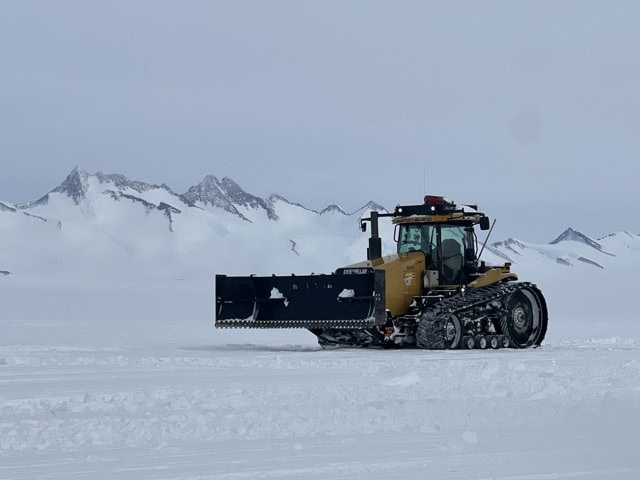
The afternoon was exactly like the morning had been, except that the wind picked up and visibility deteriorated. Now when I got stuck, I was completely alone in the swirling white maelstrom, the voices on the radio the only evidence of any soul around. I put my feet up, idly wishing that I’d brought a book with me into my cab while I waited for the floodlights of a coming tractor to pierce the snow wall around me. We repeated this blind dance until the weather got too nasty to keep it up. Taking care to space the loads far enough apart to clear drifts with a bladed tractor in the morning, we parked for the night and set up a fuel circle where every Challenger took less than half the volume of diesel it had been consuming up until then. The vehicles sheltered us from the wind, so we didn’t notice until we all broke off to park around the camp modules how much worse the conditions had gotten. We couldn’t see one fuel load from the next. This would be a mess we would have to clean up in the morning, but in the meantime there was a hot meal and a hot shower to look forward to. I’d had a run planned for the evening, but that was obviously out the question now. In fact, nobody was doing anything after work but hanging out in the kitchen. I plugged 308 in for the night and headed in with the others for dinner.
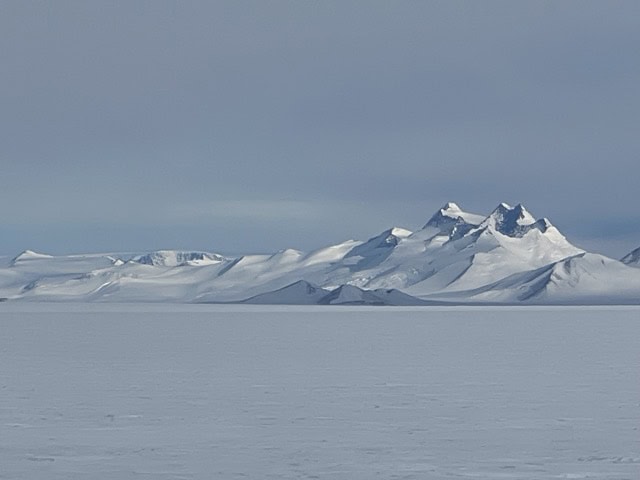
(not pictured: clouds)
Day 15: 19 November, 26 miles today, 311 miles remaining to Pole, elevation 4,766 feet, Leverett Glacier
If anything, the weather was worse in the morning. The wind had whipped through camp all night, making some strap or bit of webbing outside the living mod vibrate. The low moan that had resonated through the bunkhouse when I’d lay down to sleep was still there when I awoke, so I knew what I was in for before even getting out of bed. Large, sweeping drifts had built up anywhere anything had touched the ground—though the old timers insisted that “oh, this is nothing, just wait till we get a real storm.” Still, it was a challenge just to walk around camp, the flat light and driving snow erasing the edges of the snow piles that hadn’t been there the last time we’d been outside. We had to dig out the stairs for each of the modules, as well as the cable bridle at the front. We also had to expose the front of each ski and carve a ramp into the drifts so camp could be pulled out of the small hill that had been built around it. Once that was done, we all pulled our tractors back in a wide circle around the mods, standing by to make sure camp was free before moving on to deal with our loads.
We’d been used to everything getting parked in a dead straight line at the end of the day, but that wasn’t something we could count on. Several tractors drove off into the white out straight behind the camp train and immediately got lost, but were able to find their way back toward the fuel loads by following the GPS tracks they’d left the day before. I followed mine all the way back to the cargo load, where my heart sank to discover at least half of the 16 skis buried under large drifts—but this time I would be the only one with a shovel to dig them out. The wind and flying snow were sharp and cold, but I was sweating by the time I’d gotten two of the skis cleared, fog creeping across the plastic pane of my goggles. I did what I could to ready the sleds for the day, but was pretty sure 308 wouldn’t be up to the job on its own. When I tried to pull forward, sure enough the load held fast. Every time I tried a different angle, the weighted 30-ton machine was pulled toward the ruts in the center as if it were no more substantial than a toy. I was going to need a tow.
Once freed and left to my own devices, I moved at a crawl at the back of the caravan, passing others who were stuck along the way. Screaming down the trail at around a mile and a half per hour, I continually tried to find ways to bump my speed up a notch, only to bring it right back down as the tracks beneath me started to slip in the loose powder. The entire convoy was creeping along at a glacial pace as the wind finally tired itself out, the snow settled out of the air, and we got our first glimpse of our surroundings in a day and a half. A great wall of mountains lined our southern flank, the dark, rocky knob of Mt. Beazley standing sentry at its end. Here, the Leverett, and our path, would turn due south, but from our perspective we could see white-shrouded McLean Peak guarding the glacier’s far side, and the face of the Transantarctics as they continued into the distant clouds.
The view was spectacular, but our pace needed work. We took an extended stop for the 1000hrs load check, and the supervisor had a couple of the lighter tractors swap loads with a couple of the heavier tractors whose loads had been used for fuel circle and had diminished substantially over the trip. Then he came to tether the toolshed at the front of my load to the Prinoth, leaving me with just the three sleds of cargo. The most troublesome tractor kept its full load, but was married to the tow truck, and the two would pull in tandem the rest of the day. That small bit of engineering was just the bit of magic we needed to finally start making progress up the Leverett. I felt like I was flying, my tractor pulling as easily as it had on the firm, flat ice shelf, and though we never made it much past 5mph, we made the remainder of the day’s climb in good time and in good spirits. We made the turn between Beazley and McLean, which had grown from interesting features in the distance to towering behemoths of stone and time in a matter of mere hours. Mountains amid this much ice look like exactly what they are: islands, rising precipitously from the vast rivers and lakes and seas of ice that dominate the continent and give it its character and form. They are truncated giants, whose visible heads can only suggest the shape of the body that lies dormant beneath a truly unfathomable volume of ice.
We made camp near the bottom of the sharpest, hardest part of the climb onto the polar plateau. We had spent two and a half hard-fought days climbing four thousand feet—the next three thousand we would have to do twice in one day. It was a difficult operation, one that would require every load to be pulled by two tractors. If all went well, we’d deliver half our payload to the plateau in the morning, come back to camp, and then return with the rest in the afternoon. We would rise above these lonely, palatial peaks and enter into the world’s highest, driest, windiest, and coldest desert. But first, we would have to make the climb.