The following is the personal account of a single, long-winded individual’s experiences living and working in Antarctica. No part of it has been reviewed or in any way endorsed by the United States Antarctic Program or the National Science Foundation, or any other public or private organization, institution, contractor, or company associated therewith. The views expressed herein are the author’s alone, for good or for ill.
Day 06: 10 November, 56 miles today, 750 miles remaining to Pole, Ross Ice Shelf
I woke up with blood on my lips. I wasn’t really aware of much beyond a vague feeling of tightness and pain as I stumbled into my overalls in the dark bunkroom, but the reflection that greeted me as trundled into the bathroom to brush my teeth was caked around the mouth in patches of dried gore. I had brought an entire baggie of various lip balms, chapsticks, and other ointments with me to Antarctica, but hadn’t touched any of it since August, so I’d only taken a half-used tube of aquaphor on traverse. I didn’t understand why my lips had all at once become broken, desiccated husks, but I was going to have to figure out a solution before I used up what little remedy I had.
The morning had a vaguely ominous feel. A wall of clouds hung over camp, though it came to a hard edge in the distance where the thin angle of the sunlight gave the sky a yellow cast. Ice crystals swirled here and there through the air—not true snow, but a kind of cheap imitation that happens sometimes where the climate is dry and cold. The light wasn’t completely flat, but almost. The dimmest hint of shadows gave those of us toward the back of the caravan a general sense of the trail’s boundaries, but little more than that, and I was continually surprised as I dropped one track or the other into soft spots I didn’t know where there. Things with even a hint of color, however, tend to pop in those sorts of conditions, so when I heard the call to keep an eye out for an oil rag somebody up ahead had lost on the trail, it was easy enough to find it and stop to pick it up.
Flat light is one of those stressful conditions that naturally tenses the body as you strain your senses to keep track of your vehicle as you move it through its environment, like heavy traffic or driving rain. By late morning, as the clouds gave up and went somewhere else and the hardened sun set the fresh dusting of ice crystals on the ground to twinkling like a dense panoply of stars set into a blinding white sky, I was nursing a tension headache. I was hoping it would go away as the light improved, but everything seemed almost determined to make me uncomfortable. My lips were still bothersome, despite the copious amount of fluids and precious ointment I’d applied to the situation. The tractor’s greenhouse cab was oppressively hot in the afternoon sun, even as I was stripped to nothing but a t-shirt and long johns. My butt was getting sore from the long hours spent sitting more or less in one position, and I fidgeted for hours trying to find a way to sit that offered some measure of relief but still let me drive the tractor. Even my hat bothered me. The entire afternoon was a slog.
I had started the traverse with great plans and ambitions for portion control, as if nothing more than the magic of trail would stop me from reverting back into my natural state—a willful, excitable, insatiable, ravenous child. Whatever delusions I’d started the trip with were shattered by this evening’s offerings: chicken tenders and tater tots, with toasted donuts and real ice cream* for desert. I packed myself full to bursting before quickly washing up and collapsing into my bunk. I fell asleep almost at once, but noticed before I slipped all the way under that, finally, my headache was gone. Maybe, I wondered as I settled under the weight of my blanket, deep fried cafeteria-style food is actually good for you, after all.
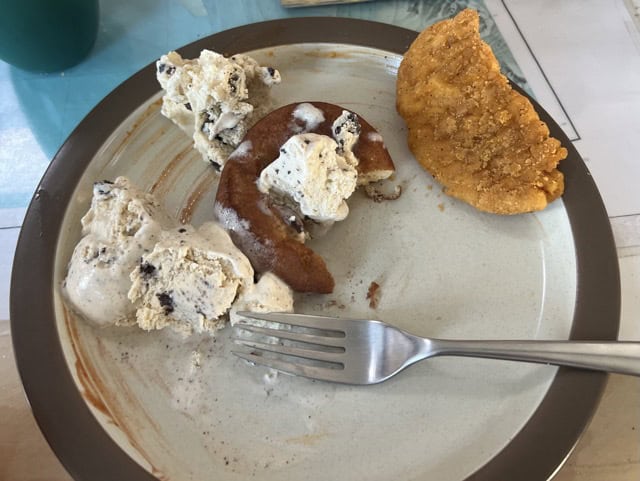
*As compared to McMurdo, which has only a mushy, soft-serve approximation of ice cream called space man.
Day 07: 11 November, 57 Miles today, 693 miles remaining to Pole, Ross Ice Shelf
The SPOT 1 kitchen was not built to accommodate 14 full-grown human beings, but that was how it had been used since the Covid-19 pandemic altered the dynamics of the seasonal traverse to the South Pole, along with everything else. Morning meetings were the only time all of us ever occupied that space at the same time; people came and went for every meal, but the daily brief was the one time we met as a group to discuss plans, chores, and advice about how to live inside the cab of your tractor for 12 hours a day while driving across Antarctica. The discussion this morning came around to the gallon-sized jugs that had once brought treats like maple syrup or salsa to the McMurdo kitchen, and which each of us now routinely peed into. It was noted that the thick plastic does not hold up well to the stress of a repeated freeze/thaw cycle, and that if you were to leave yours in your tractor it would eventually crack open—as had indeed happened the day before to one of the other operators. That was when one of the mechanics spoke up. “I haven’t peed in my tractor yet,” he said. A murmur went through the group clustered around the table and standing in the corner by stove. I couldn’t imagine it. I felt constantly parched as it was, and I was drinking enough water to have accumulated well over half a jug’s worth of pee by every lunch stop. How the hell was this man even still alive?
As the operator at the back end of the convoy, it fell to me to stop any time there was a lost item or piece of debris on the trail—assuming my tractor wasn’t already struggling to keep up with the group. This hadn’t happened often, at least so far, but when it did those moments highlighted the utter strangeness of the job I had come all this way to do. We were coming up on the 1000hrs load check when one of the guys at the front of the parade announced there was a broken cargo strap on the ground, making a point of detailing his mileage to the next GPS waypoint so I would have a reference where to look when I got there. The string of yellow tractors can sometimes stretch for well over a mile, and when you’re in the back you can’t see anything past the next three or four Challengers ahead of you on the flat ice, and without a mile marker I was likely to miss it. When I came upon the yellow tangle of webbing lying in the road I stopped, as the rest of the caravan continued on.
I decided to do my load check there, rather than jump to catch up just to stop again in a few minutes. As I walked around the cargo load, inspecting the lines tying the sleds together and testing each of the hundred or so straps to see if they had loosened, I noticed that the radio traffic of the rest of the group coming to a halt somewhere up ahead had been faded and indistinct. Many of the transmissions were in response to broadcasts that were too distant for my small handheld radio to pick up. I looked up ahead at the knot of tractors ahead, already small on the horizon. I looked around at the wide open, empty plains of snow around me. I had spent a great deal of time alone in the wilderness, but this was something altogether different. Here, I was separated by only a mile or so from the group of people I’d come this far into the nothing with—but that group, in turn, was 350 miles from the nearest outpost of civilization, and that was a remote research station off the coast of Antarctica. I could still hear the voices of some of my fellows, but some lonelinesses are bigger than others, and the gulf between us suddenly felt immense. I finished my load check, gathered up the broken strap, and started on my way back to the group.
The rest of the day was largely uneventful, the high-calorie snacks I’d brought into my cab curbing the ravenous hunger that had been building every day leading up to meals (and which had lead to complete pandemonium on my plate every time I entered the kitchen). At fuel circle, however, I was driven to crawl under my tractor to chip away at the ice that had been building up on the inner wheels by the supervisor’s warning that morning that the build-up only becomes harder and more difficult to remove with each passing day. He was right: after half an hour I had cleared one and half wheels out of twelve. I had created a project for myself, one I would have to spend the next several days working on before I could, hopefully, eventually return to a baseline level of ice on my tractor’s essential moving parts.
Day 08: 12 November, 63 miles today, 630 miles remaining to Pole, Ross Ice Shelf
A stiff, sharp wind had grown up over the course of the previous day. I stepped down from my tractor and walked to meet my bunkmate in front of the kitchen mod, where we stood looking at the red flag used to mark the boundary of of the campsite* as it vibrated angrily in the breeze. “I can’t do it,” I said, “I’m just too damn tired to run in the wind.” I was once again counting the days between bouts of physical exercise with a sense of mounting anxiety. There are certain things you sacrifice to make a journey like this one: privacy, energy, time, the ability to communicate easily and regularly with loved ones. I had hoped that my health wouldn’t become just another item on that list, but so far it wasn’t looking great.
While the work day on trail nominally starts at 0700hrs with the morning meeting, in practice it begins at bit before 0630, when everyone inspects their tractor before firing it up—giving them plenty of time to get warm before running them at max capacity all day. My daily walk-around revealed that 308 was down a gallon of engine oil, meaning that it was ready to be topped back off. Along with diesel, oil is the only fluid the operators are permitted to add to the machines without oversight by a mechanic, but it’s nonetheless something of a process, and one that I had never actually done before. It’s also, fortunately, pretty straightforward: you just need to hang a funnel so it drapes into the fill spout without spilling, and then empty a gallon jug of 0W-40 into it. The oil is kept in the generator room, which is the warmest spot in the whole camp, but even so I found that it flowed, at best, like warm honey, and I became cramped and uncomfortable as I crouched over the funnel for several long, cold minutes. It worried me, as the tractors burn oil as a matter of course—a problem exacerbated by the cold—and filling them up would only take longer once we were on the polar plateau and the temperatures really dropped. But that would have to be a problem for later; there wasn’t anything to be done but attend to the problems at hand.
Once the oil was refilled, I borrowed a 3lb hammer from the tool chest and crawled under the machine to start breaking up the giant ice formations that were growing on the inside of the tracks. This turned out to be the magic bullet, and a job that would have taken meticulous hours with my ice axe was all but done in ten minutes of awkwardly-positioned hammering. With the tractor ready and warming, I threw the hammer in the storage bin under the steps and headed into the kitchen mod for the morning meeting.
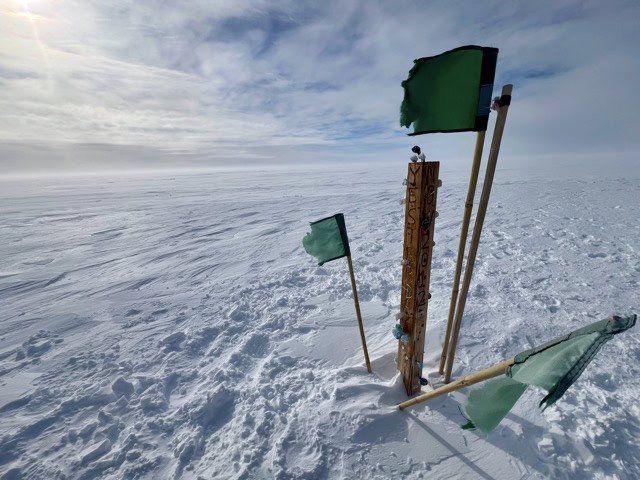
The big excitement for SPOT 1 that day was our imminent crossing of the International Date Line, a milestone that would have no practical effect on our lives, since we would continue to live by the McMurdo clock for the entire traverse. But it was, at least, an amusing diversion,** as perhaps the only other place on Earth where you could drive across this meandering boundary was rumored to be in some equally remote region of Siberia. It was not quite mid-morning when we arrived at the marker planted by a previous traverse some years before—a 4×4 labeled YESTERDAY on one side and TOMORROW on the other and speckled with small holes that were (mostly) filled with lollipops for reasons nobody present understood. We parked in our standard lunch formation (to place the tractors within walking distance of each other), took an early load check, and met at the monument for a group picture. It was a fun stop, a needed moment of levity, one that was only modestly soured by the fact that my GPS displayed the new time zone with a bright red background that made all the essential information harder to read, and I couldn’t figure out how to change it no matter what infernal buttons I pushed.
When I pulled into camp after fuel circle, I the wind was still blowing cold and steady. I did not want to run, but in the end I did not want to not run even more. Life on trail was proving to be busy—even overwhelming—but it was also largely sedentary, and the sense of inactivity was starting to gnaw at my muscles in a way that made me increasingly antsy. I suited up and headed north, the only permitted direction, chagrined to note that my feet sunk up to the ankle with every sluggish step. It felt more like wading than running, and the agonizingly slow pace dragged it out all the more. This is the advantage to the out-and-back approach, however: so long as I was able to cajole myself into running to my desired halfway point, I was left with no alternative but to cover the entire distance to return to camp, and running would be the fastest way to get back to someplace warm, and with hot food waiting for me. It was a slog, but a relief once I had gotten it done and opened the door to the kitchen mod, where a cloud of savory, garlicky steam poured into the chilly air of the ice shelf, along with the laughter of my compatriots, already dining within.
*This is done to avoid set up camp in same spot for the next few years, to assure that the snow used for making drinking water has specifically not had tractors driving all over it.
**Which, honestly, is something you need when you spend almost the whole of your waking hours in the cab of a tractor, driving in a straight line across an endless field of white
Day 09: 13 November, 44 miles today, 586 miles remaining to Pole, Ross Ice Shelf
The true curse of middle age, I think, is the way you can do everything right and still be punished for it. I’d had a good run, had a good meal, gotten to bed at a reasonable hour, and then, for no reason I could discern, woke up a bit before 0200 and spent the rest of the night trying desperately to force just a few more minutes of minutes of sleep before facing the millstone of the workday. But to no avail. When I finally rose to greet the day, resentful and confused, it felt as if I hadn’t slept at all. I forgot what I was doing halfway through getting dressed, and tying my bootlaces was a challenge of dexterity and concentration something akin to repairing an old-fashioned watch while walking across a high wire. It was going to be a difficult day, even if everything else went right.
In the beginning, at least, it seemed like everything else might. We’d set up camp in the same configuration as we had when I had previously gotten stuck trying to pull out—kitty corner to camp mods, well off the established trail bolstered by the compaction of 20 years’ worth of traverses—but when the time to start towing everything went smoothly. It was the first morning in a week with hard, bright sunshine giving crisp definition to the world around us, and we hadn’t even been rolling for an hour when the mountaineer called over the radio, “Talley ho! Talley ho! Talley ho! Mountains at one o’clock! That’s mainland Antarctica, boys!” He was right: Far across the ice was a small series of white ridges, faint with distance, but unmistakably breaking the flat line of the horizon. We had made incredible progress. Nobody had expected any sign of the Queen Maude Mountains for a couple of days, at least, but here was the first glimpse of true land we’d seen since losing sight of Mt. Erebus and Minna Bluff. It was clear proof of the miles we’d passed, and I studied the indistinct curves and slopes until they were swallowed by clouds and erased from view.
I was hauling four sleds: the toolshed, a cargo deck with a 20’ shipping container and and a 25,000lb rack of 20’ helium cylinders, and two more cargo decks each laden with reels of hose secured in cylindrical crates. Each of these rode on four large 2’x8’ skis, which were bolted under the frames of the sleds via two paulstra pads—big rubber pucks about a foot in diameter and maybe half that in thickness cemented to steel plates that acted as a kind of shock absorber. Part of my regular load check routine included examining these for damage, though with 256 corners to inspect for cracks or deformations I had to break up the routine to get everything covered in the 15 minutes we were allotted. I had come into the habit of checking the paulstra pads during the midday break on odd numbered days, so when, at the start of lunch, I found the first pad on the first ski I checked had been shattered, I didn’t know if it had happened 5 minutes before or 48 hours. But it didn’t matter. The thing was destroyed and would have to be replaced before we could continue on.
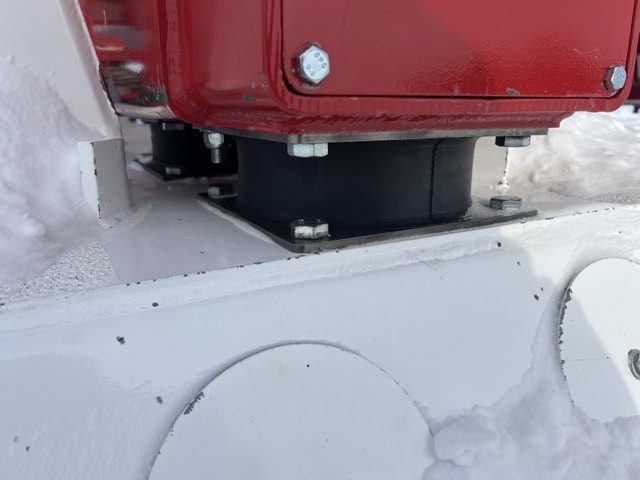
This a routine bit of trail maintenance, the way you expect to inevitably to fix a flat tire on a long bike trip or stitch some part of your backpack back together on a thru-hike. It is immediately clear to anyone who has ever had to replace a paulstra pad, however, that the sleds were engineered and built someplace warm and with specialized tools not readily available in the field. The frame of the sled has to be jacked up, which is a pain all by itself requiring a hundred pounds of lumber for support and is only the first step in the process. The ports allowing access to the nuts are child-sized. Only the smallest impact driver will fit, and even then it has to be threaded inside precisely. An adult human can only get one hand inside, and getting the socket set and then sliding your hand around to the driver’s trigger without the whole apparatus slipping off the nut is all but impossible with gloves. There are eight bolts for each pad, and the removal and later installation of every single one is a nightmare of frustration and ergonomic disaster. No part of the operation is particularly complicated, but the whole thing is time consuming and aggravating. “At least the weather is good,” I said to one of the other operators, eating a fast lunch before heading out to work on the pad. “It’d suck to do this on a cold day.” But we lost the sun to the encroaching clouds before we even got started. By the time we had the job done, we were putting our tools away in a torrent of hard, sharp snowflakes, driven across the trail by a heartless wind.
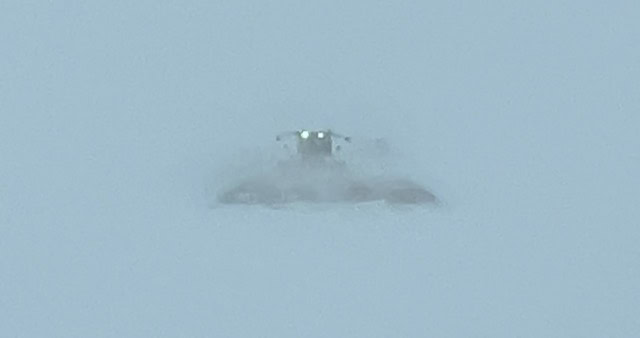
It could have been worse. The trail proceeds into much, much colder climes, and all told we lost no more than an hour and a quarter of driving time to the repair—but conditions were rapidly deteriorating as we set back out in the early afternoon, and everyone flipped on their floodlights as we started forward into the weather. Before long, we were driving in a white out. I’d known this would be part of the job; we’d been trained specially how to cope with exactly this sort of scenario. This one wasn’t even particularly bad—during the worst gusts I could still make out the yellow silhouette of the tractor ahead of me. Even so, driving into something like this in real life proved to be substantially more disorienting than I had anticipated. The flat light erased all definition on the trail, leaving only the Challenger ahead of me as a landmark. Often, it seemed as if we weren’t moving at all, the cab’s continual rocking and jostling the only sign that we weren’t standing perfectly still. At other times, the bright stream of horizontally blowing snow made it appear as if the tractor ahead were turning sharply to the right, and if I hadn’t known for a certainly that the section of trail we were on was a dead straight line for hundreds of miles I might have been tricked. I steered by the compass bearing on my GPS, keeping it oriented with the predicted path* the way I’d been taught—but it was dizzying, like falling down in a dream.
We were brought to a stop late in the afternoon when one of the tractors toward the front of the line developed a nasty vibration in one of the idler wheels. Several of the mechanics gathered around it, trying to make a quick diagnosis, but the machine would not cooperate. It was close enough to quitting time that the supervisor called it for the day, and we began the slow dance of organizing the fuel circle in low visibility—but by the time we had all the tractors in place and ready to fuel, the squall cleared and we were left with a picture perfect evening in which to fill our tanks and chip the ice from our tracks. I’d been dreaming of a hot shower all afternoon, but had given up hope when the weather turned, as I had no intention of fucking with the snow melter in high winds unless it was absolutely necessary. One day, it surely would be, but this was not that day. I had already mourned the loss of my shower and moved on with my life when the sky cleared and sun beamed down on our fuel circle shameless and full. I was exhausted, ready to fall asleep right there in my boots with my ice axe in my hand, but thrilled when I realized that when I finally managed to crawl into bed that night, I would be clean. Fresh. Renewed.
*The ice shelf is in constant, if slow, motion, so even the most recent GPS coordinates of each waypoint are out of date by the time SPOT 1 sets out for Pole. The program uses complex math to predict where the route will be each year, but it can be off by a quarter mile or more, and the trick is to remember how accurate it was before you lost visibility and to maintain that distance while keeping to the proper bearing. It is a strange, counterintuitive way to drive.
Day 10: 14 November, 59 miles today, 527 miles remaining to Pole, Ross Ice Shelf
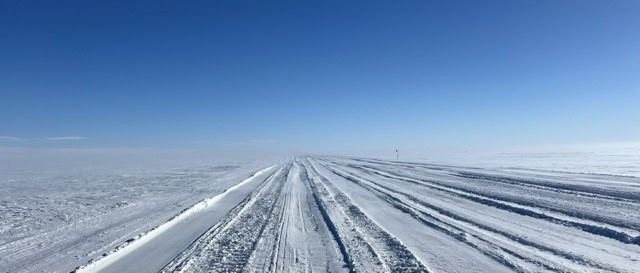
The Ross Ice Shelf isn’t completely flat. Besides the occasional patch of small sastrugi,* there is a gentle rise and fall to the terrain—but it’s far too gradual to notice, say a change of 80’ over 50 miles. Still, there is something about the utter flatness of the landscape that deceives the senses. I assumed it had something to with the lack of any reference point but the long horizon, but whatever the reason I often had a false but strong impression that we were heading up (or down, but usually up) a long incline. If this were true, of course, I would be able to see the entire caravan of tractors even from the back, instead of the four or five spread out before me in a formation intended to track pack the surface of the trail and make it easier to drive over on the way back (and of course when we did all this again on SPOT 3). A week and a half in, I still wasn’t used to operating in an environment that constantly worked against my usually reliable sense of movement through space and time.
The sky overhead was perfect and blue, but a steady headwind through up a wall of blowing snow that extended no farther up than 25’ or so but wrecked havoc with visibility at ground level. We never quite hit the white-out conditions of the day before, but the air was obscured enough that staying on trail without a compass bearing from the GPS would have been, at best, a challenge. The wind was sharp and cold, and made load check an uncomfortable ordeal, cutting as it did through every layer I could slap on. It also played hell with the thick, quilted fabric flap that was draped over the machine’s grill and which we each used to manage the engine’s intake of cold air. This almost quaint system was how we kept our tractors in the delicate balance between overheating and getting so cold as to bog down or start burning oil, and it had worked fine until we had to start fighting the wind just to fold it up or down.
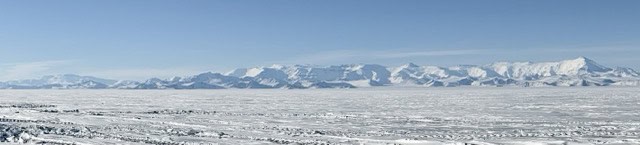
As the day wore on, the wall of snow gradually began to lower. By early afternoon, we could see sharp, white peaks breaking the line between snow and sky to the southwest. This was the best view yet of the Queen Maude range, a view which only improved as the snow wall shrunk until it was only a few inches above the surface of the shelf. Like the Royal Society mountains that dominate the view across the ice from McMurdo, these were a part of the greater Transantarctic Mountain Range, massive and foreboding, their jagged contours sealed beneath millennia of ice. But every mountain has its own personality, and I stole a glance whenever I could, drinking in the shape and temperament of each peak, glacier, and massif, trying to memorize the character of every slope. As we drove on, it occurred to me that, at that moment, these mountains belonged entirely to us—insofar as the grandeur of nature can belong to anyone. But these ancient, lonely peaks could be seen by no one else. In all the wide and ranging world, in all the trillions of living creatures granted the gift of sight, there were only 14 pairs of eyes to marvel at this sawtooth masterpiece of rock and snow.
The wind never let up, though. Fuel circle was an exercise in trying to find the sheltered places from which to chip ice or diagnose the day’s current issue with the fuel pump. It was, at any rate, nice to have an excuse not to go for a run once we were done. I was done in, and after a heaping plate of premix stroganoff with a towering side of mac and cheese, I took one last, quick peek at the serrated and jeweled horizon and crawled into my bunk.
*ridges of drifted snow that build up in parallel waves, are hard as concrete, and, in the best cases, are horribly obnoxious to drive over