The following is the personal account of a single, long-winded individual’s experiences living and working in Antarctica. No part of it has been reviewed or in any way endorsed by the United States Antarctic Program or the National Science Foundation, or any other public or private organization, institution, contractor, or company associated therewith. The views expressed herein are the author’s alone, for good or for ill.
Day 50: Christmas Eve, 77 miles today, 322 miles remaining to McMurdo, around sea level, the Ross Ice Shelf
I had long given up running. When we had first arrived onto the Polar Plateau, the weather naturally discouraged being outdoors any more than was dictated by absolute necessity—and anyway the supervisor would likely have lost his shit if any of us had been dumb enough to go for a jog in a blinding whiteout. But even as the conditions improved, the road surface continued to deteriorate. Running across the ice shelf in early November had been, at best, a continual dilemma: you could choose the uncompacted fluff to the side of the trail, which offered all the support of loose sand, or you could run in the ruts left by the giant skis, which were firm as an asphalt track but slick as an ice rink. By late December the options were pretty much unchanged, the only difference being that the unpacked snow had become a great deal softer—even a simple load check had become an ordeal, now that all travel by foot meant that we had to wade through an ocean of cotton candy.
It was during one extended load check on our way back through Sastrugi National Park that I hit on the idea of doing a few sets of jumping jacks. I had been getting antsy, waiting for a field repair to be done on a load too far up the column for me to help, and it finally occurred to me that there other ways to get my heart rate up besides trudging miserably through the snow. I clung to the thought at once, and started peppering my day with little bursts of cardio wherever I could squeeze them in. I learned quickly that this newfound activity did not obviate the need for firm snow—our first day on the ice shelf I noticed that I was digging myself into a rather deep hole—but at least I only needed to find a small patch of it, and not an impossible stretch running for a mile across the powder. Added to the routine I was slowly developing in the cab of tractor, playing around with the lone resistance band I’d brought with me to the ice until I found movements that felt exercisey, and it felt almost as if I had, at last, started to figure out how to spend 12 hours per day in a tractor without completely losing both my body and my mind.
Nothing altered the fact that we were driving farm equipment across the greatest stretch of nowhere on the planet, of course. The internet we had in the kitchen—far more reliable than the networks used at either McMurdo or Pole—was helpful, but was available only in the short bursts we could be in the mod where it was available. I’d had good luck with the satellite phone in the past, and so was hopeful when Sean Meadow suggested an afternoon call on Christmas Eve. But the stars (or rather, the satellites) did not align for us, and every attempt resulted in only a minute or so of garbled voices before the call was dropped altogether. I tried realigning the antenna, standing on the catwalk over the furiously spinning tracks as I attempted to keep the small pad at the end aligned to the north, but that only made the distorted, incomprehensible voice on the other end a little bit louder before it cut out entirely. It was frustrating to come so close without ever quite getting the thing to work, but we were, after all, alone in the vast empty wilderness of the Ross Ice Shelf. What did I expect in the middle of fucking Antarctica? It was a modern miracle that we had what communication with the outside world we did. Still, it was a little unnerving to realize that the sat phone—this capricious, erratic, unreliable system—was the technology on which we were to rely in the event of an emergency.
We ended the day a bit outside the routine, stopping for an early fuel circle at a cache some 327 miles from McMurdo. The idea was deplete the level in the steel-walled tank now, so that we could empty that much from whichever tractor was struggling the most as we passed this point on SPOT 3. It was a solid long-term plan, but one that was met with little enthusiasm from the crew. We knew it was a good idea, but we also knew that it wouldn’t get SPOT 1 to McMurdo any faster—if anything it was only dragging out the length of our return, since the loads that were slowing us down now would be just as heavy the next day. Even so, the novelty was a nice change of pace, and it was wonderful not to have to drain a bladder in the field for once. The tractors were chipped quickly in the warm weather, and we were left with nothing to do but move the nozzle from one tractor to the next. It gave the fuel circle an almost festive feel as we stood in the ring of yellow giants, joking and throwing snowballs, watching as the sun slipped behind a blanket of high clouds, their shadows dancing in graceful sweeps and swirls across its distant, veiled face.

Day 51: Christmas Day, 92 miles today, 229 miles remaining to McMurdo, the Ross Ice Shelf
After days of shorts weather, it was something of a shock to step outside the living mod and find a cold wind slicing through what were, suddenly, appallingly inadequate layers of clothing. It wasn’t actually that chilly, by Antarctic standards, but I’d let myself get spoiled by the easy summer weather to the point where I’d often left my insulated pants bunched in a corner of the cab. We were in the closing days of SPOT 1, almost close enough to McMurdo to smell the industrial cooking grease wafting from the galley, and the continent just wanted to remind us once again, before we were through, just where the fuck we were.
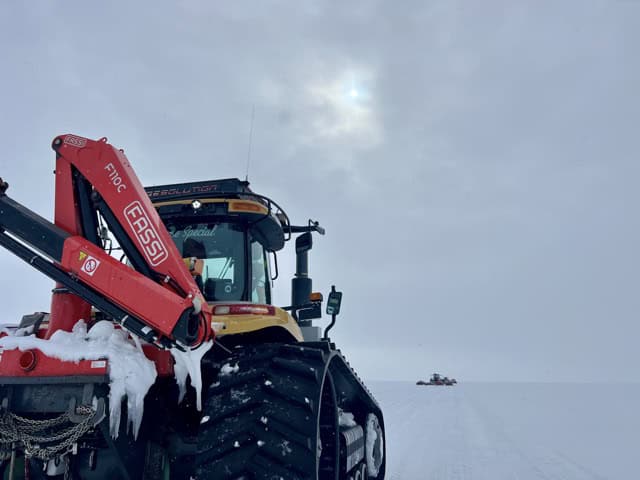
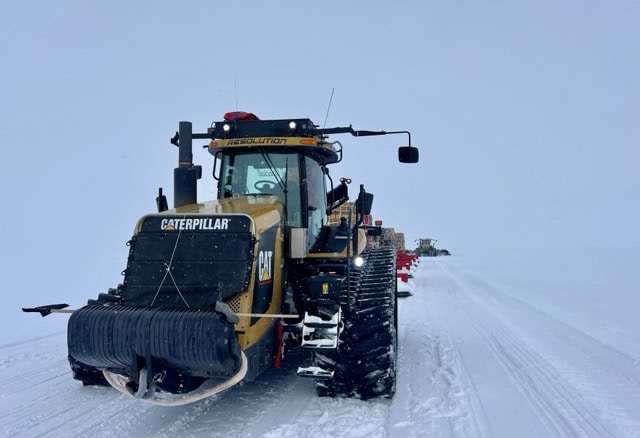
And so it was a dreary Christmas morning—much like any other on trail. We had miles to make, as we did every day, and there wasn’t a person in the crew who wasn’t eager to cover that ground as fast as possible. The cold wind, unpleasant though it was to stand around in, was helping to finally cure the top layer of fresh snow, drying it out and blowing some of it off of the hard-packed trail. We’d spent the last several days edging closer and closer to riding in 14th gear, and when the tractor pulling 303 was set up to pull in tandem one of the few loads with any diesel left in it, we were finally able to make that shift without anyone bogging down or stalling out. There was a pair of tractors pulling camp, another pair pulling a half-full fuel load, and a third pulling the dead tractor along with a mostly empty fuel load. 308 followed behind these, the first solo tractor in the caravan, more than capable of towing three full sleds of polar trash, and followed by the last three Challengers, each pulling sets of empty, inflated bladders married together into chains of CRREL tools and HMW over 200’ long. And now that we were screaming north at a blinding 11.5mph, we were certain we’d be back in McMurdo well before New Year’s—just so long as nothing else went wrong along the way.
The first thing to go wrong along the way happened to my load. I had been closely watching the pair of paulstra pads holding up the forward right ski of the garbage load for at least the last thousand miles. The steel plates holding the pad onto the frame were both cracked at all four corners—a sign of imminent, but not immediate—failure. It was a problem I’d noticed well before we had even reached the Pole, but it wouldn’t be worth the time and the horrible effort to fix until the steel plates began to buckle and twist out of place. I checked them religiously throughout each day, kneeling in the snow to inspect them and saying a brief prayer that they might hold out until we reached McMurdo, but when I approached the load at lunch I could tell from 50’ away that my prayers had been ignored. The outermost top plate was a gnarled ruin. We could have let even this ride for a few more days if the upper plate of the inner pad wasn’t also cracked; as it was, the stress the broken pad would put on the almost broken one would hasten its decline, making it increasingly likely that I would lose one of the massive skis entirely if we didn’t take care of the problem now.
This is how a small cadre of the SPOT 1 crew spent lunch on Christmas Day gathered around a load of garbage, working to finagle a series of nut and bolts through spaces not designed to accommodate the human hand, as the cutting wind blew through camp and the sun struggled to work its way clear of the gray hoard of clouds that had followed us all morning. We were getting practiced at this awful, obnoxious process, and in the end only lost a half-hour of driving time. The sun finally broke free in the afternoon as we plowed onward across the great white plains, and in the hard, clear light we could see the tracks of our southbound progress outlined in the snow. Things were once again looking bright, and our hopes grew to match the intensity of the unfiltered sunlight.
The next thing to go wrong was the snow that had built up under Fawlty Towers, the mother-in-law extension to the living mod’s main house. Something about the quality of the snow and the speed of travel had forced massive piles of the stuff under the shock-absorbing tires bolted to the underside of the building’s platform—but only under those on the aft side, making the whole structure tilt dramatically toward the front. This had been a problem for the last couple of days, but it had been hoped that a burst of shoveling the day before had eliminated the problem at least until we made it back to McMurdo. Instead, the situation was worse than ever, and would require several people to peel off from fuel circle to help clear it out. Meanwhile, we were back to field-draining bladders, a process that only became more arduous the fewer people were available to work on it. All told, it was nearly 2000hrs before the SPOT 1 crew gathered in the kitchen mod for Christmas dinner—a small feast that had been prepared for us by the supervisor, before he disappeared to keep shoveling under Fawlty while the rest of us shoveled food into our faces. The mood around the table was subdued. All of us were tired; some of us would be back shoveling before the night was through. That’s sort of the whole thing about life on trail—there is no serious problem that can wait, or that can be farmed out to anyone else. We were so damn close to the end, and though we might have each been quietly wishing for some holiday miracle to ease the remainder of our journey, we sure as hell weren’t there yet.

Day 52: 26 December, 98 miles today, 131 miles remaining to McMurdo, the Ross Ice Shelf
Everything was always wet. The predominately warmer weather meant that when the raging heat of the tractors’ engines melted something, it tended to stay melted—the exception being the water that seeped into 308’s hitch at the end of every day and solidified every night, so that each morning I would find it frozen closed and have to whale on it with a 3lb hammer before I could hook up to my load. We no longer chipped the tractors so much as scrapped slush off of them, and both my insulted work pants and insulted work gloves had achieved a state of permanent dampness. At least my insulated work boots were waterproof—the other option offered by the program, and chosen by a few operators for their superior warmth (when dry), were made from a sort of pressed, layered fabric which held onto moisture like a sponge and made trench foot a legitimate concern even on a traverse with all the advanced gear and tech you’d expect of a well-funded expedition in late 2024.
Life’s general sogginess was just another thing to adapt to while out on trail, no worse than the myriad other small tweaks we had had to make to our daily habits. The idea of peeing only into a bottle for a month straight had been a source of an unspoken, low-grade anxiety for a lot of us for weeks before we’d first left McMurdo—but within a few days it had become so absorbed as a normal part of the everyday routine that we would multitask without a second thought, pissing into a flask while steering the tractor and managing the rpm and holding a conversation on the radio the entire time. This level of comfort carries with it its own risks, however, especially if you allow yourself to be lulled into a false sense of security by flat, easy terrain. I was filling my gallon jug a little before lunch, already concerningly full from a morning diligent hydration. Still, I was completely at ease with an act I had performed with great success hundreds of times in the last seven weeks, reduced to the breezy science of lazily draping into the mouth of the jug and letting nature take its course. And then I hit a large bump. This too was fairly routine—it wasn’t as if I had held my bladder all the way through Sastrugi National Park—but this one was unexpected, the first in a long stretch of smooth trail and hidden from view by the flat light. I held the jug still, managing to keep the sloshing contents inside where they belonged even as I kept my grip on the wheel and starting scanning the road for any other possible hazards, but even so something didn’t feel quite right. I looked down to discover that while the jug was in place, I had flopped out of it entirely, and was now peeing directly onto the rubber-matted floor of my cab.
Not all emergencies are dire; some of them are just gross. No one’s life was going to be threatened by a puddle of urine in my tractor, but there was also no world in which I didn’t find a way to clean this small nightmare up immediately. The small towel I kept on hand to sop up snow melt was repurposed at once to absorb the bulk of the problem, and once that was done I set about scrubbing at the floor with a long series of disinfectant wipes I’d kept in the cab for this purpose.* The tractor weaved wildly across the trail like a car on the highway driven by a person with a severe allergy who had just discovered a bee, but I had a higher priority at the moment than keeping the vehicle straight. I had the situation triaged within a couple of minutes, but when we stopped for lunch a few minutes later, I spent enough of my break doing a deep clean that I missed the narrow window I’d have had to call home. It was Christmas Day back in the states.
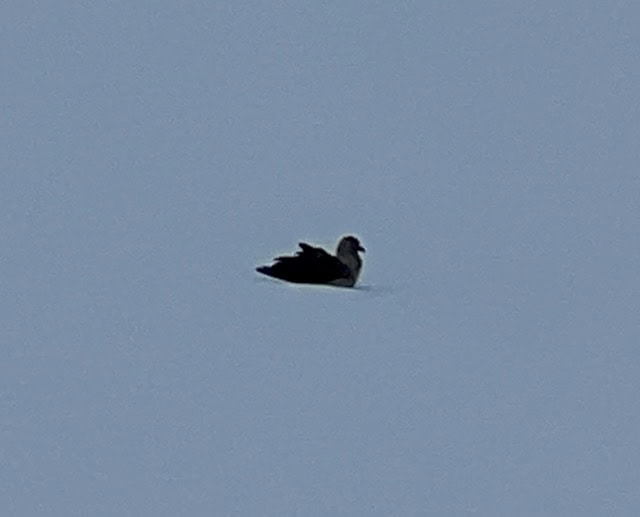
The excitement of the morning left me drained the rest of the day, and it was hard to work up the enthusiasm shared by the rest of the crew when we saw our first bird of the entire journey. The skua, a large brown semi-aquatic scavenger not unlike a fearless, overgrown seagull, was a native to the McMurdo area, and no doubt had come to investigate the caravan as a possible source of delicious trash. The radio exploded in excited chatter as the animal settled in front of my tractor at load check. This was the clearest sign yet that we were nearing Ross Island, still shrouded in clouds a hundred miles away. Skuas aspire to a level of cool they can never quite manage—the whole time the operator stopped ahead of me and I were checking our loads, the bird sat with his back to the both us, but was clearly watching our every move. When I was back in cab, and throttled up to start driving once again, he spooked and flew twenty feet off the flag line in a panic, where he settled himself once again as if nothing had happened.
He was back later that afternoon with a couple of friends—or at least, we all assumed the bird we’d seen earlier was among the trio we saw flying low over the rolling convoy. We saw them again at dinner, planted just beyond camp, eying the building carefully in the presumed hope that one of us might wander outside with a vulnerable plate of food, as happens often enough at McMurdo that incoming residents are warned to watch their heads when taking dinner home to their dorm. We watched them watch us through the window, as a dusting of snow began to fall between us. We were coming into the trail’s final stretch, close enough to have become a beacon to the gross birds of the island. If we weren’t close enough to the end to smell it, the skuas sure as hell could.
*Well, not this specifically, but, like, messes
Day 53: 27 December, 89 miles today, 42 miles remaining to McMurdo, the Ross Ice Shelf
I could remember this section of trail from early on our southbound leg. We had had maybe a day and a half of terrain just continually uneven enough to be really unpleasant, the packed snow littered with baby sastrugi, a thousand million little speed bumps placed in the road at random intervals. Now it was covered by several inches of fresh snow, which only hid the ridges from view while doing nothing to dampen their jarring, jostling effect. Even clearer was the memory of the jug incident from the day before, which made each use feel like a panicked race against the next jolt that would surely result in disaster. Never in my life had I so missed the extravagant convenience of a simple toilet.
We passed TALL TOWER! shortly after the 1000hr load check. We didn’t stop this time through to marvel at its austere elegance or wonder at the many obscure weather instruments that adorn its peak, but it still served as an important milestone in a couple of ways: first, it marked the place where, roughly, we had only 100 miles remaining on our journey, which also meant second, we could no longer use our preferred channel on our VHF radios, as we were now close enough to interfere with the traffic of McMurdo Fuels. None of the other options on our dials were as consistent or clear, so the soundtrack to our last full day on trail would be the crackle of constant static. It was an aural complement to snow that gathered throughout the day, becoming an obscuring cloud as the afternoon and the miles wore on.
Fuel circle had become something of an ordeal. At the outset, we had had two functioning pumps, which had allowed us to run two smaller circles off of two separate fuel loads, or one super efficient circle off of two bladder on the same load. Once we’d found the rhythm of the trail, it wasn’t uncommon to finish up this last chore of the day by 1830hrs or so. Now that the pump we’d built at winfly had been abandoned until the horrendous leak in its inner workings could be addressed in the shop, the process was naturally slower—but as we burned through the last of our fuel, we also needed to drain the bladders that had carried it all this way. The procedure was similar to what we had done at Pole, but without the benefit of a nicely sloped surface that pooled at the diesel by the bladder’s business end. Every day, we had to break the ratchets locking the straps in place free of the day’s accumulation of ice, so we could squeegee the fuel toward the hose, often working again gravity. Some times we had drag the far end of the bladder toward the pump, leaving a person underneath it to act as a makeshift high point so the fuel wouldn’t flow back as we pulled the 70’ rubber tube flat again. It was a time-consuming pain in the ass that left us reeking of diesel and meant we routinely weren’t finished with work until almost 2000hrs, but which time dinner was usually already cold. It was a grueling way to close out the traverse, but spirits on the crew were still high. Every one of us was overworked and worn thin, but we were so close to the end we could imagine that we could just make out its outline through the wall of falling snow. Just one more day without a serious mishap, and SPOT 1 would be done.
Day 54: 28 December, 42 miles today, 2,080 miles total roundtrip, McMurdo Station
Mt. Erebus, the southernmost active volcano on Earth, towers some 12,000 feet over McMurdo, its rounded, smoldering peak a beacon rising from the heart of Ross Island, visible for well over a hundred miles in pretty much any direction. During the brief window on the ice shelf that we had had relatively clear weather, I had kept my eye open toward the northern horizon, watching for the appearance of this distinctively rounded landmark—which would be indisputable proof that we had come at last into the final stretch of the journey home. But such evidence never came. Instead, we drove the final days directly into a wall of low-lying clouds, which seemed close enough to touch as we continued into the north and they swallowed the world around us. On SPOT 1’s last morning on trail, the only open patch of sky lay to the southeast, over our right shoulders and shrinking fast.
The one remaining obstacle on this trip was our re-crossing of the Shear Zone, the heavily crevassed belt where the Ross and McMurdo Ice Shelves pulled away from on another at different speeds, opening up thousands of dangerously concealed fissures in the firn. Protocol dictated that every person in the convoy wear their climbing harness, on the off chance that some extremely unfortunate circumstance forced any one of us to exit their tractor while still within this treacherous neck of the ice. The southbound crossing had been slow, orderly, and uneventful, and we hoped for more of the same as we gave our loads one last, thorough examination. As we passed around our cargo, we stopped as we met our neighbors, checking one another to make sure we all had buckled ourselves correctly into our harnesses. With everything strapped exactly where it needed to be, we started across, each operator giving the tractor ahead a quarter mile of breathing room before starting into the corridor themselves.
The relentlessly warm weather of the past month had greatly softened the surface layer of snow since was last seen this place. For the first couple of tractors, this difference was barely noticeable at all—just a slower feel to the trail’s veneer. As the tracks of each Challenger churned through the soft, weakened powder, however, they ripped open the snow bridges which had concealed several of the crevasses deemed too narrow to be worth the trouble of remediation. A crack in the ice has to be wider than three feet across before it is considered unsafe for a tractor to cross (and thus worth the effort of exploding with dynamite and backfilling with snow). When open to the air above, though, even a split measuring one or two feet in width will swallow your stomach, which plummets through your belly each time the tracks dip and catch, for just a moment, on the lip of a chasm that might be narrow but which nonetheless seems to have no bottom to it. Too thin to gulp down an entire tractor—yet—these young crevasses rocked those of us toward the rear of the caravan as we passed over them, bouncing from one lip to the other, a visceral reminder why it was we’d spent so much time and effort learning how to rig rescue systems by tying climbing ropes to our vehicles.
Once we had all safely landed on the McMurdo Ice Shelf, we started to relax. The distinguishing features of Hut Point Peninsula rose into view through the cloud bank, and I couldn’t help but smile as I caught sight of Ob Hill for the first time in almost two months. The pyramidal rock mound overlooking McMurdo was the first feature to emerge from the gloom—the first natural monument not made of ice or snow that we had seen since we’d climbed up the Leverett on our way to Pole. This brown-black cone, streaked with a rainbow of mineral deposits and dusted with snow, was as familiar a landmark to me as Mt. Rainier had been when I lived in Seattle, the Williamsburg Bridge when I lived in Brooklyn, or the crowns of the Black Mountain range were now that Sean Meadow and I had made a home for ourselves in a damp, green patch of Appalachia.
Here was the sign finally welcoming our convoy home after all these many long days, even before we crossed the Willy Field skiway and passed officially across the outer boundaries of the station’s perimeter. We would only have a couple of weeks in McMurdo before we had to head back out and do the whole damned thing again; just a couple of weeks to replace all the broken plastic sheets and refill all the bladders, to repair the machines and restock the cabinets, to relax as we could and recuperate our minds and our bodies, and to fill whatever time remained after all of that with good people and bad food. Sean Meadow would be waiting in our well-worn dorm room, the light of her face as I burst through the door with a duffel bag full of horrors to be laundered as sweet a dream as the long, steaming shower I had been fantasizing about for weeks. It would pass quickly, this blip in an ocean of time on a blip of rock in an ocean of ice, but while it lasted we would make the most of it we could. As hard and as cold and as temporary as the place could often feel, for a little while, anyway, we were truly coming home.