The following is the personal account of a single, long-winded individual’s experiences living and working in Antarctica. No part of it has been reviewed or in any way endorsed by the United States Antarctic Program or the National Science Foundation, or any other public or private organization, institution, contractor, or company associated therewith. The views expressed herein are the author’s alone, for good or for ill.
Day 06 – Monday, 21 October 2024
Ambient temperature -27°C
In the morning we drilled.
Work at the Shear Zone starts at 0700hrs every day with a morning brief breaking down what jobs need to be done and who is assigned to do them. Even after we’d each learned the rhythms of the camp, however, and everyone knew everything that had to be done to prep for a day’s work, it still took us until after 0900hrs to get ready. There were machines to warm up, machines to fuel, equipment to gather and load, warm gear to layer on, climbing harnesses to secure over the top of those layers, and a full palette of ropes and hardware to clip onto them. I’d also learned through unfortunate experimentation that it was always better to pee before stepping into the harness, as the location of the belay loop made operating the zipper of my bibs incredibly awkward. It made me pity the members of the crew who had to remove their harness altogether just to avoid peeing their long johns.
The day started windy, and only got worse as we set up our rig by one of the two crevasses we were planning to remediate. Visibility was great, and every so often I snuck in a glance at the smoldering cone of Mt. Erebus as I fought to keep my back to the wind, while also keeping the anchored side of my rope tight, the slack end of the rope out from under my feet (or anyone else’s), the drill head properly centered over the hole I was trying to bore, the hot water hose feeding the drill from getting tangled in any of that mess, and the sun out of my eyes well enough that I could read the depth markings on the hose as it passed into the ice. Running a hot water drill is a wet job, and while I was able to limit the exposure to my boots and my mittens, by the time we’d finished making the blast holes for the first crevasse those mittens were soaked enough that they froze into solid crab claws the moment I stopped holding the piping hot hydraulic hose. The second crevasse we’d be working on was the open one we’d seen on our first day in the Shear Zone. As we pulled up and clipped in, I struggled to force my freezing fingers into dry gloves, but I couldn’t make them fit, so I threw a couple of chemical hand warmers into each frozen mitten and crammed my hands back into them. Which worked, oddly enough, at least well enough to allow me to keep using my hands.
I’d been using an extra long rope on the first crevasse to allow me to move from one far corner to another without switching anchors—which is a bit of a process even without frozen mittens—and it didn’t feel like it was worth the effort to change ropes even though the second crevasse was much narrower and the Pisten Bully was parked much closer. This meant I had an obscene amount of slack I had to bundle up and hang from my harness while I moved on to other jobs around the drill rig: playing out hose from the mounted spool for the person running the drill, or shoveling snow into the melter to replenish the water supply. It also meant that when someone had to cross the open rift in the snow to set up a perimeter of safety cones on the far side, I was the best positioned person to do it. I made my way gingerly to the narrowest part of the opening a slid close to the edge, keeping my rope as tight as I could manage. Too tight, in fact, since when I stepped across and planted by foot on the far edge, my prusik hitch did exactly what it was supposed to do and yanked me to a stop—just while I was dead-center over the crevasse, staring straight down the narrow walls of ice into the shadowed depths far, far below. Not that I was in any danger, of course, or even flirting with it. But even so, I would never have set out to straddle a fissure in the ground in such a way as to look directly into the cruel, implacable, gemstone-blue eyes of this hostile, alien, wonderful place. For that moment, from the bottom of that cold, black abyss, I could feel it staring back.
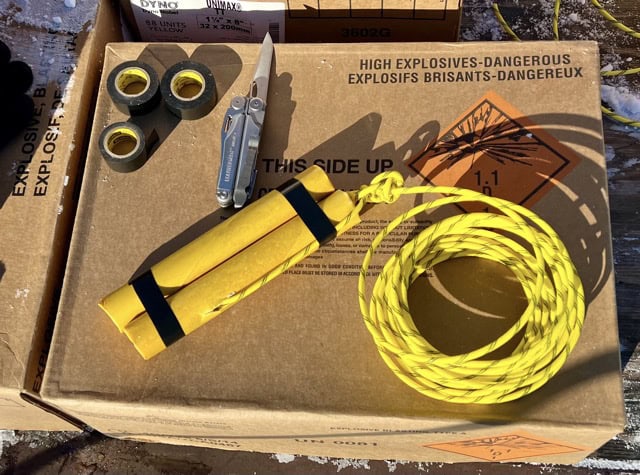
By the time we broke for lunch I was already wiped out, and ate my half-assed peanut butter sandwich without noticing it. I started to regain some feeling with my second cup of coffee, and was dimly aware that I’d been assigned to head back to the open crevasse with the blaster and the science assistant, along with 800lbs of dynamite and hundreds of feet of detonating cord. We parked by the crevasse and set to work threading the cord through single sticks, then taping the sticks end to end along the length of the cord, so we could fill the 30’ deep holes we’d made that morning with columns of high explosives. It was cold work, mostly because what needed to be done was too precise to do with insulted gloves, and protocol forbids the lacing of dynamite with det cord anywhere but at the intended blast site. But after a few hours of focused, repetitive work, all the holes were filled, and each column had been tied together with more cord. We headed back to camp to collect blasting caps, a spool of electric wire, the firing device, and anybody who wanted to come out and watch some shit get exploded.
Once we’d gotten everything we needed, we headed back out toward the detonation site, but stopped well short and parked the Pisten Bully at such an angle that the shock wave of the blast shouldn’t shatter any of the glass windows, while the blaster headed up to the crevasse on a snowmobile to rig the cap and run the wire back out to the safe zone. When he asked for a volunteer to set of the dynamite, I tried to act cool, but my enthusiasm was readily apparent to everyone present. When presented with the firing device, I was astounded at how like the cartoons this part of the process actually was—it was a rectangular wooden box with a t-shaped handle. The blaster walked me through the procedure, and had me practice depressing the handle a couple times with enough force to generate the electric charge that would fire the blasting cap, which would in turn explode the detonation cord, which would, finally, set of the dynamite. When he was satisfied, he tied the wire onto the firing device, and the countdown began.

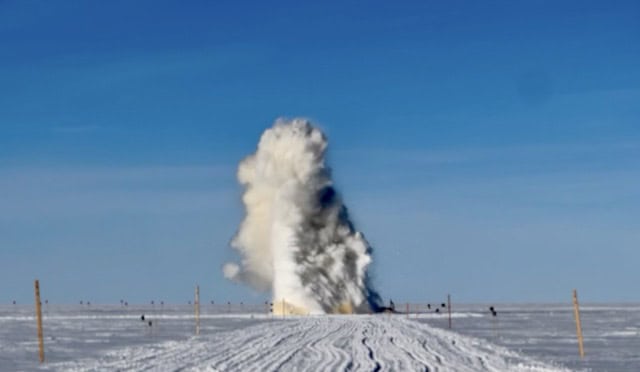
Later, the science assistant would describe the scene after the explosion: “He just stood there, staring at the smoke rising out of the hole and giggling.” I’m not sure I remember it exactly that way, but I’m also not sure what anyone else would have done in that moment. The wind had given up by then, and the sun felt warm on the exposed skin of our faces. The rest of us were giddy with anticipation, but the blaster, ever the profession, calmly finished his countdown and yelled “fire in the hole!” I pushed in the plunger. The barest fraction of a second, and a perfectly symmetrical wall of snow shot twenty feet into the air. The powder had already started to fall back to earth when the sharp CRACK! of the explosion reached senses. Then, like that, it was over, and, yes, I do recall standing there, watching the white sugar snow mix with the tobacco-brown smoke and billow and roll across the ice. And, maybe, yes, I was giggling, but what a strange and marvelous day it had been. I had stood atop something vast and terrifying, intricate and beautiful, something truly awe-inspiring—and I had come closer to it than I ever could have pictured beforehand, as the winds tore at my skin and screamed in my ears. I saw something that, just for a moment, had shut out the cold and the baleful glare of the hard Antarctic sun. Something pure. Something deep.
And then, with that memory still germinating in my soul, I had blown the fucking thing right to hell.
Day 07 – Tuesday, 22 October 2024
Ambient temperature -15°C
In McMurdo, I always hung my work clothes on a hook when I got back to my dorm room, which made it easy to leave my random assortment of tools in the pockets. This habit finally failed me in the Shear Zone camp, where limited space dictated that I keep them folded at the foot of my bed. I’d made it almost a full week without incident, but my luck finally gave out on the seventh day, when I opened up my bibs and my channel-lock plier landed right on my foot. I limped around camp as we got ready to investigate the carnage we had wrought to the narrow crevasse we’d exploded the day before. We’d had to let it air out overnight to let the toxic gases left over from the blast clear, and everyone was anxious to see the final result. It was, it turned out, kind of a mess. The ideal result is a clean, open canyon that can be easily filled with snow scraped from close by, but the hole we’d made was bridged in several places by massive piles of boulders made from hard-packed snow. It would still serve as a step between potential hazard and passable snow road—though the blaster seemed to take it harder than the rest of us.
While the other operators got to work mining snow and pushing it into the crevasse, I went back with the others to bump camp 300’ or so across the Corral. We’d all but depleted our supply of clean snow to melt for water, and we needed to move into an area we had intentionally left undisturbed for just this occasion. When all the pieces were relocated, I moseyed around camp seeing what chores needed doing, then settled in to enjoy a hot cup of ramen noodles. I was just finishing up when two tractors arrived from McMurdo, driven by the mechanics supervisor and the procurement officer, who had broken free from their desks to bring us a fresh herman nelson heater, a second functional snowmobile, and as many marker flags as they could beg, borrow, and/or steal. They stayed for lunch before unloading their cargo and heading back to the island.
We still had one more crevasse to explode, so after lunch a couple of us set out once again with the blaster. The weather was absurdly warm, and even though I was doing nothing more physical than kneeling on the snow, making bundles of dynamite, I was far too hot for my coat. When I brought a box load of rigged sticks over to the blaster, he said, “you know…” he trailed off. “Nah,” he shook his head, “I shouldn’t even say it.” “What?” I prodded. “Well, aren’t you glad we’re not doing this again in weather like yesterday’s?” I agreed. It had been cold, and the difference this afternoon had been a delight. But it didn’t hold. As we were wrapping up at the crevasse the wind picked up, ever so slightly, and suddenly it was freezing again. “I knew I shouldn’t have said anything,” the blaster said as we hopped into the Pisten Bully to collect the blasting machine, blasting caps, and the spool of wire. “It was too good to last.”
Working in the Shear Zone is like a game of the Floor is Lava that never ends. You can’t exit your vehicle until properly roped off, but anytime you’re on one you’re safe. Switching anchor points from the ground can be a giant pain in the ass—especially with gloves or mittens, and especially with a long rope. But if you can just climb onto the vehicle you’re switching your anchor to, voila!, it’s as simple as clipping in and calling it good. And if you’re switching from one vehicle to another, it’s best if they can be parked close enough to step from one onto the other, in which case you can avoid having to rope up altogether. It’s like walking into a languid, hazy dream; one where you’re constantly tripping over a rope.
I was thinking about all this as we clustered together, every human on their own rope, to watch the second crevasse explode. The science assistant had volunteered to be the trigger person, and I watched as the blaster gave her the same briefing he’d given me the day before, knowing the strange weight of such a casually bestowed responsibility. The blasting machine is a small, worn altar, one that literally compels its operator to bow while pushing in the handle. When the moment comes, there is that half-heartbeat of utter stillness before the shower of snow erupts from the ice, and a brief eternity before the thudding POP! makes its way to your ears. And when it was over, and the wind quickly carried the plume across the empty, ivory plains while behind us the snow blew off of White Island in gauzy streams that caught the afternoon light and gave shape to the cold and cutting wind, I looked over at the science assistant, who was standing there, just watching the smoke rising from the hole. She was giggling.
Day 08 – Wednesday, 23 October 2024
Ambient temperature -24°C
The first order of business was to investigate the blast site. While the rest of us were getting our kit together for the day and trying to figure out why the fans in one of the tractors weren’t working, the Shear Zone supervisor and blaster took off on the snowmobiles to do a recce. They were back before the mechanic had replaced the blown fuse responsible for the fan fiasco, and had formulated a plan by the time the operators had wandered back over by the kitchen mod. The dynamite had done its job—mostly. The concealing snow cap had been blown off the crevasse, leaving its smooth face exposed a good fifty feet down, except for a bridge about a third of the way across the road, which would have to be cleaned up before we could backfill the hole. And by cleaned up, I mean exploded.
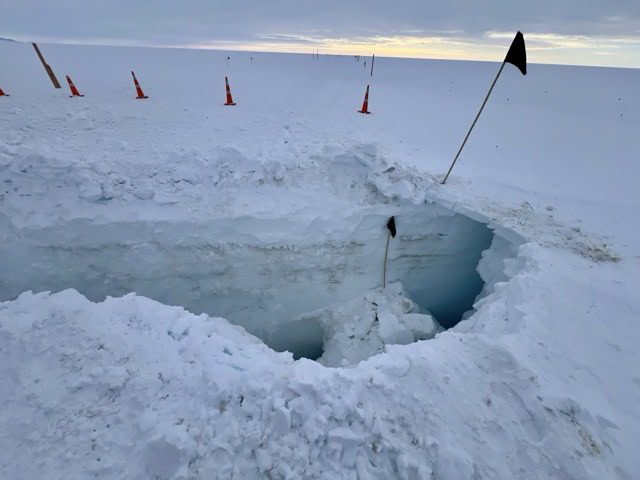
While the blaster collected his supplies, the rest of us headed into the Shear Zone to look at the open crevasse. It really was a marvel, this sheer buried canyon made of ice and snow; it was a little disappointing how completely photographs failed to capture it—but then again, the person equally afraid of heights and of dropping his phone into a glassy abyss is probably not someone who will ever be ideally placed for the shot that truly captures the ice’s soul, or whatever. We kept our lines tight, peering over the edge, trying to make out the geography of what turned out to be two intersecting crevasses as they angled into the dark beyond the hole we’d made above them. The bridge offered the best viewpoint, though the footing was narrow, with a sheer drop all the way to the bottom on either side. We wouldn’t hit the bottom, of course, properly roped in as we were, but that wasn’t necessarily a comfort. “Watch your step,” called the mountaineer after I’d crossed to the other side, “if you fall from there, you’ll swing wide right into this wall, and I promise you that will hurt.”
When the blaster arrived, he set about rigging a 40’ loop of aged, 400-grain Russian det cord, playing out the remainder of the spool he had on hand. This was draped gently over the bridge, with either end dangling into the crevasse. Because there was no dynamite in this blast, we didn’t need to be as far away when it went off. Because everything was basically on the surface, and because we were substantially closer, this explosion was a great deal louder than the previous two—a true BOOM! that rent the air around us when it came, with a brief but visible fireball that rose from the snow like a shot. The bridge disappeared in a loud fluffy white puff of smoke, and with that, it was time to get to work.
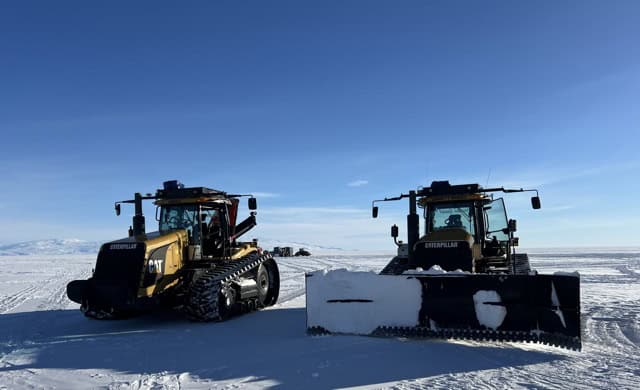
Putting a blade on an ag tractor1 does not make it a bulldozer. For that matter, giving an operator whose background is in trucks and loaders a vehicle with a blade does not mean he will know how to use it. The Challenger hydraulic controls are both temperamentally sensitive and bludgeoningly imprecise, and positioning the blade requires the use of four fingers on the right hand. And if you, like me, were still learning your way around the machine, it would be as if you had only a rudimentary understanding of the piano, but had just been given a car that required you to play a Beethoven sonata in order to steer. So the crevasse-filling process for me was less of a lesson in blade control than a constant, desperate search to figure out what the fuck had just gone wrong.
The process, at least, is fairly straightforward, regardless of how awkward a fumbling operator might make it: The GPR is used to find a safe, crevasse-free zone to the north of the trail,2 as close as possible to the hole being filled. This patch is then mined for snow by bladed tractors, which then push it into the open chasm. It sounds easy, but doing it smoothly takes a steady hand and an incredible amount of finesse, and I had neither. In the end, the other operator did most of the actual work, while I spent most of my time working to fix the mistakes I’d made on my previous pass. Every so often, however, I would get a good push into the crevasse, which was equal parts satisfying and terrifying, the giant pile in front of my blade dropping in a second into the void beyond, which would reveal itself just in front of my tracks. The mountaineer, as per SOP, was parked across the crevasse in the Prinoth, to monitor the stability of the wall we were working over, and to make sure we never came too close to the edge.
It’s frustrating to understand the thing you have to do without the skill to match it. All it takes is practice, of course, but at that point practice was exactly what I hadn’t had. I was amazed when the last push finally filled in the hole completely, making the entirely breadth of the trail passable for all heavy tracked vehicles—one second, you could still see the outlines of the crevasse that we had exposed, and the next it was erase in a single bladefull of snow—but I still felt completely at sea, lost and unhelpful. The only thing left to do was to clean up the trial, which I couldn’t figure out at all, and only watched as the other operator did the job in a handful of adept passes. He was kind enough about it once we were parked back at camp. “Oh, you did good enough. It just takes time.” But I was wiped out. I looked around at the flags marking the perimeter of our site, noting that they were still. There was no wind. It would be a good day for a run, and I needed one; it had been days since I’d last gone out and the exercise would help me burn through my pent-up angst. But first I needed a nap. I staggered to my bunk, clumsily stripped off my bibs and immediately fell asleep on top of my covers. I’d only wanted a quick snooze, but woke up a couple of hours later—and by that time, the wind had returned, spiteful and fierce. I had missed my window.
Day 09 – Thursday, 24 October 2024
Ambient temperature -19°C
I had been routinely limiting my intake of liquids around dinnertime and strictly avoiding them thereafter. It is common practice on traverse to use your pee bottle in your bunk (behind the privacy curtain, of course), but I am a naturally socially awkward person, and sharing a room with two strange women3 made urinating in bed particularly uncomfortable—especially since there is no quiet way to do it. Not that that stopped me, but I did try to prevent it from happening often. I’d also only narrowly avoided leg cramps on two separate nights, so I eventually gave in to my thirst, trying to find the zen in letting nature take its course.
With all the crevasses of concern exploded and backfilled the trail through the Shear Zone was officially open for tracked vehicles. However, it would never be safe enough for foot traffic, so we would continue to be roped in anytime we worked on the ground. The last major job for the operators was raise the 4×4 monuments marking the sites of remediated crevasses that had been partially buried by drifting snow over the past year. As there were 40-50 of these on either side of the trail, it would clearly take quite a while, so the other operator assigned to the task and I donned our big reds and worked out a plan: I would drive the crane Challenger, pulling him behind me on a sled with two long steel runners and flat plywood platform, to which he would remain tied onto the entire time. When we pulled up to a monument, he would secure rigging around it, and I would pull it up with the crane, while getting blasted in the face by the wind as it continued to strengthen throughout the day.
The Fassi cranes on the back of the tractors had always been intuitive to me in a way that the blades had never been—though I could never quite figure out why, as they bore only a scant resemblance to any piece of machinery I’d ever run before (they’re fun to operate, though since the controls sit outside the cab and using it requires only small gestures, it’s a cold, cold job). We quickly fell into a rhythm, and made it all the way to the far side of the Shear Zone4 when camp started trying to call us back for lunch. We demurred, preferring to stay in our groove while the weather was tolerable and we were making good progress. Camp was increasingly skeptical about our well-being during every hourly radio check-in, but with the end in the sight we just wanted to finish. The trail was in perfect condition, as if there had never been any hazards to worry about in the first place. As we finished up and headed back into the kitchen, though, I looked up at the satellite radar image of the area the Shear Zone supervisor had posted on the wall the day we had arrived. In a space maybe four square miles there were hundreds of visible splits—and a fat white line showed where the trail ran through it, years of compression having left a mark in the snow visible from space.
The image was used to show which sections of the Shear Zone were open to which vehicles, but it was a stark reminder why were there in the first place. The first proof-of-concept traverse hadn’t even known this sea of danger existed until a tractor fell into a crevasse. Twenty years later, we were here doing work that had become routine, following long-established procedures. But the risk endures, as new fissures open every year, and the ones considered inconsequential for the tractors—and thus not worth the effort to open and fill—could still swallow a human being, or twist an ankle, or break a leg. We were camped beside a sort of natural minefield, a fact that none of us, by design, was ever able to forget.

Day 10 – Friday, 25 October 2024
Ambient temperature -9°C
Our last full day at Shear Zone camp was also by far the warmest, though an unbroken blanket of clouds gave the skies a moody cast. I remembered an article I had read online during a phase when I was desperately trying to find an upside to the unbearable, gray Seattle winters which had mentioned that photographers prefer this kind of weather, as the diffused sunlight doesn’t cast any hard shadows. Natives of the upper Midwest are familiar with this phenomenon as well, as what is known as flat light erases all shape and definition to the surface of the snow, leaving a single white void that obscures hills, tracks, curves, holes, and any other features you might otherwise use to navigate an open snowfield. This is why the USAP relies on flags to identify safe routes and to mark hazards that might otherwise be easily missed.
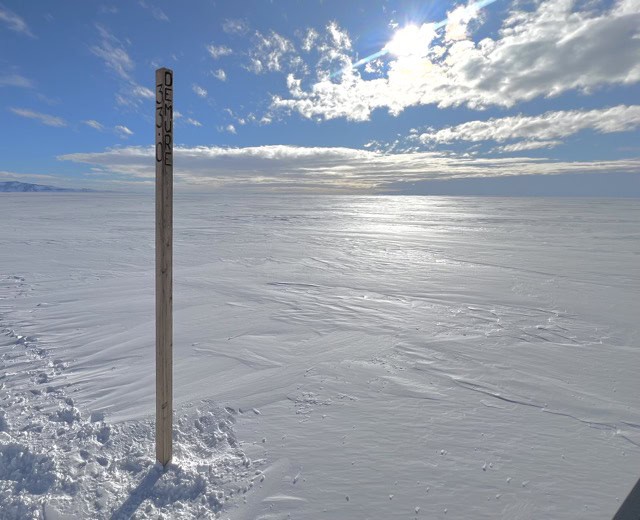
In fact, replacing missing, sunken, or damaged flags was one of the last tasks we had to complete before breaking down camp for the season and heading back to McMurdo. The only other items on the checklist were to take GPS reading of each of the monuments marking filled crevasses,5 and installing new monuments where we had done this filling this year. This last job fell to me, after the mechanic had routed the names and numbers of the new features into the 12’ sticks we’d brought along with us for this purpose. This would be the first and only time I would enter the Shear Zone by myself. Of course, my location and status would be monitored from camp the same as ever, but the feeling of profound solitude in not having another human by your side in a place that foreboding and immense is electric.
There are times and places when working without direct oversight can be seen as an opportunity to cut corners, but a crevasse field is not one of them. All the knots and procedures had started to become second nature to me by that point, but as I stood on the steps of the tractor I took great care to check and double-check that I was properly tied in and anchored. As soon as I stepped onto the snow, I was reminded that habit had been so thoroughly ingrained in us before we ever the station: the crevasse we had filled in a few days before was opened at the surface just a few feet off the trail. Where I stood, atop a buried mountain of backfill, I was safe, but two steps to the north and I’d almost certainly break through the thin bridge just on the other side of the crossed black flags I’d come to replace with a wooden monument. Even as I set about making a post hole with a comically large 6” ice auger, my heart stopped for just a moment as the bit hit a small void under the snow and the drill dropped in my hands. We could make this place passable, but we would never make it safe.
Just as I got back to camp, a group of campers was heading over to look at the traverse module from Antarctica New Zealand that had arrived late in the evening the day before. I’d seen the Kiwis running their rig through the Shear Zone while I’d been placing monuments, and was as curious as the rest to see how our new neighbors lived. As we gathered outside their trailer, we stood in a big circle and introduced ourselves. Then the kiwis followed our supervisor to go have a look at our camp, and we followed theirs inside their home. The quarters were tight, but state of the art and well kept. It was an impressive, if short, tour that was derailed rather quickly as the kiwi supe was talking about the features of their bathroom, and I opened the door to discover a woman from ANZ who hadn’t accompanied her compatriots for reasons that were immediately evident. I slammed the door while mumbling an apology. Our guide said simply, “Huh, I thought everyone had gone to your camp,” before going on about the bells and whistles in their towing vehicles, but wasn’t able to follow anything else he said, fixated as I was on whether I’d just cause some sort of international incident in the literal middle of fucking nowhere.
The sun came out in the afternoon, warming the air even further and replacing the flat white of the surrounding landscape with vivid color and sharp, rich shadows. Whoever wanted to was given the opportunity to head into the Shear Zone one on one with the crevasse specialist for personalized GPR training. It was a fascinating way to look at the work we’d been doing all this time. It was also the missing piece of the zoom class the program had paid for us to take—which had been a fine overview and all, but needed a practical demonstration for the lesson to stick. With the GPR mounted in front of the Pisten Bully it was possible to see the strata of snow and ice beneath the surface, and we learned to read the telltale echos of an approaching crevasse. The crevasse specialist, nicknamed Dr. Snow by the supervisor, was in her element, and was enthusiastic in answering every random, esoteric question I threw at her. The practical purpose was for us to learn to use the device to find potential hazards and clear a safe path for travel across the ice shelf, but mostly I asked questions about the snow and the movement of the ice sheets. Riding in the strange German tractor with a bona-fide expert was my best chance to ask all the questions I’d often wondered about in the years I’d been coming to Antarctica. Even more fascinating than the direct, understandable explanations I often got were the times she would cock her head in response to a query and say, “you know what? Nobody actually knows that.”6 In a world in which all things seems to have a ready, googleable answer, how novel and marvelous to be in a place where so much basic information was still part of a complex, wonderful mystery.
When I returned to camp from GPR training, I threw on my snowboarding pants and fleece hoodie and went for a run. It was the first time in days I’d been able to go for a good jog around the perimeter of the Corral, and it felt good to move through the chill of the light breeze that had picked up late in the afternoon. I moved sluggishly—partially because I was tired, but mostly the corral had picked up a new layer of drifted snow since the last time I’d laced up my trail runners, and every step was like running through sand. I stared around at the scenery as I ran, anxious to drink every bit of it in as my time in this lonely jewel of a place—this masterpiece of ice and rock and snow and sky—came to a close. I would see it again, and not too far into the future, but from the cab of my tractor in a mile-long convoy pushing to make miles every waking moment of the day. This experience had been something altogether different, a strange, baroque gift I still didn’t quite feel I deserved even at the end of it. What had I done to earn this unique time in this unique place? Maybe nothing. And maybe that, ultimately, is the point. Whatever reasons the powers that be had had for sending me here weren’t important, at least not at that moment. I didn’t need to know why to appreciate it, to let it fill me up, to be carried by a quiet sort of gratitude as I rounded a corner and ran toward the flat empty infinity of the ice shelf with the wind at my back. I was there.
- The USAP’s fleet of Challengers—and, in fact, pretty much all the towing vehicles used in the program—are agricultural tractors designed and built for farm work and not, like, moving snow. ↩︎
- The direction is important because of the way the predominant winds tend to drift snow, and mining powder from the east side impacts the trail less when nature inevitably asserts its authority over the works of humankind. ↩︎
- Not that gender has anything to do with it, specifically, but the vibe would have been different had the room been filled with other phallically-equipped individuals doing exact same thing I was doing, and not the humans I heard getting up in the middle of the blazing bright Antarctica night to go pee in another building. ↩︎
- Called Home Free South, because if that’s the direction you’re traveling, you’ve passed the crevasse zone and are free to remove your harness. ↩︎
- This is an annual job, as the two ice sheets that make up the Shear Zone are in constant, oppositional movement, and nothing on or near the surface is technically in the same place it was the year before. ↩︎
- My personal favorite: apparently nobody knows where all the snow around here comes from. Antarctica is the world’s biggest desert, with very little in the way of genuine precipitation. What we do get is drifting snow blown in on the backs of massive wind storms—and clearly this snow has to fall somewhere, but according to Dr. Snow, no one has figured out where that somewhere is. ↩︎