The following is the personal account of a single, long-winded individual’s experiences living and working in Antarctica. No part of it has been reviewed or in any way endorsed by the United States Antarctic Program or the National Science Foundation, or any other public or private organization, institution, contractor, or company associated therewith. The views expressed herein are the author’s alone, for good or for ill.
Day 01 – Wednesday, 16 October 2024
Ambient temperature unknown
The Antarctic summer was in full swing. The population of McMurdo had swelled to the point where the galley had achieved the continuous dull roar it would radiate for the next several months, and though the last sunset of the season wouldn’t happen for yet another week, there was no meaningful darkness left in the night sky. As I meandered from my dorm at 0615hrs the light was already dazzling, violent and bright as it would be at noon. The air was still and, for Antarctica, comfortably warm. We could not have asked for better weather on the day we were heading out into the field.
After a nervous bowl of raisin bran, and a fairly dry morning meeting, the SPOT operators split into two groups. One of these would take the plastic sheets we’d prepared over winfly down the road to Willy Field and start filling fuel bladders on top of them, an arduous, delicate task. The other would spend a few minutes taking a shuttle van back to the dorms to gather our belongings (shooing away all the while the departing winterovers who kept mistaking the van for the bag-drag taxi), deliver those things to the living modules parked at SPOTSA, hook our Challenger tractors up to our loads, and drive to the Shear Zone. It was my first time leaving the outer bounds of McMurdo on land, and the entire morning was given a surreal haze by a kind of giddy excitement—highlighted by the sight of a tractor driving in slow, continuous circles around the camp mods, towing four sheets of HMW, each of which bore an operator working on all fours with a broom to clear the plastic of the snow accumulated in a recent storm.
We had a brief meeting in the kitchen to review the order in which we’d drive down the trail, and the way we would coordinate our movements over the radio. Once we were outside, it was quick work to attach our freight and look it over to make sure everything was in good order. I was driving tractor 292, a freshly-rebuilt vintage B model that would eventually be returned to its home at Pole. But before it made that journey, it would first tow a pair of steel diesel tanks. When everyone had climbed into their cabs, the ritual on the radio began with the lead vehicle: “The Prinoth is ready.” “306 ready.” “311 ready.” “292 ready.” “313 ready.” “PB ready.” The small red tractor bearing the ground-penetrating radar started rolling. “The Prinoth is moving.” The giant yellow CATS followed. “306 moving.” “311 moving.” I took a breath, and dropped into gear. “292 moving.” “313 moving.” “PB moving, all tractors are moving.” We were on our way.
The morning’s drive was smooth and easy, the long-familiar landmarks surrounding Ross Island slowly shifting, the perspectives growing and shrinking as we moved farther from town. As we left Willy Field behind and took to the SPOT road, the chatter on the radio was the only thing keeping us tethered to town—and since a flight was coming in, there was a lot of it, though as the miles passed it became increasingly laden with static. After a couple of hours all I could hear was gibberish, which I tuned out as I following the rolling scenery. I was caught off guard, then, when the tractors ahead of me suddenly stopped moving. I brought 292 to a halt, trying to figure out what was going on, when I saw the traverse supervisor heading my way with his usual swaggering gait. I jumped out of the cab to meet him. “Did you call a stop?” I asked. “Sure did,” he said. “I didn’t hear you.” He laughed, “that explains why you didn’t stop where I told you to.” He thought for a moment. “292 doesn’t have a cab radio,” he said. “No.” “The radios at Pole use a different system, so they didn’t install one of ours in that machine.” He pointed at my handheld, clipped onto bibs. “You’re missing an antenna.” “Oh shit, so I am,” I said, realizing that without the antenna my radio had become all but useless once we’d left the range of the repeaters in McMurdo. He laughed again, “I thought it was weird when I found one in the kitchen after the meeting. I guess now we know why you couldn’t hear anything. Anyways, let go eat lunch.”
Back in my tractor with a newly re-antenna’d radio, I could once again hear all the traffic about the afternoon’s flight, as well as everyone in my group. The call and response began again, clear as the crags poking through the glaciers blanketing White Island to the south. “The Prinoth is ready…” and we were off again, treading comfortably toward a stark horizon where the perfect white of the ice shelf met the 70’s Kodachrome blue of the sky. The drive was pretty, but otherwise unremarkable. We traveled for a couple more hours before I heard the supervisor call for us to stop. We were there.
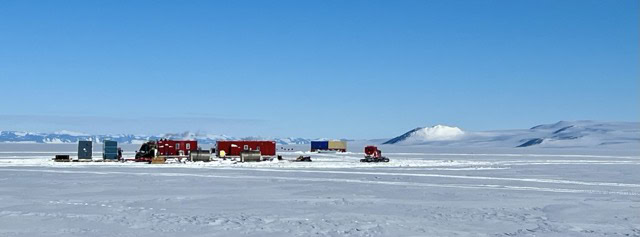
Before we could proceed to set up camp, however, the Prinoth had to scout the area. Our safe zone would be an elongated pentagon almost a mile and half all the way around. This coffin-shaped area is marked by flags at its perimeter, and is known as the Corral. While little was likely to have changed in the past year in the relatively stable ice under the Corral’s surface snow, the pair in the lead vehicle used the ground-penetrating radar, or GPR, to make sure, while the rest of us waiting on the road, idling our machines in the sun. I’d shut the cab heater off a while back, but I was warm in my cozy little greenhouse, listening to the drone of the radio as I watched the Prinoth make slow passes across the snow. I wasn’t aware I had drifted off to sleep until the loud thwack! of a snowball hitting the side of my tractor brought me back to the ice shelf. They had been calling my name on the radio for the last minute, but I’d been out cold. Finally roused, I got my instructions for where to set up the fueling station, and we made camp. The first day’s job was done: we had made it to the edge of the Shear Zone.
Day 02 – Thursday 17 October 2024
Ambient temperature -27°C
The US Antarctic Program, in its current, non-Navy iteration, is only about 40 years old,1 and is in many respects still in its experimental phase, struggling to figure out what works at the frozen end of the earth and the end of a tenuously threaded supply chain, and what doesn’t. South Pole (overland) Traverse is about half that, and every season further refines its equipment and processes without laboring under the misapprehension that any group of human beings living in the cold with a limited (if generous)(by USAP standards) budget is ever going to get it exactly right. That said, there have over time been some areas of consistency within SPOT—though these, like everything else in the post-Covid era, are also rapidly changing.
The standard departmental breakdown is to divide the staff into to two teams, each on entirely separate traverses. The first to leave is SPOT 1, which has in its detachment a mountaineer who is responsible for making sure the route is safe for travel, and, having accomplished that when that traverse makes it to Pole, flies back to McMurdo. SPOT 2 usually leaves a few weeks later, and takes longer to reach the same goal, spending much of the time along the way reflagging the trail and doing any necessary maintenance—though this year SPOT 2’s usual journey had been diverted to a special project to reroute sections of the trail through the mountains. But in a more typical summer, the two cross paths as SPOT 2 is still on its way to Pole and SPOT 1 is on its way back home. Once it arrives there, however, SPOT 1 becomes SPOT 3. All the same personnel and equipment (minus the mountaineer and any one-way drivers taking a piece of equipment to Pole) as SPOT 1 are on SPOT 3, but with a new round of fuel bladders and a newfound sense of urgency: SPOT 3 must take off as soon as possible so it can deliver its payload and return to the relative safety of Ross Island before McMurdo’s long-range SAR apparatus is dismantled for the winter. What this means, in practical terms, is the existence of two similar but distinct long range mobile camps. So while SPOT 1 was being prepped back at SPOTSA, it was a fully-loaded SPOT 2 camp that had taken up residence in the corral, just on the safe side of the Shear Zone.
The pipes froze overnight. Specifically, the pipes connecting the sinks in the bathroom to the graywater drain froze sometime in the early hours before I bumbled in at half past 5 to brush my teeth. As one of the earlier risers, I was one of the first to notice the drain issue. Unfortunately, I only noticed it after I had spit toothpaste into the sink and was staring at it, bleary-eyed, trying to figure out why it was still there. The heat trace2 had had failed—or, rather, it had been run through an unlabeled circuit breaker that had been left off, since no one knew what it was supposed to be attached to. And while turning the breaker back on was an easy fix, the pipes were in bad enough shape that by the end of the day, the mechanic who had been tasked with fixing it was still improvising a series of increasingly interesting solutions, without success. Meanwhile, without the liberty of running water to clean up after myself, my toothpaste residue continued to mock me every time I walked by the bathroom.
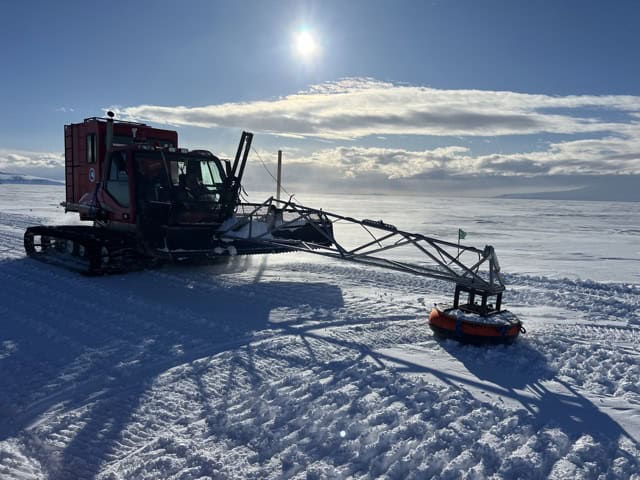
Work at the Shear Zone began slowly. This was by design, since dangers posed by crevasses were the reason we were there in the first place. The Prinoth was driven out by one of the SPOT supervisors and a specialist, who spent the morning creeping along the traverse route, taking a series of detailed GPR scans that specialist would review in the afternoon with her assistant. This data would be used to guide our work the rest of the time we were out there, but in the mean time it left the rest of us with time to tackle a few odds and ends. We fueled the tractors, using an electric pump hooked up to the tanks I’d driven out from McMurdo, got one of the hot-water drills running, and were formally trained on the use of the two snowmobiles we’d brought with us. In the afternoon, I had to move a small skied building that had been staged in the corral since the early days of SPOT, lest it be reclaimed by the continent under a mound of drifting snow. In the process of hitching it to my tractor, I unfastened a chain I’d assumed had only been shacked to the building’s tongue to keep it from getting buried. When I started moving, however, and the shack started to list dangerously to the side from which I’d removed the chain, I realized by mistake—thankfully before destroying an artifact of the first proof-of-concept traverses.
Toward the end of the day, the weather started to turn, clouds and blowing snow obscuring the surrounding mountains. It wasn’t particularly bad weather, per se, but in Antarctica, sort of bad weather can very quickly become extremely bad weather, so we spent some time making sure all the hatches in camp were properly battened. We would just have to see what work we’d be able to do in the morning.
Day 03 – Friday, 18 October 2024
Ambient temperature -18°C
The Shear Zone looks just like any other stretch of the ice shelf. In essence, that is what makes it so treacherous—it is in fact two separate ice shelves, the Ross and the McMurdo, moving in two separate directions and at two separate speeds. The enormous pressure of these two colossal frozen seas rubbing against one another causes the ice to shear, to buckle and crack, forming a line of perilous chasms a mile wide at its thinnest point. This river of crevasses extends the length of the McMurdo shelf, meaning there is no possible overland route that can avoid it, and it is cloaked by the same layer of hardened drifted snow that carpets the entire region. This is why the first step in working in the area is the creation of a reliable GPR model of the ice beneath the surface.
And that model still required a fair bit of refinement before the team could put together a plan to make the Shear Zone passable for a fleet of Challengers. The weather had cleared overnight, though visibility was limited to a few miles in each direction. As the crevasse specialist and her assistant set to work marking the sections of the belt that needed a closer look, the operators took turns learning to drive the Pisten Bully, a small, red, squat German tractor that looks a lot like the less glamorous cousin of the Prinoth. I’d heard nothing but terrible things about them for years, but this one was a lot of fun to drive around the ice (though by all accounts they are miserable on solid ground). When the day’s training was done, the lot of us turned our attention to the drains in the bathroom sink, which were still frozen shut. The latest plan was to put heat on the underside of the floor, which rode maybe three feet above the ground on giant skis. The mechanic had an idea he wanted to try: “Who here had a lonely childhood they’d like to relive?” he asked. “We’re going to build a fort under the building. I’ve got some old woolen blankets in the tool shed. I need you guys to go around every room and vehicle and see what magnets, hooks, and clips you can find. We’ll make a tent under the floor and run a hose from the heater into it.”
The fort was a rousing success, at least in terms of being a fort. The rest of the plan went untested, as the only portable gas-powered heater we’d brought with us didn’t put out any heat—and this after putting out so much heat the day before it melted the control box from the hot water drill the crew was trying to clear snow from. The herman nelson heater is a reliable piece of gear, which can be counted on to start in even the coldest conditions, at least if you squirt a little gas on the carburetor first and light it on fire, but they were made in the era of the Vietnam War, and some times things just break. As the mechanic was sidelined into working on the heater so he could keep working on the frozen drain pipes, one of the other operators and I went off to help the blaster organize the explosives magazine.
I’d never actually been around dynamite before walking into this container with over a thousand pounds of the stuff. The other operator had spent a fair bit of time working in quarries, and he was used to it, but I could help but startle every time he dropped one of the 40lb boxes on the floor with a loud whack! that rang in the small, enclosed space. Dynamite, I learned, is incredible stable—which is part of what makes it so useful. I also learned that over time it weeps nitroglycerin, which leaves the wax paper it’s wrapped in dark and vaguely greasy, like old oilcloth. The boxes had been stacked for secure transport, but now we arranged them in strict FIFO3 order, as anybody with background in food service would recognize is the right and proper way to organize everything. Once that was done, we opened a few boxed and started poking holes through individual sticks with specially-made brass pokers, to be threaded later with detonating cord. Not even that morning would I ever have imagined that, in the afternoon, as the wind stilled and the temperature rose, I would find myself kneeling in the snow, repeatedly stabbing a rod through sticks of dynamite.
As we finished up at the explosives magazine, the mechanic was throwing in the towel on the herman nelson. He could get the engine to run just fine, but the heater wouldn’t produce. We put the decrepit thing away, and he crawled into the fort to evaluate other alternatives. That was when he noticed that the pipes had finally thawed on their own—some combination of the heat trace, the heat of the building, and time had solved the problem none of the rest of us could, and just in time to call it a day. With the work day done, I changed out of my quilted bibs and fleece and down vest and work base layer for a thinner base layer, snowboarding pants, and a thinner fleece, and went for a run around the Corral, followed by my first, short-but-blissful hot shower in camp. What a godsend, to be deluged in steaming hot water at the end of the day; worth every last shovelful of snow it took to refill the snow melter outside.

Day 04 – Saturday, 19 October 2024
Ambient temperature -15°C
It’s the wind that makes all the difference. The day we entered the Shear Zone itself was technically the warmest day we’d been camped in the Corral, but the bluster made it the least pleasant to be outside. Of course, this was the reason the USAP had issued all of us cold weather gear to begin with, so as long as visibility remained fair and the windchill didn’t dip down too far, we would head out as planned—but with one eye constantly scanning for any sign that conditions were about to deteriorate. I wore my standard quilted work coat while we prepped the Pisten Bully, the Prinoth, and one of the hot water drills, but by the time I headed inside to secure my climbing harness with warm and pliant fingers, it felt like I was wearing a jacket made of solid ice. The other operator who was also heading out that day and I both changed into our big, red parkas (called Big Red by everyone in the program), which in most conditions is just too much for a single layer: too thick, too bulky, too warm. It’s hard to layer effectively for working in the elements when your outer shell is like a portable furnace, but I had clearly found the failure point for my trusty Carhartt, and it was time to jump into the down pool—or at least to wade in it, as I ended up keeping it unzipped the entire day.
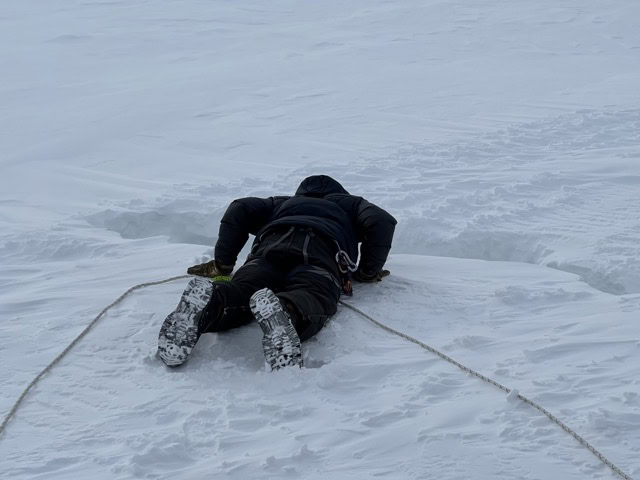
We were going out to profile features that had appeared on the radar scans that seemed worthy of further investigation, using the hot water drill to find the edges of the crevasses and to measure the thickness of the snow bridges that covered them. This we did by feeding a three-foot metal tube with a spray nozzle on the front into the hole it bore into the snow by shooting a jet of hot water from its business end, and noting the measurements marked on the hydraulic hose that fed it when it finally broke through, in the abyss below. Feeling the weight of the drill as it fell into the open space just a few feet beneath us was a visceral warning sign of the hazards hidden beneath the flat, innocent plains of drifted snow on the surface. It was a reminder what all the protocols and gear and weeks of training had been for. We were in an area that was, by its very nature, a dangerous place, but I never felt unsafe. We used the hulking machines as our anchors—and each of us was always securely tied onto one of them before we ever set foot on the ice itself. We kept our lines tight, so that if the ground underfoot ever did give way we would only fall to waist-height. I kept thinking of my time on a maintenance crew with the City of Asheville Department of Water Resources, and how sketchy every job site on a major road had been; how we’d frequently had to work within feet—and sometimes inches—of cars and semis and lines of lifted pickups, screaming by uncomfortably close and uncomfortably fast, as we fought the mud and raging water and fatigue and the elements for sure footing and balance and enough space to sling a shovel in those slick pits, as we dug out never-ending spadefuls of rock and dirt and heartbreak. Crevasse falls do kill people, but traffic kills a great many more, and I was in far less danger working in a known crevasse field than I ever had been on the roads of Western North Carolina.
The SPOT trail passes directly through the Shear Zone for one mile, before turning to the southeast and running between two long parallel crevasses. That one mile is dotted with several dozen monuments, 4x4s planted to mark the areas where crevasses have been remediated—which is to say, exploded and backfilled with snow, at least until its safe to drive a large agricultural tractor over them. The effect when you’re on foot and staring down that corridor is eerie, this narrow bridge of safety across a vast river of death, only made passable under strictly controlled conditions for a single season at a time. The gravity of the risk was brought to the forefront of our vision as we pulled up to an open crevasse, one that had been noted and marked in a past year, but had since widened until a large piece of the snowbridge above had collapsed. A few of us played out our ropes, laying on our bellies and staring into the yawning chasm, the intricately twisted snow giving way as the walls descended to the baroque, blue ice that spun lazily down into the dark, impenetrable heart of the shelf. “It’s like it has no bottom,” somebody said. “It just goes on forever.”
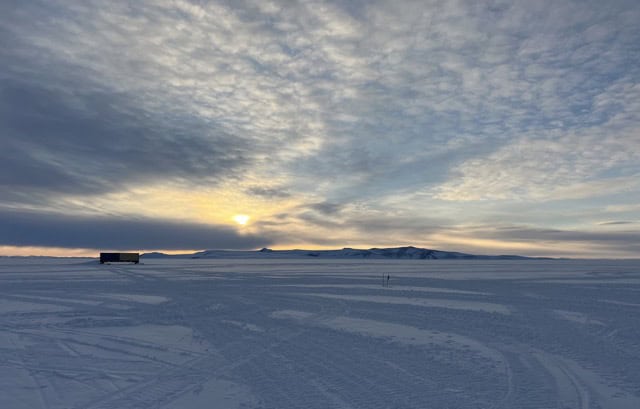
It was mid-afternoon when the weather started to turn and the visibility began to drop. Not terribly, but enough for the supervisor to call it for the day. In Asheville I had worked day and night, in all conditions. I’d worked in thunderstorms and blizzards, in driving rain and howling wind; but at the Shear Zone, nobody fucks with the weather. We packed up the rigs and headed back to the Corral, where the wind picked up more fiercely than ever, before blowing itself out by the time we’d finished getting everything fueled and parked and prepped for the night. The only snag was that the driver’s side door of the Pisten Bully had become cockeyed and wouldn’t latch closed. The three operators tried, in various combinations of positions, to hold the door at just the right angle for the mechanic to secure it in the correct orientation, but as it turns out doors are heavy, and no matter how many times we tried we were always a little bit off. In the end, all it took was the Fassi crane from the tractor parked immediately next to it to lift it into position, and the half hour we had spent straining ourselves in the cold was rendered moot in a few short minutes. But whatever; it was time to head inside.
Day 05 – Sunday, 20 October 2024
Ambient temperature -18°C
At first, I was afraid of the incinolet. Most people are. There’s something about radical changes to our poop routines that profoundly unnerves us, whether it’s traveling to a different country with different hardware or toilet customs, digging a cathole in the wilderness, or shitting into a furnace at the back of a mobile home in Antarctica. I assume it has something to do with the natural anxiety our ancestors felt during those deeply vulnerable few moments when they were exposed and truly defenseless in their wild and dangerous environment. Usually, these changes aren’t that big a deal and are easy to adapt to, but that does little to calm the nervousness of a first time pooper. Even the training the SPOT 1 supervisor gave a small group of us didn’t put me at ease.
“It’s a not party,” he began, unfolding one of the conical paper liners used for every deposit, “without a party hat.” He walked us through the process, which culminates in a tidy paper dumpling of tp and waste4 that is dropped through a foot-pedal actuated trap door into a tiny inferno. After an hour inside the heating rings, all that’s left is a small pile of sterile ash, to be collected later into a bin. The burn chamber is vented to the outdoors, but you do occasionally catch a whiff of burning shit, which is not a wonderful smell, but is a actually a great deal less noxious than you’d likely imagine—somewhere closer to ashtray than outhouse, but not nearly as offensive as either. It’s also surprisingly specific: once you know the odor of ultra-high temperature feces, you’ll be able to recognize it anywhere.
The first morning, the incinolet was a hair-raising adventure; by day three it was routine. Peeing into a bottle, on the other hand, was something I’d been doing since the days when my dad, stereotypically driven to save as much time on family vacation as possible, refused to pull over to the side of the road. As recently as the late 1900s, USAP policy allowed for personnel to urinate freely outdoors near specially designated sites, marked with a yellow flag, but as long I’d been working for the program no drop has been allowed to touch the pristine surface of the ice. Everyone not using an indoor flush toilet or outdoor u-barrel must use a designated pee bottle, which are made freely available for loan.5 The issued bottles are liter-sized, opaque white nalgenes with a large black P markered on the side, but of course, you can pee into pretty much anything of yours that you want to. SPOT spends much of winfly hounding the kitchen staff for empty gallon-sized jugs (maple syrup containers are common, though the wider-mouth salsa varieties are the favorite), since a single liter of capacity is substantially inadequate for a full day spend in the cab of a tractor. At the Shear Zone, most people’s large jugs lived under a bench in the generator mod, across the hall from the sinks and shower and at the other end from the incinolet. I hadn’t much considered before we left the fact that I would be sharing space with a wall of my campmate’s piss, but it was something else that turned out to be relatively easy to accept—especially once I’d discovered the convenience of leaving my own jug on the floor, myself. This tendency also gave the camp supervisor a fairly unobtrusive means of monitoring the group’s fluid intake. “I’ve been seeing a lot of dark pee in the gen mod,” he said at the start of one morning meeting, “guys, we’ve got to make sure we’re all staying hydrated.”
In the field, there is even less distinction between work and life than there is at remote research facility like McMurdo or Pole. Routine chores are part of the job, and each day at least one of the operators would stay in camp with someone more senior monitoring the radio and work on odd jobs while the rest went out into the Shear Zone. The first day my turn came up was a warm one—or rather, the absence of the wind made the high-powered sunshine feel warmer than usual, and I spent the morning bopping around camp in nothing but my t-shirt, base layers, bibs work boots, fleece shirt, insulated gloves, and fleece-lined hat. I felt almost naked as shoveled snow for the melter, filled the water jugs in the kitchen mod, fueled the generator, and moved the fueling station around so I could push the collapsing pile of clean snow closer closer to the building.
Hoping to take advantage of the good weather while it lasted, I changed out of my work clothes at lunch and took a few laps around the Corral, making it back inside just in time to catch the rest of the group before they headed back out to the Shear Zone to keep profiling crevasses. It was my day to cook dinner, and I had funneled my nervousness at having to cook for 10 people into an elaborate meal plan that greatly exceeded the ingredients available. I wanted to make chicken parmesan, but was missing the proper cheese, and had no tomato sauce at all. These problems I intended to solve by pulling the guts from a family-size box of Cheese Pizza Hot Pockets, which I would then dress up with olive oil and canned minced garlic. Not wanting to waste the outer shells, I refilled them with provolone and more minced garlic and pressed the halves back together, calling them Italian cheese pastries. While I was frankensteining a passable marinara, the weather in the Shear Zone took a sudden, drastic dive. Visibility had dropped, and when we looked out the kitchen window, all we could see of the work area was a solid wall of blowing snow. The day’s weather window, nice as it had been, had closed, and everybody outside had to pack it in and return to camp.
I’d brought along the few remaining lemons I’d had from the bag Sean Meadow had brought me from Christchurch, and I figured this was as good a time as any to learn how to zest them, so I could whip a lemon butter for the broccoli I would refuse to heat in the intimidating industrial microwave. This would prove to be my downfall, as the regular oven betrayed me as soon as I tried to heat anything. Sure, everything cooked, but everything also took twice as long as I had planned. The broccoli delayed the chicken. The chicken delayed the pastries. The pastries delayed the garlic bread. And the pasta was delayed simply by my forgetting how long a big ass pot of water actually takes to come to a boil. Dinner was a full hour late, most of which was spent helpless staring through the oven window at food that didn’t seem to be getting any hotter for all the effort I was putting into looking at it. Still, when everything was finally done and the kitchen full of hungry Shear Zone campers was let loose at the spread, it all seemed to go over well. Maybe I’d overdone it—and if the kafkaesque pile of dishes I had to clean after dinner was any indication, I more definitely had—but the food had been good, and it was fun to try new things. By the time every plate and baking sheet was clean, the counters properly disinfected, and the water refilled, I was about as tired as I’ve ever been. The next time I cooked on trail, I decided, I was throwing a pre-made lasagna in the oven and calling it a day.
- As of this writing, the program, in its original form, is exactly 65 years old—which also isn’t terribly ancient, when you think about it. ↩︎
- Which, I learned only a month earlier myself, is a wire heated by an electric current used to keep pipes from freezing. When it works. ↩︎
- First In, First Out ↩︎
- Poop only. Incinolets are in fact designed to handle pee as well, but they’re also designed for a family of 4, and the effect of 10 grown human’s combined urinary and defecatory deposits is apparently a nightmare of lovecraftian dimensions. ↩︎
- All pee bottles are clean when issued, at which point they become the user’s responsibility; there are a couple of designated cleaning stations at McMurdo, and the process is pretty simple and not actually gross—all the more reason that the people who surreptitiously drop off bottles full of piss are the bane of the employees of the Berg Field Center. ↩︎