The following is the personal account of a single, long-winded individual’s experiences living and working in Antarctica. No part of it has been reviewed or in any way endorsed by the United States Antarctic Program or the National Science Foundation, or any other public or private organization, institution, contractor, or company associated therewith. The views expressed herein are the author’s alone, for good or for ill.
October, 2024
When it comes to SPOT—or really any job in the Antarctic that involves running a piece of equipment anywhere off station—the title Heavy Equipment Operator is deceptively narrow. There comes with the job the same degree of routine inspection and maintenance as any operator job anywhere (though anything more complex than adding basic fluids to the machine falls to the more specifically-trained, and better paid, Heavy Equipment Tech), but driving is just one part of a job too nebulous and ever-evolving to summarize in a single label. The skillsets of the individual operators vary, but the balance requires every trade that a mobile field camp might need to survive. Each operator on the South Pole (overland) Traverse needs to be a patient and attentive driver, as well as a sort of glorified gas-station attendant; but on any given day some may need also to be handymen, carpenters, welders, cooks, janitors, electricians, plumbers, medics, mountaineers, data analysts, or inventors. This is not only true after the traverse has left the safety of McMurdo and headed into the Antarctic backcountry, but even during the weeks and months that precede its departure. The department spends the shoulder season, called winfly,1 working industriously on countless projects in preparation for the summer’s long haul across the ice.
I was asked my background when I first interviewed for the job, but never really understood the degree to which I’d actually have to rely on my half-forgotten years of stage carpentry—and the hiring manager’s excitement at learning I’d once spent a season occasionally playing around on the climbing wall at McMurdo’s Big Gym was hard for me to place into context. I had the impression I might have to run a circular saw to make a field repair to a table or a bunk, or jury-rig a tie-down to replace a worn-out piece on one of the sets of fuel bladders, and I saw my history as a long-distance hiker who had needed from time to time to improvise a solution in the wilderness as the greater asset. I was a not quite prepared to be presented with the shell of a sled that was to house a brand new diesel pump and told that part of my job was to build the rest of it, engineering improvements to the design of an older iteration along the way. It was an intimidating assignment, but since the pace of winfly was unhurried and I was given the time and freedom to keep fucking around until I got the result I was after, I happy to spend the days coating my work clothes in layer after layer of fresh sawdust.
Nor was that the only job. Before we could start dewinterizing the camp modules—or even move them off the snow berms on which they’d been stowed since the previous March—we first had to compact the winter’s accumulation of drifted powder at the South Pole (overland) Traverse Staging Area, or SPOTSA. This large groomed pad a mile down the ice shelf from Ross Island had to be compacted with specialized trailers several times over before it was firm enough to physically support all the work that would need to be done to make the mods ready for travel. In order to join in that effort, though, I would need a crash course in driving the agricultural Challenger tractors favored by the USAP for heavy-duty, long-distance towing. I’d had years of experience in a wide array of heavy machines, but had been up front about my naivety with regard to these rubber-tracked tanks. They are hulking brutes, enormously powerful but with wildly sensitive controls, making it frighteningly easy to send all 55,000lbs of machine careening across the snow with the lightest touch. I was given operating guidelines, then set free to perform basic tasks, which I would accomplish with varying degrees of gracefulness and success. Reporting back to the lead operator one afternoon, I told him, “I couldn’t remember whether you told me to build a berm or to make a giant fucking mess, so I just went ahead and did both.”
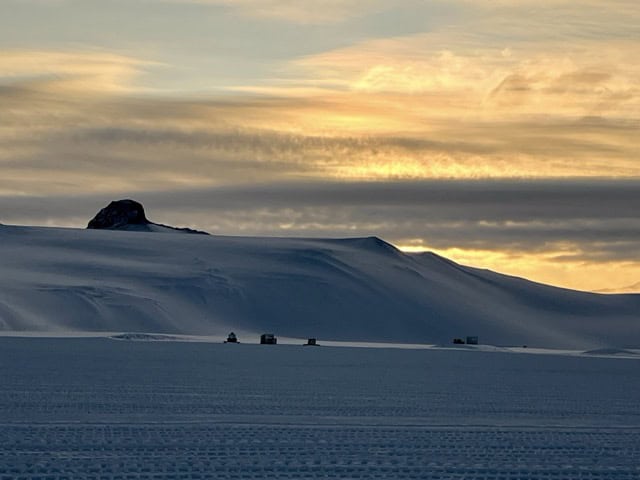
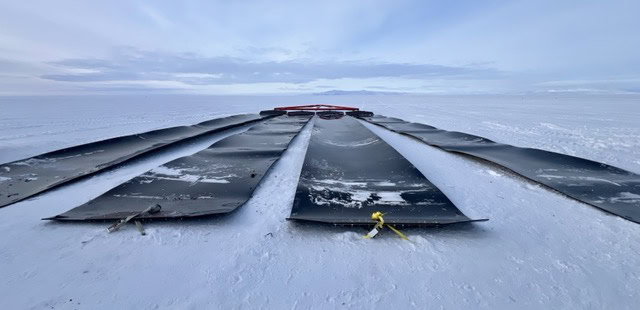
There is a tipping point early on in a new job, I think, before you’re practiced enough to actually be good at it but when things start to make sense, when the confusing formation of dots you’ve been staring at for weeks begins to resolve into a single complex image. It’s a grand feeling, this slow blossoming of nascent competence, quite different from the proud comfort of mastery, but almost as intoxicating, and its warm glow carried me through cold, demanding days on the finished SPOTSA pad, bolting steel plates onto the 70’ sheets of HMW2 we would eventually use to sled our 3,000-gallon bladders all the way to Pole. Every day on the ice shelf, it seemed, was brutally cold—whether I was running a crane on the back of tractor, resetting the D-rings used to tie a small wooden bunkhouse to an older, heavily abused pair of plastic sheets, or replacing the shock-absorbing rubber pads sandwiched between the camp modules and their 8’ long skis. SPOT operators, as group, need a wide variety of skills, but perhaps the most import talent of all is the ability to learn the myriad specifics of such a highly specialized endeavor. There is a high value placed on making sure that there is at least one person (and preferably two) on every traverse who knows how to do every weirdly unique job, so that when something eventually goes wrong on trail, there will always be someone on the team who is able to fix it.
As winfly inevitably gave in to mainbody, the techs brought more and more tractors back to life after their long winter in the hills above McMurdo, wired together the living mods in first the SPOT 2 camp, and then those in SPOT 1, and fired up the generators, finally giving us a warm shelter in which to seek refuge from those cold days on the ice shelf. For the operators, one of the biggest projects of the season was still gathering just over the horizon: filling the bladders with a total of almost quarter of a million gallons of fuel. But while we waited for the pumps at Willy Field3 to be brought online, there was still an endless list of odds and ends to be pinned down, tightened up, rounded off, and sorted through. We restocked supplies for cooking, cleaning, and engine maintenance, made housekeeping repairs, loaded up the food lockers, replaced filters, strapped down cargo, and cleared SPOTSA of snow drifts after every storm. We also met the techs frequently for training sessions which covered anything the program had decided we might need to learn for the trail, including the use of fire extinguishers, physical therapy, exercise, CPR, our tractors’ GPS devices, gas and diesel powered heaters, and ground-penetrating radar.
By far the most lengthy and thorough training course—and the one that most consistently set me into near-panic as I struggled my way through it—was crevasse safety and improvised rescue systems, what we referred to colloquially as ropes class. At the end of each workweek, when most departments across McMurdo were tidying up for the weekend, or else knocking off early, all the operators, techs, foremen, and supervisors in SPOT (along with the lean crew from Heavy Science Traverse, or HST) gathered in the Big Gym. There we would all step into our issued harnesses and learn to tie all the knots, bends, and hitches needed to safely navigate a static-line system. I’d been truthful in my interview—I had learned the basics of fixed-line belay systems when I went through my McMurdo climbing wall phase, but this was something altogether more complicated and substantially more consequential. One week I wrestled with one of the more basic hitches for so long that I never really caught up, and spent the rest of class desperately trying to figure out what everyone else was doing. The next day I found two spare bits of retired climbing rope and began a daily ritual, tying and retying each evening every knot listed in the handbook we’d been given, until they started to feel natural and I could at last summon them into my fingers with only a thought.
Even so, ropes class was continual roller coaster for me: every time I felt like I’d finally mastered whatever it was we were supposed to have learned the week before, something new would throw me for a loop and I felt like I was lagging behind again. It was of small comfort to hear that many of my coworkers had struggled for three years, four years, five years before they felt like they’d gotten the hang of the complex networks of ropes, carabiners, and pulleys we were stringing together each week—but at least some of them had finally gotten it. If nothing else, I would be surrounded by more experienced people while we were in the field. As it was, I managed eventually to bumble along well enough that by the time I learned that I was being put on a crew that would be sent out to do crevasse detection and mitigation at the Shear Zone, I wasn’t completely hopeless. Even so, I was taken aback, and had to look the announcement over several times before I could accept that I wasn’t misreading it. This trip out to the joining place of the McMurdo and Ross Ice Shelves, a minefield of hidden fissures in the ice unavoidable on any overland route between McMurdo and Pole, was considered a choice assignment among the operators. Even as the day of our departure drew close, I still wondered whether the powers that be hadn’t made a mistake. I sure as hell didn’t feel ready to put any of these many weeks of training into practice.
There is a 12’ deep trench dug into the snow just to the north of SPOTSA. Officially known as the crevasse simulator, its use by the Search and Rescueteam, or SAR, for practice has given it its more popular nickname, the SAR-Chasm. This site is the location of the final run-through for SPOT’s ropes class, as it enables an unsettlingly realistic practice setting for crevasse rescue. That dress rehearsal was one of the final requirements for the Shear Zone team before we could leave for the field, and as it happened, we were able to fit it in after lunch, just a day and half before we were scheduled to depart. The weather was perfectly dismal as we arrived and began pulling our harnesses on over our thick, quilted outerwear, with blasts of freezing wind driving the stinging snow into our faces. I couldn’t help but second guess myself at every step, and my insulated gloves gave me all the dexterity of a violently drunk man trapped inside a wet sleeping bag, but all my knots held, and with only a few snags I was able to help rig up a pulley system to a nearby tractor and pull one of our cohort from the bottom of the pit. As I stood at the edge of the SAR Chasm, leaning forward to keep my own rope taught while I lowered an anchored line with a carabiner down to her, I could still hear the Shear Zone team’s supervisor’s opening words at that morning’s briefing on the work we were setting out to do. “We’re going to do a dangerous thing,” he had said.
“But we’re going to do it safely.”

- Short for winter fly-in, winfly is the six-week bridge between the laconic darkness of winter and the frenzied glare of summer—which, incidentally, is referred to officially by the program as mainbody for entirely inscrutable reasons. Winfly starts when the first USAF C-17 lands in August, and lasts until the first flight of mainbody in early October. ↩︎
- HMW being the shorthand used in the department for High Molecular Weight plastic, which is heavy, thick, durable, and incredibly slick—an important feature if you’re trying to drag two and half tons of fuel across the snow in a timely manner. ↩︎
- Williams Airfield, about 7 miles from town on the ice shelf, is the home of the skiway and the summer roost for program’s fleet of ski-bearing aircraft. ↩︎
Hey Al!
Love this blog!!! Not sure if Cody mentioned this to you but would love to host you for a future program. Could be virtual but be better in person with you showing media and discussing your treks around the ice.
Goodluck and safe travels always!
Love, Papa B
Wow, who knew !!! So interesting
Stay Safe