The following is the personal account of a single, long-winded individual’s experiences living and working in Antarctica. No part of it has been reviewed or in any way endorsed by the United States Antarctic Program or the National Science Foundation, or any other public or private organization, institution, contractor, or company associated therewith. The views expressed herein are the author’s alone, for good or for ill.
It was through a series of Tinder dates arranged during a phase of my life when I was both working seasonally on the ice and single that I perfected my go-to explanation for what it is, more or less, that the US Antarctic Program does—or at least I briefly thought I had. This was early enough in my career on the ice that I hadn’t yet learned to play the Antarctica card sparingly, and as a result I frequently found myself struggling to bullshit my way through an illustration even the program’s media outreach specialists find difficult to make clearly and succinctly, and all while trying to come off as confident, knowledgeable, and charismatic.
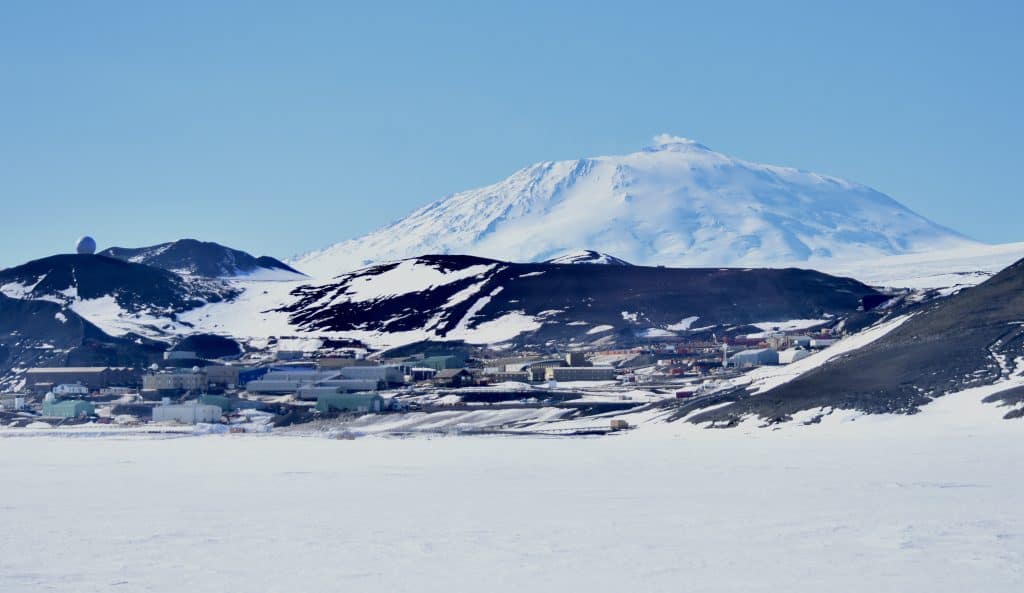
In the simplest terms, the function of the USAP is to provide the infrastructure and logistical support necessary for scientists of pretty much every disciple imaginable to come to the continent and collect the data they need to ply their various, highly-technical trades. This is the part of the pitch I got down. What I never mastered were the inevitable follow-up questions, because of course that answer isn’t terribly satisfying; it tells the truth without painting a picture, but the picture is just so god damned big. To provide a platform for study at the magnitude attempted by this offshoot of the National Science Foundation requires the ongoing operation of three year-round research stations scattered across the seventh continent, each of which functions like its own tiny, isolated city—albeit with transient populations who are required by contract to return to true civilization for at least 6 weeks every 14 months. Palmer Station, along the relatively mild coast of the Antarctic Peninsula, is the smallest of the trio, and generally has little to do with its louder, larger cousins across the ice. Amundsen-Scott Station is at the South Pole, and is the image conjured to most regular people’s minds when they hear the word Antarctica. Larger than Palmer, its remoteness nonetheless keeps its population sparse, located as it is hundreds of miles from anything else on the vast polar plateau. McMurdo Station is the program’s logistics hub, situated on Ross Island, approximately 60 miles from the mainland, along the natural border where the permanent Ross Ice Shelf meets the annually-formed sea ice of the frozen Ross Sea.1
Each of these stations is staffed by seasonal contract workers with specific, distinct jobs that, taken together, allow for the existence of human society in the least habitable habitat on Earth—and thus not only make scientific research possible, but make it possible at a truly mid-boggling scale. Every year hundreds of researchers working on dozens of different projects come to the ice, each of them supported by this broad network of interdependent contract employees. McMurdo, especially, is immediately recognizable to any newcomer as a straight up town. It is a true megalopolis by Antarctic standards, with roads, a profusion of weathered semi-industrial buildings, traffic, construction, office complexes, dumpsters, and a summer population that regularly verges on quadruple digits. Its continuance is independent of any one scientific project, as the breadth of the summer population of contract employees alone requires a sizable staff to sustain. As a grunt worker it can be easy to forget that any endeavor more intellectual than mopping the floor or moving accumulated drifts of snow with a front-end loader is ever afoot—but that is ultimately what makes McMurdo the research mecca that it is: all of the groundwork has been so thoroughly established, all a science team really has to do is show up and do science. If your work is sponsored by an American institution and you’ve managed to get your funding squared away, the program will get you and your equipment to whatever specific site you need to get to, and will guide, feed, house, and clothe you along the way.
Officially called grantees by the program in reference to way they obtain financing for their research (and beakers2 by the contract workers), the academics are sort of the default public face of the Antarctic—the USAP’s cover models, despite the fact that they typically only deploy to the ice for as little as a few days or weeks at a time. It isn’t surprising that nobody’s first thought when you tell them you work in Antarctica is logistics or infrastructure, but it does get tiresome to have to paint the entire picture every time the subject comes up with someone new. It was the fact that I needed to explain to a series of puzzled women how it was that I worked half the year in Antarctica without being a penguin scientist that drove me to look for a charming, non-rambling way to describe how it was that I was ever down there at all. Without the right context, it seems, no one can quite picture their date unloading ski-bearing aircraft with an antiquated CAT loader, trundling on monster-truck tires across an ad-hoc airfield built onto a slab of ancient ice hundreds of feet thick and hundreds of miles wide, which is in constant, if imperceptibly gradual, motion. I was, for years, a cargo handler in a community of support staff that includes cooks, helicopter pilots, janitors, dish washers, mechanics, carpenters, trash collectors, plumbers, warehouse workers, and all manner of tradespeople and so-called unskilled laborers, all working together under the umbrella of the USAP’s Antarctic Support Contract to create the framework that allows a glaciologist from the University of Minnesota to bring a team into the heart of the Transantarctic Mountains to collect in a week the data they’ll spend the next several years sifting through.
All three of the US stations are staffed year-round—and there is always at least one or two ongoing science projects being done at each—but most of the work happens during the Austral summer, from October until February, when the sun doesn’t set, but circles the sky in endless, lazy loops. The weather is warmer (getting, in some places, as high as the low 30s), storms are less frequent and usually less intense, and the constant daylight allows for work to be done at all hours. While the continent as a whole is immense and empty in a way that defies imagination, where there are outposts of human civilization the summer is defined by a crowded, frenetic energy. There is a lot to be done during these few gentler months before the twilight returns to the ice and brings with it the bitter fury of winter; time is always a factor while the sun is shining. When you look down at the flurry of constant activity from one of the viewpoints above McMurdo on a clear, sunny day, it looks like some hobbyist’s model of a mining town, one that has been stepped on an left in the snow, where it has since been claimed by a determined army of frantic ants, each bundled in its own teensy red USAP parka.
And who better understands an ant than another ant? It was the ice that ultimately brought Sean Meadow and I together, one of things we shared as individuals before we shared them as partners. We have never needed to describe Antarctica to one another, nor our own places within it. That alone isn’t enough of a foundation for a relationship, of course, but it’s not for nothing that most people choose to build a life with someone who is already living the way they do. The damage done to a blossoming romance by the disruption of a half-year deployment is a common theme among friends from McMurdo who have tried dating in the real world. Most people have to choose one or the other, and it’s rare that love wins out over the ice (though it does happen from time to time). How much more precious, then, to find someone who fits into your hopes and dreams, fits into your heart, fits perfectly across your chest like a loved and heavily worn down coat—while living, permanently impermanent, at the ass-end of planet Earth. And though by the dictates of the Antarctic Treaty no one can own this place, even the smallest piece of it, it is nevertheless ours: a home we can visit, but never truly adopt, as we stand on an ever shifting patch of ice, holding one mittened hand in another.

- All of which were named after long-dead Englishman James Clark Ross by soon-to-be dead Englishman Robert Falcon Scott, whose general ineptitude at leading a party into the frozen unknown was outmatched only by his confounding inability to give different things different names. ↩︎
- Named for the laboratory assistant on The Muppet Show with a monosyllabic vocabulary, because they’re, like, you know, nerds. ↩︎