The following is the personal account of a single, long-winded individual’s experiences living and working in Antarctica. No part of it has been reviewed or in any way endorsed by the United States Antarctic Program or the National Science Foundation, or any other public or private organization, institution, contractor, or company associated therewith. The views expressed herein are the author’s alone, for good or for ill.
May, 2024
I was struggling to stay awake. Despite the mild early summer weather, the air conditioning in the converted manufacturing plant used by the Asheville Department of Water Resources Maintenance as a home base was set almost low enough to see your own breath, and I had overcompensated. Stuck inside the East District office for the day to attend a zoom training for my required Class C Potable Water Operator’s Distribution License, I was bundled up like a first-grader waiting for the bus in mid-January, and settled into my cracked and defeated office chair feeling warm and cozy. The trainer’s frequent digressions made it hard to follow material that was already excessively dry (now, many months later, I can still easily recall the fact that this man claimed he was easily able to remember his wedding anniversary because of its proximity to Smoky Bear’s birthday—“just three days before!”—but couldn’t even guess as to the relative strengths/weaknesses of water mains built from ductile vs. cast iron, which was the sort of thing I was actually supposed to be learning) and as he talked forever onward about whatever topic his mind brushed against I found I could barely keep my eyes open.
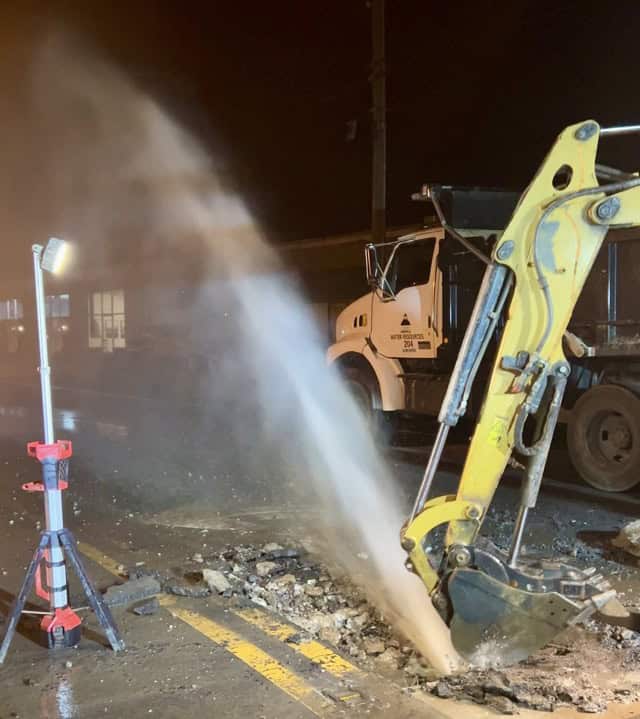
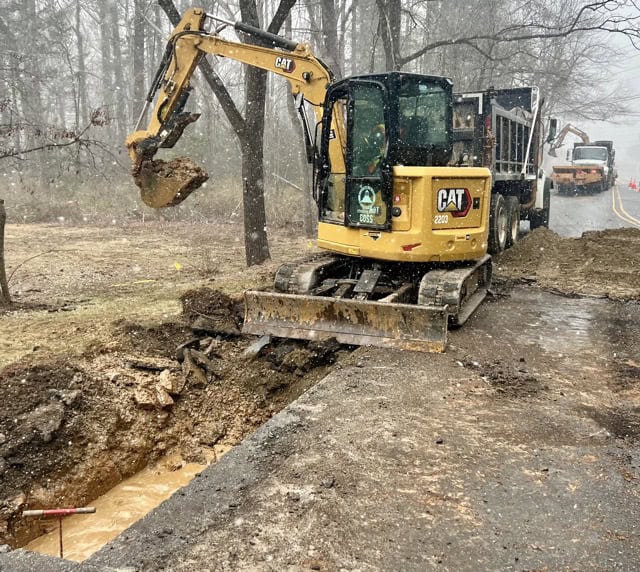
I was starting my eighth month in water maintenance, a job in which I, broadly speaking, repaired leaky, cracked, exploded, or otherwise broken water mains, but which in practice consisted mostly of standing knee- or hip- or belly- or chest- or neck-deep in the mud (what is known in the business as the hole), and shoveling the uncooperative earth of Asheville, North Carolina by hand at all hours of the day and night. This pivot in my career path had been influenced by several factors: the nesting instinct prompting Sean Meadow and I to build our own little home together, a growing desire to stay somewhere within a not-impossible drive of our respective families, and, ultimately, my own frustration at finding my path toward the position I’d been chasing for years in Antarctica had apparently dead-ended. Working seasonally in the great frozen wasteland at the bottom of the world had been a hell of a ride for the previous seven years, but I had always had a glimmer of something vast and inviting calling across the lifeless white horizon. I wanted to work in the deep field, to enter and embrace that lonely expanse, and when I failed again and again to land a contract that would take me there I lost heart for the job at the center of the US Antarctic Program’s logistics operation at McMurdo Station that had for several years given me a receptive outlet for all my energy and drive.
I was ready for a change, and since I couldn’t do the job I really wanted to do, I figured as I may as well try something else entirely; but the job hadn’t turned out to be quite what I’d been expecting. I’d always assumed that a middle-class upbringing and a long series of light-duty occupations which had allowed me to “focus on my art” had rendered me far too fragile and doughy for this sort of back-breaking manual labor, and was pleasantly surprised to learn that I was, in fact, up to it—but that nascent sense of blue-collar pride didn’t make the work any less grueling or physically exhausting. Water maintenance is infamous in the roughneck world as a particularly shitty undertaking—even outside of our little patch of Western North Carolina, where the weather, terrain, and uncommonly high pressure of the water system conspire to make the job uniquely and extraordinarily unpleasant. The work is arduous, dangerous, frustrating, never-ending, and yet often tedious in the extreme. It’s brutally hot in the summer and bitingly cold even in the Southeast’s typically mild winters. It’s overwhelmingly noisy, each job site an aural conflagration of diesel engines, screaming gas-powered pumps and saws, and the ever-present roar of clean, treated drinking water erupting from a break in a 2” or 4” or 6” or 8” or 12” or 24” cast iron or ductile iron or stainless steel or polyvinyl chloride pipe under anywhere from 20 to 400 pounds per square inch of pressure driven by the topography of the Blue Ridge Mountains. It might nonetheless have been bearable if not for the incredible demands Asheville’s aged and rotting infrastructure places on those tasked with fixing it: even when not on call we were frequently required to work long, unpredictable hours, often late into the night, simply because there was no one else to do the job—only to drag our miserable asses back into the shop early the next morning. During bad stretches, some of the workers wouldn’t even bother going home, opting instead to sleep in their cars, or tucked in the back of one of the service trucks, or even in a pop-up tent outside in the employee parking lot. It was a thin existence, one that left no room for a life outside of the hole. By the time the department’s Senior Supervisor sat my crew down one winter morning to offer us praise for working through lunch during a snowstorm, I had already decided I would be gone by the following fall. I just wasn’t sure what I was going to do instead.
When a friend from the ice had casually mentioned that this might be a good year to apply once again to join the South Pole Overland Traverse, or SPOT, I was at first dismissive. I’d moved on, I felt, grown up and left those frost-bitten dreams to shrivel and die on the plateaus of the world’s greatest desert. I didn’t much care for the prospect of trying to reanimate them, especially dim as I considered my prospects. My friend was insistent, but so was I: I was sick of the program, sick of the bureaucracy, sick of the instability of seasonal work, sick of pursing mirages on the ice that vanished as you approached them. Eventually he relented. But when I related the conversation to Sean Meadow that evening over dinner, she was less easily deterred. “You need to do this,” she said, “You’ve chased after this job for years; it’s the only job I’ve ever seen you genuinely excited to pursue. You need to try.” I protested. There was no way they would ever hire me, and anyway, I wasn’t particularly keen to pack up and leave the life we had been building together in our own tiny corner of Appalachia. But she knew me too well—there would always be a part of me that heard the call of that vast white wilderness, however faintly, and if I had any opportunity to get there, however remote, I needed to take it. The rest of it we could figure out along the way.
I wasn’t terribly surprised when I managed to score an interview; I had made it that far a few times before. Nor was I shocked when the interview seemed to go well. Antarctica had been my home in all but the legal and technical senses for years, and it was easy and natural to fall back into the argot of the ice with a fellow Antarctican. I was technically qualified and comfortable within the McMurdo community. But I kept my expectations low—so low that I had almost forgotten about it a couple of weeks later as I was dozing/not dozing in my cracked and defeated office chair, while the Class C Distribution trainer rambled on about his favorites among the fire hydrants he had seen across the nation, boasting proudly of his photograph collection. I was brought back to the present by an animated buzzing in my pocket. I pulled out my phone, expecting to see a notification for a spam email, or a text from Sean Meadow about meeting up with some friends for drinks after work, or an article my mom had found on the 10 most scenic bars in Asheville, but it wasn’t any of those. It was a job offer. Should I accept the contract, I would leave in a few short months to become a heavy equipment operator, driving a tractor across the Seventh Continent from McMurdo Station, off the mainland coast, to the South Pole, and back.
“Holy shit,” I said to the empty room, the trainer on the screen now talking excitedly about the runaway truck ramps found on the steep mountain highways across the western passes of our state.
“I’m going back to Antarctica.”