Day 36: 23 May, 25.6 miles today, 700.5 miles total, Kaibab National Forest
“I know it’s a silly thing,” I said to Sean Meadow, “but one of the things I was most looking forward to in finishing the AZT was getting to Utah. Aside from the odd hour-long layover in Salt Lake City, I’ve never actually been.” We we’re in San Diego, volunteering with legendary trail angels Scout and Frodo, helping to get hikers ready to start the PCT in the backyard of their comfortable Southern California home. It was early May, and we’d just learned that the summer jobs we’d been promised had been given to other people, after the hiring manager we’d been talking to—and who had told us that the jobs were ours—had quit in the middle of hiring season. We were trying to plan our next move. I’d been itchy to get back to the Arizona Trail almost as soon as we’d left it, but the climb up the North Rim of the Grand Canyon would be hard closed to the public until at least June. Sean Meadow hoped to be home in Pennsylvania by then; I wasn’t sure what I wanted to do, except, someday, go to Utah.
She thought for a moment. “Well, we can go when we leave here, if you want to. Go backpacking for a couple of days in Zion. Camp at Bryce Canyon. See at least a little of the state.” It was such a perfect idea, with such perfect timing, that the matter was settled almost immediately. We’d spend a few days threading our way to the northeast through Death Valley and Las Vegas, and then go see what southern Utah had offer. I was so pumped that my enthusiasm for the adventure wasn’t dimmed a bit, even when I learned I would have to literally shit into a bag while in the backcountry in Zion—despite the abundance of extremely diggable soil at both of the areas our permit allowed us to camp.
It was while we were in the park, and I found myself with cell service despite being situated at the bottom of a giant canyon, that I thought to check the AZT class of 2023 page for updates—maybe, against all logic and experience, the Park Service had reopened the North Rim early and I could finally put this trail to bed. What I learned, instead, was that the closure had been extended by two weeks, “until June 15, at the earliest.” Well, shit. We’d be long gone, by then.
The idea was all Sean Meadow’s. “Look,” she said one evening at camp, “we’re already out here with a car. You can’t hike the complete trail, but so what? You can finish the rest of it if you want to. A lot of people have to skip miles on their thru-hikes. A lot of AZT hikers have had to that this year! You can do a rim-to-rim hike some other time, but we still have time for me to drop you off and for you to finish that last section into Utah.” I wanted to sleep on it. It was a fantastic offer, but first I’d have to let go of hiking into and out of the Grand Canyon itself—it was kind of the crux of the entire hike, the crown jewel of the Arizona Trail. But Sean Meadow was right. It could wait. Better to hike what I could now, while we were in the right part of the country.
We planned at first for her to drop me off at the Northern Terminus, leaving me to walk south toward the North Rim. The rough dirt road to the campground at the state line (called State Line Campground) was passable even by small, low-clearance cars like Sean Meadow’s Vibe, we were assured—just so long as it was dry. So it was that we made the turn off the state highway with much trepidation in the middle of un-forecast downpour. The sign just past a sticky-looking mud parking lot read “ROAD IMPASSIBLE WHEN WET.” We stopped and talked over our options, and it was with some measure of shared relief that we agreed to camp further south, along a paved road, and drop me off as close to the North Rim as possible. With any luck, the road to State Line would dry out in the time it took me to walk there.
In the meantime, we luxuriated in a well-groomed front-country campsite at Jacob Lake, where we roasted brats and marshmallows over our campfire before stepping into our palatial $40 walmart tent. We talked as we pulled out onto the road the next morning about how neither of us had ever seen pit toilets before so clean and so we’ll maintained. The drive to the park’s gated northern boundary was over before I knew it. With that entrance closed, the AZT between there and trail closure at the North Rim still buried deep in snow, and the Park Service now warning hikers not to road walk that section lest they be injured, killed, or fined, this was the point at which I would resume my walk to Utah. I’d be jumping 33 miles ahead, but so be it. Lots of other hikers hadn’t made it even this far.
Sean Meadow and made plan to meet where the trail crossed the road by the Jacob Lake campground, and we said our good byes. I listen to the sound of her engine grow dim as I walked the highway the last few hundred feet to the gate, where the trail briefly kissed the pavement before winding back up into the hills to the east. I felt more alone in that moment than I had I weeks—but also a sort of elated giddiness. It was so good to be back on trail.
I didn’t even mind that most of it at this point was still buried in thinning snow, nor that the bits of it that weren’t had turned the footpath into a frigid, flowing stream a couple feet deep in some places. The morning was an exercise in trying to keep my footing while keeping my feet dry, which I sort of did, a little, but the small valleys I was tracing were beautiful in the clear, bright morning, and the ringing echo of the woodpeckers hammering away in the trees around me kept my spirits high even as my socks got a little soggy.
Around midday, the trail finally climbed out of that series of drainages and started in earnest to forge northward across the Kaibab Plateau. I had a stellar view of the East Rim at a spot that I assumed must be near a parking lot, given the handful of older people meandering about, taking in the scenery. Indeed, I wouldn’t be far from the highway I’d driven down to start this section of trail for the rest of the day—but I never heard more than the occasional car. For the most part, I was alone with the birds and the mud and the sunshine and the trees.
Later in the afternoon, I stopped for water at a flooded, penned-in pond within view of the road. I don’t know if that particular spot is always a popular hangout for whatever larvae it was I kept scooping up into my bladder, or if it had something to do with all the waterlogged grass, but every time I filled a liter, it was full of these gnarly little swimmers. I finally figured out, however, that they were scared of me, and would briefly dive out of harm’s way whenever I disturbed the surface. Giving the water a firm slap let me then get all the yellow, tabun-soaked water I needed, without all the little wrigglers waiting die a grisly death and clog my filter in the process.
As the sun was sinking in the west, I finally came to an abandoned campsite, complete with fire ring. It was just barely out of the wind, but just barely was good enough. I’d had a good day, but I was ready to settle into my sleeping bag and get some rest. I’d be back at it again in just a few hours time. For now, it just felt good to be back.
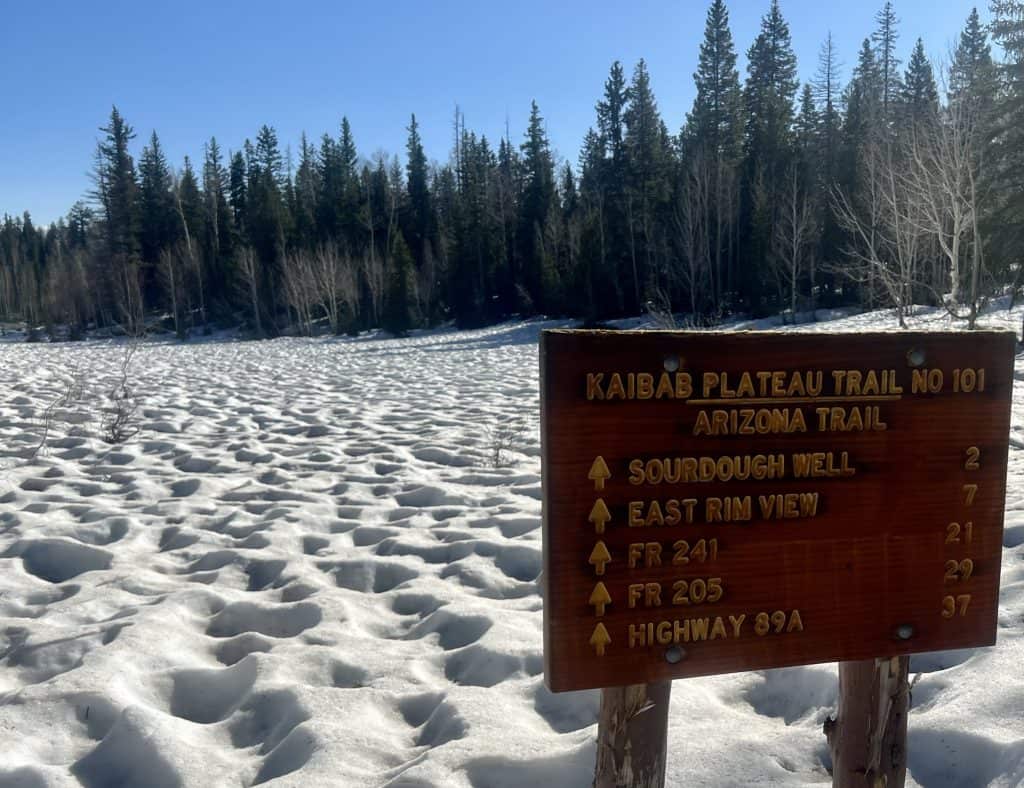
Day 37: 24 May, 28.7 miles today, 729.2 miles total, Kaibab National Forest
I had clearly missed the bubble in my time off trail. Aside from the view-lookers I’d passed the day before, I hadn’t seen a single other person out on the trail. In a typical year, no NOBO would be out hiking this close to June, anyway—but this was far from a typical year. It had been a heavy-traffic year for the AZT, and a strange one with lingering snow and a broken trail up the North Rim. Lots of people had bailed before this point, but I’d have figured lots of others would have paused. I’d been alone plenty of times on this hike so far, but the feeling now was that nobody else had been out here for days, at the least. The patches of snow still remaining this far up the Kaibab Plateau had melted the footprints of my predecessors away, and refrozen smooth without them. It was just me and the deer, without a trace of other people—except for the nearby highway, of course.
“Snow is slow,” according to the old saying I just made up.* Even if you’re not route finding, even if you’re not breaking trail, even if you’re not planting each cramponed step before taking the next, snow is the pace killer. It’s uneven, it’s slick, it takes extra physical effort to navigate; your speed drops even as the energy it takes simply to walk skyrockets. The morning before had been exhausting. I was thankful now to be gradually heading downhill, as the blobs of snow still clinging fiercely to each north-facing slope would diminish and eventually disappear with the drop in elevation.
By midday I was finally free of the stuff, and cruised into a trailhead close by the campground where Sean Meadow was staying. She met me for lunch with water, cookies, and cold, fizzy diet coke. I had a blanketless picnic while we chatted about this and that. The time passed quickly, the way rest stops always do, and soon we were saying goodbye and I wandered back into the woods.
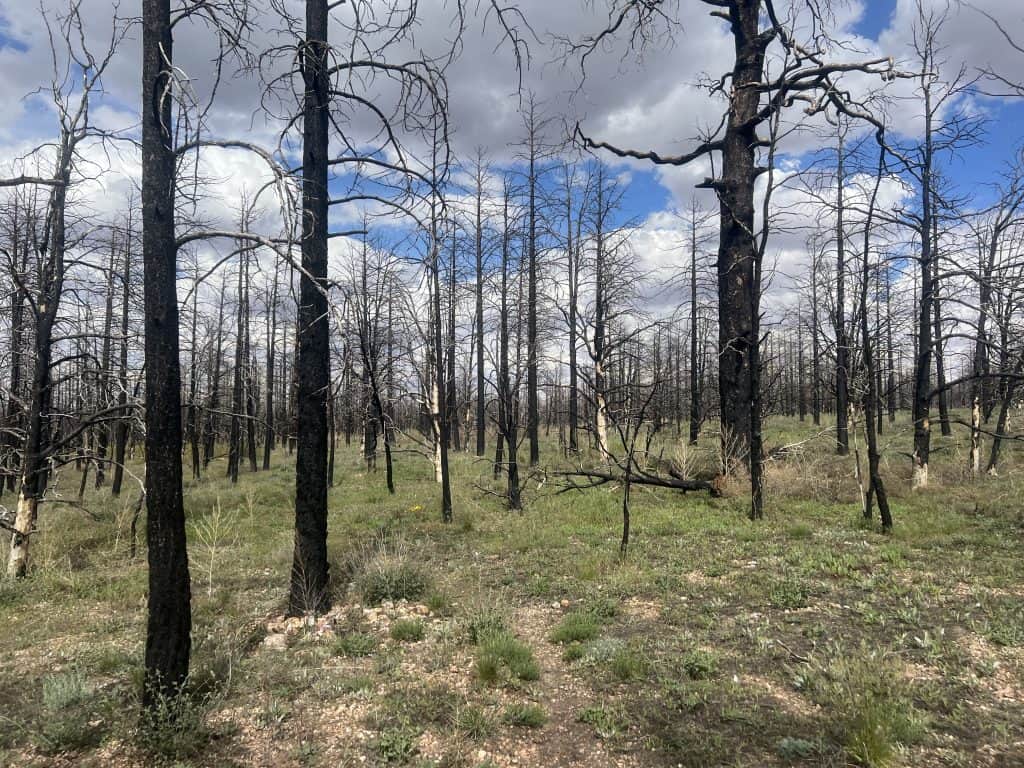
The afternoon was a long slog. The open stands of ponderosa pine I’d merrily been breezing through had given way to a desolate burn that stretched on as far as I could see. Sandy grit infiltrated my shoes, and in the heat turned my socks into sandpaper. By the time I reached the next water source, a stagnant cement tank with deep green water, my feet were an abraded, painful mess. I cleaned them up as best I could and put in my last pair of fresh socks, but my just barely too-tight shoes continued to rub on my raw skin as I walked well into the evening, unable to find a decent spot to camp in the flat, unburnt fields of chaparral that eventually replaced the burn as I continued downhill. It was almost sunset before I was finally able to pitch my tent and eat a hurried dinner. I’d made good time, and was completely done in, falling dead asleep almost before I pulled my sleeping bag up to my chin.
*Though I’ve never heard anyone say this phrase before, I assume somebody must have, somewhere. The rhyme is just too pithy and is exactly the sort of shit axiom hikers love to repeat.
Day 38: 25 May, 13.0 miles today, 742.2 miles total, Utah/Arizona state line
It didn’t feel like a thru-hike—and maybe it wasn’t. True, hikers on 5-month trails often take weeks off for personal reasons or to allow trail conditions to improve, but doing so on a 6 week hike really seemed to violate the spirit of doing the thing in one go. Maybe I’d become a section hiker.
Reinforcing that creeping sensation was the inescapable fact that this was the third time now that I’d hit this trail with feet unaccustomed to walking long days through an arid landscape. The first two times I’d had brand new shoes that were up to the job of keeping the desert off my feet—at least long enough for them to toughen up. This time, however, this pair of trail runners were showing their age: the tread was wearing smooth, the soles were frayed and peeling at the edges, and the mesh upper was worn and defeated enough to let sand, dust, and grit permeate my socks. It didn’t matter how often I changed them; within minutes, each new pair of socks was studded with sharp grains that tore into my delicate, unprepared feet.
There was nothing to be done about it, I decided as I hobbled off to dig my morning cathole. I’d cleaned my feet and changed my socks, emptied my shoes of invasive debris as best as I could. I just had to walk 13 more miles, and my feet could heal in peace. It was perhaps this train of thought that distracted me from my surroundings long enough for me to put my hand directly onto a cactus while pooping. I sighed, pulling the long spine from my thumb, surprised at the amount of blood it has drawn. The desert does not forgive you the luxury of absent-mindedness.
I knew the pain in my feet would recede once the rhythm of walking settled into my body, but even so it took a while, and the flat, thorny landscape didn’t do much to take my mind from it. I was just starting to wonder whether this hike would end in a sun-blasted anticlimax, when the trail dropped into a small canyon and started snaking toward the northeast. “This is a nice change,” I thought, before climbing out of the canyon and up onto a ridge. I stood at the top, pausing for a moment to take it all in.
I was three miles from the northern terminus, looking out over a long, grassy slope sprayed with orange and purple wildflowers. Across a shrub-spotted valley stood the Vermilion Cliffs, deep ruddy mountains with bright bands of color. The orange glow of the midday sun made the green of the chaparral dotting their steep western slopes seem to explode. It was exactly the sort of breath-taking view that a camera fails to capture every time. Not that I didn’t try.
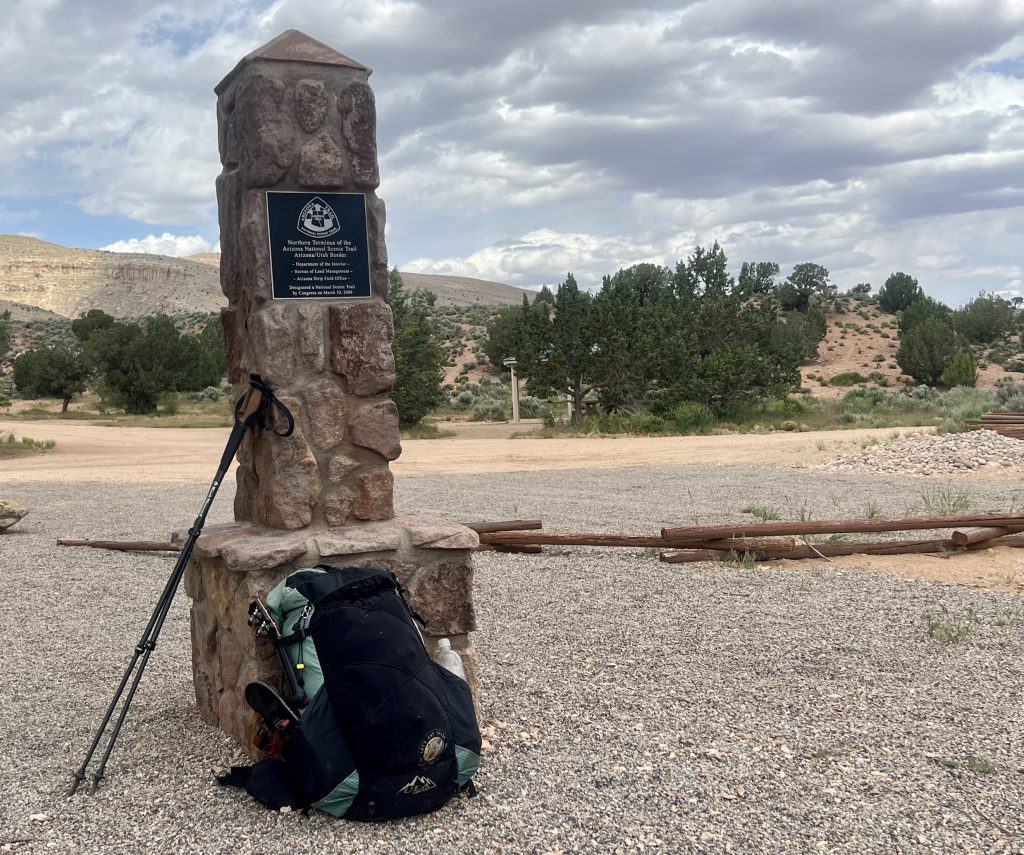
The gentle walk down toward the State Line Campground, crowned by that spectacular vista, made the last few miles feel like a victory lap, even with that gnawing pain in my feet at every step. It was true climax, a grand finale. Thru hike or section hike, I’d walked as much of the AZT as I could, some 740 miles of it, from Mexico to Utah, and this felt like fine way to finish. I touched the monument at the Utah state line marking the trail’s end and signed the register next to it, looking at names of the hikers who’d got there before me. I recognized the slow Canadian I’d met on my third day, but no one else—and there had been no entries above my own for several days. Then I headed off to the shade of a nearby gazebo to wash my feet with the last of my hard-won desert water, and wait a few minutes for Sean Meadow, who was on her way with a cold, fizzy diet coke and a warm smile for a weary, sun-beaten section hiker.
Mostly.