Day 25: 20 April, 4.4 miles today, 468.5 miles total,* Tonto National Forest
I’d been off the AZT for nearly two weeks. A lot can change on trail in 13 days, and it was very much my hope that it had. When I’d bailed out at Pine, the trail north to Flagstaff was a morass of deep snow and sucking mud. The latest reports suggested there was still a bit of both, but that for the most part this stretch of trail had become reasonably passable—maybe even pleasant. It shouldn’t be the grueling slog that the other hikers who had forged on ahead had forced themselves to contend with.
But first we had to get there. After a series of non-hiking-related adventures, circumstances, and events, Sean Meadow found ourselves once again riding a Greyhound together toward a long-distance trail. The ride from Flagstaff to was only an hour and was hosted by a driver who yelled at literally everyone at the bus depot as he checked them in and gestured vaguely for them to load their bags in the luggage hold behind the front wheel. We’d been unable to solicit a ride back to Pine from strangers online, so once the bus stopped in the McDonald’s parking lot in Camp Verde, we were left to do so in person.
I can be hard enough to get a ride hitchhiking in proximity to a well-known national scenic trail, but the AZT is famous only to a small, niche community, and we were still 45 miles away from it. Though the road we stood beside was busy, the drivers who didn’t pretend not to see us stared at us as they passed with dismay and suspicion. We were not particularly welcome there; none of the locals being willing to do the one thing guaranteed to get rid of us.
After an hour, an SUV pulled up offering to take us as far as Verde Lakes. We didn’t have any idea where that was, but figured any distance would help in the long run, so we jumped in. We went nine miles before being let out along a far more desolated stretch of state Hwy 260, which was all to the good, we figured, as it weeded out drivers who wouldn’t be going as far as we needed—and we had a bit of shade to stand in, to boot. Still, it was another hour and half before a young man pulled over and offered to drive us all the way.
He’d seen us hours before, when we’d first starting thumbing in Camp Verde, but he’d been going the wrong way. There’s usually a self-imposed pressure to entertain anyone kind enough to give you a ride, but this fellow was only politely interested in anything we had to say, so Sean Meadow and I spent the ride struggling to come up with open-ended questions to ask. The guy had had a tumultuous upbringing, culminating in the trailer fire that claimed his mother’s life. Now that he was a bit older, he had moved back in with his grandparents, divorced some 20 years but still living together. They’d always cared for him, and as they were struggling in their twilight years, he was more than happy to return the favor. As for us, he was only too happy to help, and he drove us all the way to the trailhead.
So it was that we got a much later start than we’d hoped for, but by the time we finally set foot on the Arizona Trail, we were so relieved to finally be walking that we didn’t much care. We wouldn’t make it far before making camp for this first evening back on trail together, but that was fine. We were hiking again at last, wandering the mountains together as the last vestiges of civilization became obscured and muted with distance. We were back.

(fraternal)
*For anyone keeping track more scrupulously than me, the miles don’t add up from the previous total because I switched to the mileage given to me from the Hiker’s Logbook app, which I trust more the math the got me the running total I’d been using in this blog thus far.
Day 26: 21 April, 16.2 miles today, 484.7 miles total, Tonto National Forest
We realized early on in the day that we’d sort of painted ourselves into a corner, and we’d have to choose between a short day or a grueling slog that likely wouldn’t end until we’ll after sundown. Having studied the options and found that there was no need to put ourselves through the latter, we opted for the the former, and so spent much of the day hiking at an easy pace, taking long breaks in the shade whenever the mood suited us.
It was a good day for it, clear and warm without a cloud in the sky. We had views for days to the south, and could clearly see that the Mazatzals were now free of snow—a good sign for the following days’ trek up the Mongolian Rim, a decoratively eroded wall of rock towering over the trail to the north. The path wove gingerly through forests of tall pine and tarmacs of barren, red rock, intercut every few miles by frigid, glassy streams burbling merrily in their channels through the beds of pine needles. Some days being outside is just really darn pleasant.
We were taking a break by a stream when we met our first AZT thru-hiker since getting back on trail yesterday. I wouldn’t have known him from Adam, but Sean Meadow recognized him right away as someone we’d met the year before on the CDT, a fast, confident hiker named CO. The moment she mentioned it, though, I recognized the loud, stylized American flag gaiters, still vivid and new when he’d been wearing them at Doc Campbell’s Trading Post, now faded and worn like an old pair of jeans. He’d been busy since we’d last seen him that cold morning in New Mexico—after finishing the CDT, he’d hopped over to the midway point of the PCT, where he’d been forced off-trail in 2021. He hiked south to Mexico, checking that trail off his list before heading clear across the country to hike first the 1,300 mile Florida Trail, then Alabama’s Pinhoti Trail. Once those were done, he headed west to tackle the Arizona Trail. Upon meeting the man, I had assumed he was a strong hiker, but in the 358 days since we’d last seen him, CO had been in continuous motion. After chatting for a few minutes, he headed on—not surprisingly, he planned to go a lot farther than we were going—and for the second year in a row, I watched him leave, thinking we will never see that dude again. Not on this trail, anyway.
We got to camp early, and spent a while lounging and talking by our tents before making dinner and getting ready for bed. It’d been a short day, but I’d slept badly the night before and was nonetheless exhausted. I was practically vibrating with excitement as I shuffled into my tent, ready to let the growing twilight wash over me as the sound of a rushing nearby stream whispered a backcountry lullaby. I burrowed into my sleeping bag and let the sound carry me away.

Day 27: 22 April, 23.1 miles today, 507.8 miles total, Coconino National Forest
What a difference a couple of weeks makes. There was still snow on top of the Mongolian Rim, but it was patchy, thin, and after three miles or so it was gone altogether. When I’d stopped at Pine, there was at least 30 miles of waist-deep drifts—not particularly treacherous, but agonizingly slow to walk through, because it wasn’t hard enough to walk across. While I’d enjoyed the challenge of hiking the first three weeks alone, without companionship, support, guidance, or assistance, on the whole I’d come to this trail having proven to myself on the big three whatever it was I’d needed to prove. I wasn’t sure I could make it to Flagstaff in time under the conditions that existed when I hit Pine, true; but more importantly, I didn’t want to.
Even the small amount that remain when Sean Meadow and I crested the rim was a pain in the ass—it was just also thankfully over quickly. Now all we had to do was cross the eighty-something miles of this plateau between us and Flagstaff. We were off to a decent start: not only was the snow mostly gone, but the high water crossings that had troubled earlier hikers were substantially lower and easier to cope with. We dropped quickly down into a canyon around midday, armed with a precise set of instructions on the best way to cross the river at the bottom, only to find that all we really needed to do was walk straight across. The current was strong, but the water shallow—though it was obvious from its painful bite that it hadn’t yet shaken the memory of being snow just a few days before.
We crossed sprawling fields of dried mud which only days before would have been a slick, shoe-sucking nightmare to cross. We made incredible time for a couple of people who were only on their second full day back on trail, and that after a big climb and a few miles of snow and mud. The trail was in great shape, and as the afternoon shadows lengthened and the sunlight took on the golden cast of early evening, we blew past several perfect-looking campsites, as we weren’t quite yet ready to stop. This is how we came to find ourselves amidst an endless meadow of rocks, desperately searching for a patch with enough actual dirt to pitch our tents on. We were not successful.
In the end, we found a patch of ground by the shittiest forest-service road I’d ever seen that was still too rocky to stake out a tent, but would serve well enough as a pad for cowboy camping. So it was that we lay out under the sky, my first night on the AZT without the meager protection afforded by the thin walls of a lightweight shelter. The air was warmer than it had been when I’d left the trail, and I was hopeful we might actually sleep comfortably, gazing up at the panoply of stars only during the odd interval of wakefulness in an otherwise peaceful night.

Day 28: 23 April, 24.0 miles today, 531.8 miles total, Coconino National Forest
As I drifted off to sleep, I actually caught myself thinking that I was maybe too warm, a little stuffy, even. As the night deepened, however, that quickly changed. The drop in temperature squeezed a surprising amount of moisture out of the air, coating everything with a layer of dew—including my sleeping bag. Down doesn’t insulate well when damp, and I woke up shivering in the middle of the night. Bracing myself for the shock of cold that would hit me the moment I opened my quilt up to the elements, I added my down jacket and felt hat to the evening’s backcountry pajamas and hurried back into my sleeping bag. It wasn’t going to be a comfortable night, but at least I would be just warm enough to get a little sleep. So much for cowboy camping.
In the morning, Sean Meadow and I tried to warm ourselves by vigorously complaining about how cold we were, but nothing seem to make any difference until the sun rose high enough to shine, just a little, directly into our camp. We got ready in a hurry, shaking ice from our water bottles and throwing on our hiking clothes as quickly as we could. Movement meant warmth and we were anxious to get hiking.
The morning’s walk was variations on a pair of themes: flat, sweeping forests of lodgepole pine (in both their burnt and unburnt state), and thick, brown cow ponds from which to filter our drinking water. The trees smelled wonderful and crisp, but the monotony of the scenery started to get to me after a while. Then too, the trail itself wasn’t particularly easy to walk on, as the parts that weren’t rock-hard dried mud deformed by the passage of other (mostly bovine) feet were actual, literal rocks. Just as I felt about ready for a change of pace, we started a 20-mile stretch of trail that was nothing but snow, standing water, and mud.
After two slow miles, we stopped for lunch at a forest service road, taking advantage of a dry patch of grass to spread out our sleeping bags to dry in the sun. We discussed our options, whether to keep slogging along the AZT, or bail to the dirt road, which would also be snow-covered, wet, and muddy, but which also stood a chance of having the occasional dry patch. We opted for the latter, climbing over snow drifts and wending our way through muddy pools as we stared at the astounding amount of water in the fields bordering the road. Every drainage ditch was overflowing, every meadow was a swamp. And so, having hiked our share of alpine bogs the year before on the CDT, when we hit the trail a few miles later we chose to follow the road out to a state highway we could follow up past Mormon Lake and the worst of the snow/swamp situation.
It really wasn’t a bad walk, though the sheer abundance of snowmelt meant that any potential source of drinking water would be fouled by mud and debris. It’s why we carry filters, after all—though water that sits in plant matter for a while develops an unfilterable taste that is distinctly bitter and unpalatable. We walked the highway until we hit another forest service road, thankfully closed to all automobile traffic. We found a blissfully flat, dry, and soft patch of earth surrounded on all sides by mounds of snow and pools of melt—and in fact this spot had clearly been swampland just a few days before—but we were safe and secure, grateful to be able to pitch our tents and listen from our snug little shelters to the whining chorus of frogs singing from the melt pools everywhere around us.

(occasional)
Day 29: 24 April, 24.2 miles today, 556.0 miles total, Coconino National Forest
Unfortunately, there is neither safety nor security to be had in a swamp. Maybe that’s obvious to most people most of the time, but we’d been tired and had either had to make that campsite work or else keep walking the highway until we’ll after sunset, so we sort of needed to believe the best. In fact, as I was first drifting off to sleep I wondered idly if I wasn’t perhaps a bit over-layered for what felt to be a relatively warm night—but that was before the cold had really sunk in, and the unprecedented condensation that comes from setting up camp in, essentially, the middle of a shallow lake on a chilly evening penetrated our shelters and left us, once again, wrapped in dampened, ineffective down.
I was low-key dreading the morning’s walk as we packed up our sodden gear and got ready for the day. Highway walking can be incredibly boring as well as hard on the feet, and we had nearly 13 miles of it waiting for us to finish filtering another liter of flood water and get on with it. As it happened, however, the morning was exceptionally lovely—the weather was beautiful, as was the forest on either side of the road. The trees were full of excited, euphonious birdsong, and the air was full of that wonderfully sharp bite that only a wet pine forest has. And that was even before we rounded a long bend and got our first glimpse of overfilled Mormon Lake, with the snow-capped, serrated edges of the San Francisco Peaks towering in the distance beyond.
As we walked the miles boarding the lake, I watched as a kettle of vultures glided on the wind, nimble and elegant. Vultures get a bad rap just because they’re scavengers, but they really are as graceful in flight as any other large bird, despite their Freddy Kruger faces. As the wind died down, I noticed that I was being followed by a huge black cloud of something that looked like mosquitoes, except that they seemed to have no interest in ruining my life. About that time, Sean Meadow caught up with me after having stopped to retire her shoes, and she was swatting at her own swarm of not-mosquitoes, cursing them as she went sailing by. The insects hounded me for a mile or two, and then seemingly vanished. I looked around for the creepy, gross shadow that had been following me for the better part of an hour, but it was nowhere to be seen. Until I glanced down at my hand, that is, and saw a dozen of the beasts perched on my glove. Dozens more sat on my sleeves and still more hung onto my legs. None of them were biting me, or honestly bothering me in any way, so I suppose I could have let them alone—but come on. Being covered head to foot in bugs is fucking disgusting, and I started furiously brushing them away, realizing all the while I would never get them all, whatever the hell they were, and whyever the hell they’d chased me for miles just to hang out on my body. When we stopped for a break just past the lake’s northern shore, the not-mosquitoes were gone completely, leaving to wonder whatever on earth had just happened to us.
We rejoined the AZT in the late morning, and after a bit of confusion as to which way we needed to go, set off once again for Flagstaff and points north. We climbed a short hill up to a plateau, where we found ourselves suddenly back in the desert. There were stunted trees and shrubs, but also cacti, and some little motherfucker of a plant that drew a surprising amount of blood from my finger while I was laying all of gear out in the sun to dry over lunch. It was miraculous timing, really, because we’d no sooner packed up our dried equipment and started back out than the sun was obscured by a wall of threatening clouds heading our way. We were working our way around a severely overfilled pond when the storm hit, the wind lashing us brutally with fat drops of angry rain. The AZT had run close to the pond’s edge, and now was completely underwater, forcing us to avoid the gate and climb over the barbed-wire fence surrounding the cow-water while still being pelted by the rain.
After a few minutes, the brief downpour let up, but the cold wind was an unpleasant reminder of Arizona’s patent refusal to be some place dry and warm. It followed us the rest of the day, until we found a gently forested plain, sheltered from the wind. We pitched our tents in a copse of trees, hoping for a drier, warmer night than the last two we’d seen. But if all else failed, at least we’d be in town by the afternoon, with a heated hotel room waiting for us somewhere up ahead.
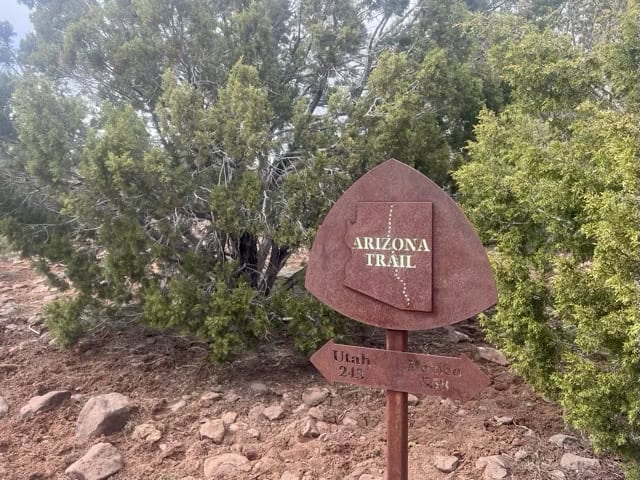
Day 30: 25 April, 11.9 miles today, 567.9 miles total, Flagstaff, AZ
Finally, finally, when the cold edge of night fell through the darkness, we were dry and warm—and I’d have finally gotten a good night’s sleep if it hadn’t been for the painful open wound in my right heal, which had been my overzealous reward for refusing to stop and clean sand out of my shoe after a river crossing a couple of days before. I may have brought this suffering on myself, but that didn’t let me rest any better. It was, in any case, nice to be warm, at last.
We had a fairly short, uneventful day following the old AZT (now the “Flagstaff Urban Route”) directly into town. The morning was actually quite lovely: little more than a pleasant stroll through the pines, the sun-dappled floor aromatic and comfortably toasty despite the growing breeze. At midmorning we crossed what was clearly a small stream in most years—which might even possibly have run dry by this time—now swollen to a small river the color of chocolate mills wafers, which had swallowed the rows of trees and shrubs lining its old banks. It was only knee-deep, with barely any current to speak of, however, so it was an easy crossing despite the icy chill of the dirt-water.
We ambled through the forest in the increasingly intense wind, finding ourselves spit all at once out of the trees and onto the pavement of Flagstaff. The question that had lately been dogging me as to why so many AZT hikers on social media were fixated on the local Taco Bell was answered when I realized that it for no more profound reason than the fact that it was literally the first restaurant the route passed by. Choosing to live well rather than Live Más, we eschewed that option for the actual Mexican restaurant just 0.2 miles up the path. We were in town. We had chores to do, supplies to buy. But first we had to eat.
