Day 11: 27 April, 18.2 miles today, 176.0 miles total, Gila National Forest, NM
Gila River Crossings: 0
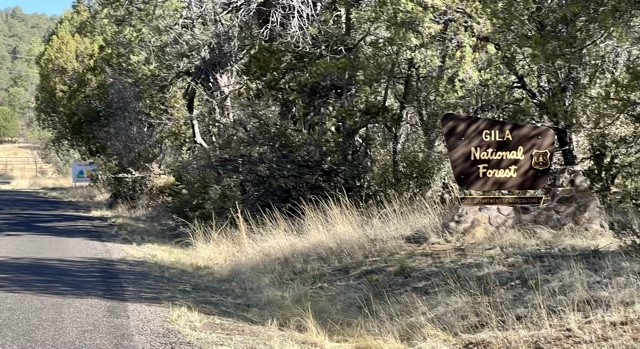
Today we didn’t even set foot on the official CDT, opting to leave Silver City via the Walnut Creek Alternate Trail. Despite its bucolic name, Walnut Creek is actually the name of the road we walked on to get out of town. It was surprisingly busy for a country two-lamer at 0730hrs on a Wednesday, but as we got closer to the boundary of Gila National Forest (pronounced Heel-ah) the traffic thinned out until it was nothing but the odd pickup or dump truck on its way to or from the gravel road grading project we’d pass later in the morning.
The reason we chose this particular route was the potable water we’d find at a picnic area near its end, but unfortunately both of us had managed to misread the guide and blew right past it without stopping or looking back. We didn’t realize our mistake until we were already a mile and a half beyond it, at which point we immediately went from carrying more water than we needed to get to the next source to not carrying enough.
It wasn’t a big deal, as we really were only barely not carry enough water; the bigger issue was my low-key frustration at having done something so preventably dumb. Sean Meadow was sympathetic, but blunt: “Well, it won’t be the last time we do something stupid.” Fair enough.
With that, we left the Walnut Creek Alternate Trail and entered the Gila River Alternate Trail, a route through the Gila NF far more popular with CDT hikers than the CDT itself (though by all reports the official trail though this area is pretty stellar). There are a number of reasons for this alternate’s popularity, but we came to one of biggest ones after just five miles: water. Flowing, pooling, running, natural water—our first source on trail that wasn’t a cow trough or a regularly stocked cache. And once we hit it, we were never more than a few minutes’ walk from more. Streams, creeks, ponds, pools, puddles. It was unbelievable.
We spent the afternoon well-hydrated, leaf-frogging with H (trail name pending) and a group of three young hikers she’d befriended at the hostel in Silver City. They were all very friendly, but it did feel like we were losing H (trail name pending) to that clique, leaving Sean Meadow and I on our own. Ish. We were seeing more people out on this stretch of trail, and we’d been meeting new people every day. We’d run into Caterpillar only briefly on our second night in town, but we’d lost that group again as they’d needed a rest day and we were pushing on. I wasn’t sure when—or if—we’d see them again. I could only hope.
Day 12: 28 April, 19.8 miles today, 195.8 miles total, Gila National Forest, NM
Gila River Crossings: 31
It’s a common misconception among the uninitiated that waterproof footwear is a backpacking necessity, when really the opposite is true—far better are shoes that are water permeable and dry quickly. You will not keep your feet dry on a thru-hike, no matter what you do. You will walk for days through the rain; you will ford rivers, creeks, streams, and canals. Your waterproof shoes will be powerless again the deluge to which you will subject them, and then they will never dry. I remember an incident on the AT, when I was walking behind a young man wearing goretex-lined boots through a late-spring thunderstorm. It rained into the night but cleared up by early morning, and by noon my trail-runners were dry. When I ran into that kid three days later, his boots were still wet from that storm.
We woke up at the same time as H (trail name pending) and her trio of young ‘uns, though they got ready in a hurry—I suspected that their goal was to walk all 30 miles to Doc Campbell’s in one go, though I wouldn’t know for sure until we got there ourselves the day after. At any rate, all of them had cleared out of camp before I’d finished drinking my breakfast shake from the warmth of my sleeping bag.
We spend the morning working our way across a crest of mountains. It was actually quite pretty, though a bit steeper hiking (both up and down) than I’d anticipated. It took us until midday to cover the 12 miles to the Gila River, and even then we posted up for lunch by a spring for an hour before heading down to the river itself.
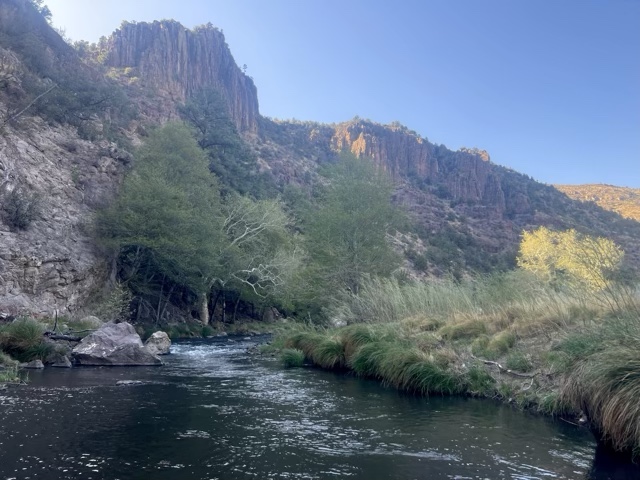
The Gila winds it’s way through the bottom of a sort of soft-shouldered canyon: some of the walls are cliffs, but most of the them rise gradually to the spires and pinnacles above the river bed. The river twists and turns and perambulates through these mountains, and does so in such a way that walking beside it for very far on one side becomes impossible, so you cross and walk along the other side, until continuing on there becomes impossible, so you cross. At this point the trail vacillates between established path and vague suggestion, and often the pink line in our guide representing the Gila River Alternate had no counterpart in the physical world.
So we spend the afternoon fording the same river over and over and over, then losing the trail, then bushwhacking in the right general direction until we found it again (since all we ultimately had to do was follow the canyon north). It was ridiculous and surprisingly fun, a lot like playing the woods as kids. We tried to keep a tally each time we had to wade across the Gila—first ankle deep, then knee deep, then thigh deep. The number above represents our best effort, but it was hard to keep track.
Day 13: 29 April, 9.1 miles, 204.9 miles total, Doc Campbell’s Trading Post, Mimbres, NM
Gila River Crossings: 31 (again!)
I couldn’t put my finger on the precise reason—whether it was the cool night air blowing in through the open vestibule of our tent, the sound of the Gila River flowing just down the rise from our camp, or just because crossing the river all afternoon had worn me the hell out, I couldn’t tell—but I had the best night of sleep so far on the hike. Poor Sean Meadow, on the other hand, who had learned just how badly her inflatable sleeping pad was leaking, very much did not.
We woke up at our customary 0530hrs, but allowed ourselves the luxury of laying in our sleeping bags for a few extra minutes before actually starting the day. We deflated our pads, committing to the act of getting up, and I unzipped the tent to get the change of clothes I’d been airing out overnight as Sean Meadow went outside to get ready. I’d just slipped on the underpants I’d left sitting on my pack outside the tent, when I felt something prickly in the region of my groin. At the same time I noticed a many-legged something sitting on top of the shorts I’d also left outside.
I am not proud of the sound that escaped me in that moment. I can only say in my defense that, groggy as I was and met at the same time by a tiny stab in the balls and an unidentified invertebrate on my sleeping bag (and influenced, no doubt, by a story a pair of hikers had told us a couple of days earlier about being bitten by a massive centipede in their bed back in Hawaii), I’d leapt to the conclusion that I had a centipede in my underpants, and had responded accordingly.
I did not have a centipede in my underpants. I think it must have been a errant pine needle that was lost in the shuffle, because when I checked I found nothing. Nor was there a centipede in the tent. Sean Meadow, alarmed my the noise I was making, was peering into the tent with her headlamp. After taking in the situation, she started scolding me: “that is a sound to make if there is a bear in the tent, not a caterpillar.” I had to give her that one, but I still maintain that screaming like a wounded child would also be appropriate if in fact there is a centipede in your undergarments. Centipedes are vile.
The sun was well above the horizon when we started hiking, though it would still be a couple of hours before it was high enough to clear the top of the wide, eroded canyon. Those hours were cold, the Gila crossings sharp and painful in the morning chill. Our feet quickly became numb, and we plodded through the valley as if we were walking on blocks of ice. Or pace was leaden, and each crossing was like a small punishment; until the sun rose high enough to shine down and warm us, and then hiking was fun again. We didn’t even mind that we missed the official trail junction and crossed the river two or three extra times.
We ended the day’s hike at Doc Campbell’s Trading Post, a little general store in the middle of nowhere. We’d sent resupply boxes here to stock up for the 120ish miles to the next town. The store also had limited camping out back and unlimited use of the bathroom (the toilets of which are plumbed with hot spring water, which makes for a unique eliminatory experience—a “spa-treatment facial for your butt,” to quote Sean Meadow) as well as a more quotidian shower (for hikers only), so we spent much of the afternoon packing up our food, cleaning ourselves up, and buying sodas and snacks from the store.
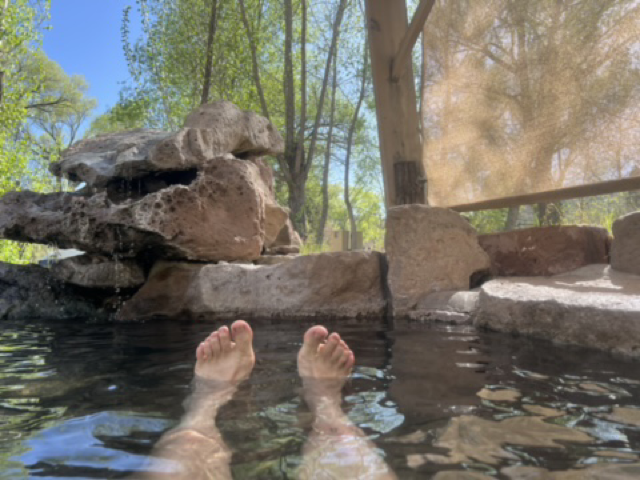
All that done, Sean Meadow and I headed down the road to a riverside campground that may not have had showers, but did have natural hot pools. We spent a relaxing couple of hours soaking in the hot water as we soaked in the view of the cliffs above us. We talked for a while with a CDT hiker from France, who had never done a long hike before, but whose background in ultramarathons prepped him to do the sort of high-mile days that simply considering makes my feet ache. I always feel outclassed by hikers like that, even though it’s rare that any of them are dicks about it. This guy, in fact, was super nice and enthusiastic. He just hiked much faster than I did. The trail is of course big enough for the both of us; there’s still a place for me even in the bubble of super fit hikers who can match my best day before they pause for lunch. It’s only my insecurity that ever makes it feel any different. As is commonly said in the thru-hiking community, “we all walked here.”
Day 14: 30 April, 16.6 miles today, 221.5 miles total, Gila Wilderness, NM
Gila River Crossings: 61
In retrospect, we ought to have assumed that Doc Campbell’s, a country store on a country highway in the middle of the countryside, would have a bright arc sodium light over the parking lot that would burn all night long. Every time I fell asleep for a moment, I’d wake up to find that I’d rolled over so that the damn thing was shining right into my face again. Others hikers complained about the rooster who went to work at 0430hrs, but I was already awake. At least Sean Meadow’s repaired sleeping pad was holding up.
It was very cold when we got up, very cold as we pack up our gear, very cold as I ate the un-microwaved burrito I believe to the root cause of several problems I had later that afternoon. We left DC’s TP semi-bundled up and weighed down by the 6-7 days of food loaded into our packs, and started the road walk over to the Gila Cliff Dwelling National Monument. Stashing our packs behind some bushes at the trailhead for the Gila High Route, we popped over to check out the ancient site feeling considerably lighter.
The Cliff Dwellings were not what I was expecting. Built into a series of caves on the side of cliff overlooking the West Fork Gila River below, they were constructed using a stone and mortar technique that seemed much more modern than their age would suggest. Made by ancestors of the Pueblo people and abandoned over 700 years ago, they still feel livable.
We walked back up to the High Route trailhead, grabbed our ludicrously heavy packs, and started up. The Gila High Route proved to be everything that the CDT was and the Gila River Alternate wasn’t: hot, exposed, and dry. We were only on it for a handful of miles before taking the Little Bear Canyon Trail to reconnect with the Gila. That was a fun walk, as the trail meanders a sloped and forested drainage that continually narrows and steepens until you’re walking through a slot canyon that eventually spits you out right onto the Middle Fork Gila River.
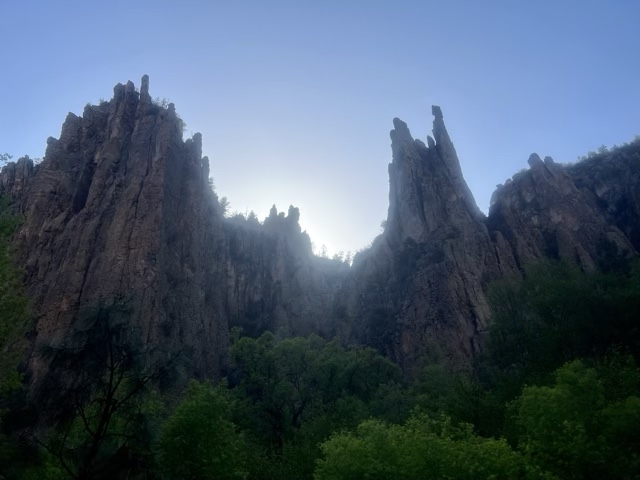
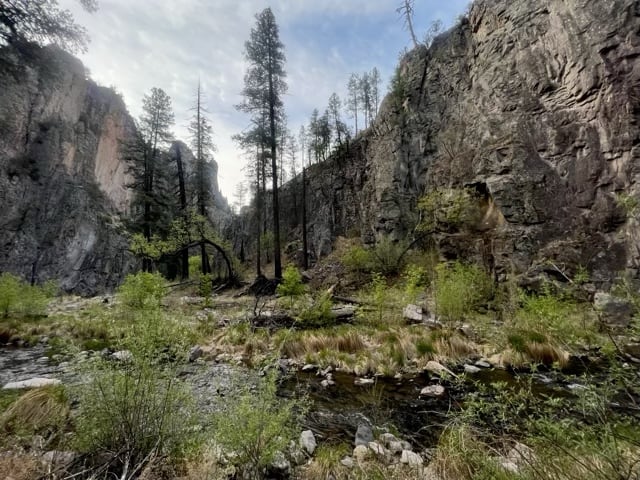
The Gila River south of Doc Campbell’s is a silty confluence of its three northern forks. The water is clean, but somewhat opaque. The middle fork, on the other hand, was crystal clear, full of darting fish, almost grown tadpoles, and what appeared to be several beaver dams. The canyon floor was lushly forested, which actually made the trail easier to follow, as it was now a clear line through the woods. The canyon walls loomed high above us in layered spires and peaks—I spent the day taking pictures, but I don’t think even one of them captures what it is like to watch to those great columns of stone move against one another as you walk below. This place is among the most beautiful I have ever seen.
It was a fun afternoon spend counting each river crossing, gawking at the canyon walls, and swimming in the cold river at a bend where the water got unexpectedly deep. Even that dastardly un-microwaved breakfast burrito couldn’t spoil the day. Not that it didn’t try.
Day 15: 01 May, 20.8 miles today, 242.3 miles total, Snow Lake, NM
Gila River Crossings: 103
“22!” Sean Meadow shouted across the river. It was even 0800hrs and we already forded the Middle Fork Gila almost two dozen times. “The sun is running away from us,” she said, the disappointment audible even above the churning of the water through the rocks. We’d been chasing it all morning, and had seen it splashed against a canyon wall up ahead, warm and inviting, but when we got there we found that it was still several hundred feet up the rock face. It had been a frigid morning, Sean Meadow bundled up in ever top layer she had, but our wet feet kept the both of us cold and uncomfortable.
By the time the sun reached the canyon floor, we were already getting tired, and Sean Meadow had put in her headphones to help her get through the morning. This left me to carry on the crossing count call-and-response on my own, but I kept getting confused. “54, 55, 56, 56, 56, wait, 58? 59.” My inexact tally would reach 76 by the time we stopped for lunch.
Our progress was halting, which was frustrating, as we’d planned our food resupply figuring we’d easily do 20 mile days through this section. Instead, we found the water slowed our steps, and we frequently had to pause to find secure footing before taking another. The terrain by the Gila was often either rocky or covered in dense brush, which makes for slow hiking generally, but we also lost the trail at about half the crossings and had to spend time finding it again.
At lunch, we talked about how much fun crossing the Gila had been at first, and what a drag it had become. As we readied ourselves for the afternoon’s waking, we expressed our wish and hope that we’d have fewer crossing to contend with. 10 minutes after we got going, we came to a part of the river where some beavers had been, well, busy. They had done their work well, building a dam so effective that it had widened the river so that it stretched from a sheer cliff on the west side, to a protruding rock face on the east. The pooled water in between was deep, at least 6 feet, which left us with three options for getting across: A) swim the pool, B) climb across the rock face and down the far side, or C) go up the hill behind the protruding rock face, which was super steep but still didn’t technically involve rock climbing. I started with option B, but gave up when I couldn’t figure out how to get down the last 5 feet while wearing my pack. So I joined Sean Meadow in option C, which does read like the safest choice but felt sketchy as hell. I ended up scooting down the far side on my butt, cursing the beavers as clods of dirt shot up my shorts.
After that, though, the crossings did become fewer and farther between, and we started making better time. Still, it felt like it took all the energy we had to make it to Snow Lake, only to learn that, as Sean Meadow put it when I caught up with her at the shoreline, “this lake sucks.” It is true: Snow Lake is a shit lake. While it looks as if it might at one time been a natural pool or pond formed by a depression in the earth along the Gila’s path, it had been dammed by humans who could have leaned a thing or two from those damn beavers downstream. I don’t know what it looks like in a good year, but in 2022 Snow Lake was a mud puddle, neither scenic nor a source of badly needed water. We had read in the guide that the only spigot in a nearby Forest Service campground was turned off—if that were the case, we’d need to push on to the next source, almost 3 miles away. But when Sean Meadow pulled the lever, sweet lifesaving drinking water came pouring out. All we had to was select our tent site and drink our fill.
Day 16: 02 May, 24.4 miles today (+2.7 miles driven, not counted in total), 266.7 miles total, somewhere in NM
Gila River Crossings: 0
Total Gila River Crossings: 226
We didn’t realize it at the time, but our arrival at Snow Lake was effectively the end of our time with the Gila River. While we did, I guess, technically cross it several more times throughout the first part of the morning, it was a parched mockery of its former flowing glory. The river bed was totally dry, save for a handful of pools and puddles.
We hit a “pond” at the northernmost point we would hike with this river, where we watched a flock of cattle drinking from the far shore while we filtered some water for the exposed path ahead: some 23 miles of dirt and gravel roads leading us back to the CDT proper. We hit a steep climb up to the road and started walking.
We had noticed some odd clouds beyond the hills in the distance when we first came up to Snow Lake the evening before—I first took them to be evidence of a windstorm somewhere to the Northeast. As we started the road walk, we could see clearly that what we were looking at was smoke. Neither Sean Meadow, nor any of the handful of hikers around us, new anything about it. Was it a controlled burn? Industrial pollution? Was it going to become a problem? We had no information whatsoever.
The road walk was fine. Distinctly tedious, but it did feel good to be making progress after our sluggish pace through the Gila Wilderness. We were passed several times by white Forest Service pickups, but didn’t think much about it. We waved at them; they waved at us. I came to shaded spot just off the road where I found Sean Meadow plopped on the ground, taking a break. I joined her for an early lunch, and just as I was sitting back to relax and let my almond butter burritos digest, another white Forest Service pickup came along, but pulled up beside us.
“Can I give y’all a ride?” the driver called. “No thanks!” we replied. Sean Meadoe clarified: “we’re walking on purpose; it’s ok.” “It’s my job to give y’all a ride,” he said. “Thanks, but we’re good. We’ll walk.” “Y’all can’t walk. There’s a fire. I gotta collect all the hikers,” he said. Ohhhhhh, that’s what he was getting at. “Are you guys doing a prescribed burn?” Sean Meadow asked. “Prescribed burn? Girl, this is a wildfire. Get y’all’s stuff together and get in the truck.”
The fire, reportedly called the “Turkey Fire,” had started yesterday, and spread quickly due to dry, windy conditions. No hikers were being allowed to walk—one of the fellows ahead of us had tried to talk the Forest Service guys into letting him bushwhack away from the fire, but they wouldn’t allow it, concerned that the fire might already be spreading faster than they could control. It meant a break in our continuous footpath—unless we wanted to walk back to Silver City and take the main CDT route around the fire. Maybe eventually a detour could be established, but not here and not today. Our line would be broken for the 2.7 miles it would take to deliver us to the upwind side; but not by our choosing.
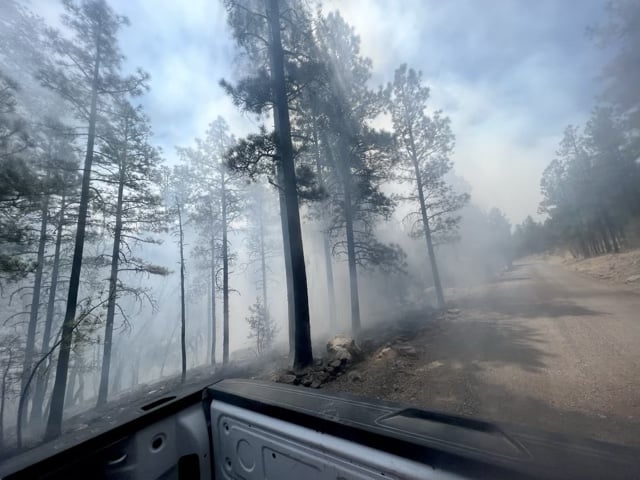
We had to ride in the bed—as it turned out, from our location there was no viable way around the fire, so we were being driven right through the area we hadn’t been allowed to walk through. There were times we could barely see from all the smoke. As we’d clambered into the back of the truck, the driver had warned us, “keep y’all’s mouth and nose covered. Use them buff y’all hikers always got.” We could still breathe, but the air was acrid and sharp, and relying on a buff to keep the air clear for more than a couple of minutes would have been laughable.
I was most surprised by the way all of the trees were burning from the bottom up. The fire was being spread by the dry grass on the forest floor. That would burn, them ignite any plants at the base of the tree, the finally the tree itself would burn. The atmosphere, white and chalky with wood smoke, was ethereal, haunting, menacing. Sometimes the ground was pink under the smoke and ash—evidence of the flame retardant that was being airdropped over the area. Masked, flame-suited silhouettes worked in the dim haze to dig trenches. It was one of the strangest rides of my life.
Before Sean Meadow and I started the CDT, my dad’s biggest concern was that we would end up walking toward a wildfire in New Mexico—indeed, he brought the subject up anytime the trail was mentioned. I believe the exact words I used to try to allay his worries were this: “the Forest Service would never let anyone walk into a forest fire.” We had both been right, it seems: we had, and they hadn’t. We were dropped safely off on the far side of the fire, well out of harm’s way.
We looked over our shoulders throughout the rest of the day at the billowing clouds of smoking rising from the forest we’d just left and slowing enveloping the land to the east. We were out of the rich, lush, waterlogged Gila Forest. We were back in the dry, hot, and windy New Mexico we’d met at the start of this hike; and what a welcome we’d gotten.
Day 17: 03 May, 22.6 miles today, 289.3 miles total, somewhere in NM
It is very uncommon even (or maybe especially) for people who are hiking together to actually hike together the entire day. In that respect, Sean Meadow and I were pretty normal: sometimes we’d walk together, chatting merrily about this or that; sometimes we’d walk together in silence; but often we’d walk alone, each moving at whatever pace was most comfortable, and meeting up for meals and breaks. I’ve also seen this dynamic at work within almost every trail partnership or trail family; each hiker might be no more than a quarter mile away from another, but still may not see another human soul for hours at a time. A thru-hiker’s only constant companion is pain.
I had a bunch of clever ideas to expand on that pithy statement, I think, but today really beat me into the ground, and I can’t piece together those ideas from the crumbles that remain. Suffice it to say that feet hurt most of the day, so badly some nights it keep me awake. Sean Meadow had foot problems of her own—and we’d both been wearing identical supports on the right knee (hiker couple chic, I know), though to treat different ailments. My legs were scratched to hell, my lips were chapped and sore, I was utterly and completely and totally exhausted, and I was covered in dust from top to toe—every square inch of my body was filthy. My soul was filthy. I couldn’t even muster the energy to brush my teeth or change my shorts before crawling defeated into my sleeping bag.
Thank god tomorrow would be another day.
Day 18: 04 May, 22.9 miles today, 312.2 miles total, Mangus Mountains, NM
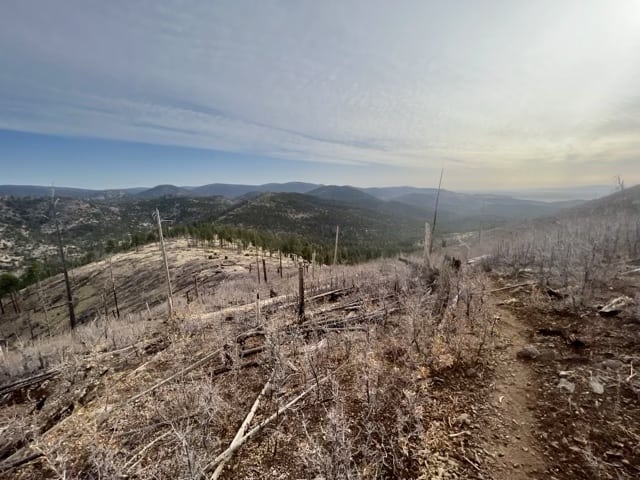
The Gila Wilderness, though truly spectacular, was quickly becoming a distant memory. It was also starting to seem more and more like an aberration in New Mexico than the norm. In the so-called “Land of Enchantment,” any actually enchanting places appeared to be exception rather than the rule. But I suppose “Land of endless cow shit, dry choking dust, and constant obnoxious wind” doesn’t fit on a license plate.
While I wasn’t exactly being bowled over by the high-effort, low-reward hiking of south-to-mid NM, I was actually fairly content with the odd peak at the strange conical mountains in the distance, at least for the time being. Sean Meadow, on the other hand, had started to find serious fault in the state. “Bullshit,” she called it—though she herself attributed much of her attitude to the length of this stretch between towns. She’d said, “I can be dirty for four or five days, but after that it all goes to hell.” And the dust in the New Mexican desert is aggressively ubiquitous; I could understand how it was getting under her skin, as it had already caked over every inch of mine.
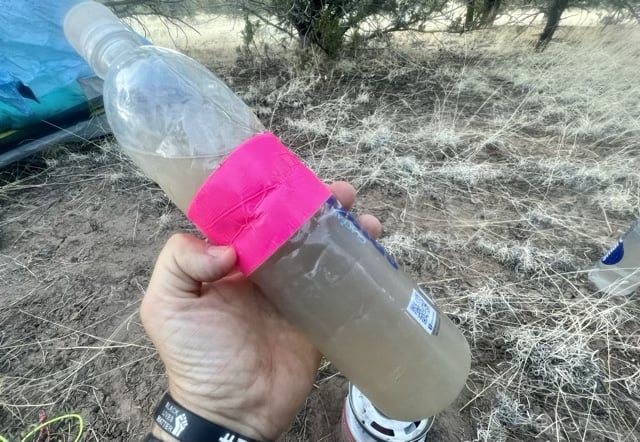
For me, though, the real frustration (and the thing I missed most about the Gila) was the water. Having had a taste of what it was like not to have to carry 10lbs of water at a time or plan every day based around where we might find it, it was especially difficult to return to a part of the state with no natural sources. We were back to filling up at cow troughs filled with opaque water of questionable shades, and seemingly always spaced roughly 20 miles apart. Filtering it always took forever, as the sediment in the liquid rapidly gunked up our filters and slowed their output to a trickle. We typically didn’t filter the water we boiled for dinner, but counted in that case on whatever we were adding it to to mask its natural musk.
New Mexico was proving to be the CDT’s boot camp, excessively—and quite possibly intentionally—unpleasant. On the whole, I thought we were actually holding up quite well. But that didn’t make it fun. The old saying on this trail is to “embrace the brutality.” But, seriously, fuck that. What an asinine, antiquated piece of machismo nonsense that saying is. We would endure the brutality, survive it, get past it, find a way to live with it. But we wouldn’t embrace it—we would still need something to laugh at while we were out here, after all, and the difficulties of life on this part of the CDT were nothing if not ridiculous. Beat your feet into a pulp walking over rough stones for mile after mile over mountain after mountain without a view, breathing in the dust that coats your skin, hair, lips, and eyes, freezing every night and broiling every day, sucking on a bottle of mud water to keep yourself alive long enough to take in the absurdity of the fact that you have chosen to do this to yourself on purpose: scoff at the brutality!
Day 19: 05 May, 22.8 miles today, 335.0 miles total, Top of the World General Store, Hwy 60, NM
The day began with an easy 6 mile walk to the cleanest, clearest cow water we’d seen in ages. Aside from the algae, which was easy enough to avoid, it looked as pristine as fresh well water—so we didn’t waste time filtering, opting instead to use purification drops (aquamira) in our bottles and bladders. We were looking forward to camping outside the general store, where we could sleep in (which is to say, wake up at 0700 instead of 0530) before buying breakfast. Everything just seemed easy.
Then we got back on trail, except that we couldn’t find it. Very much like the day we left Lordsburg, we had to cross a scrub grass cow pasture with no markers, no trail, not even any footprints to follow. After a couple of miles, we came to a barbed wire fence we could at least follow, though the ground underfoot became sandier and the brush became thornier. I’ve said it before, but walking on sand sucks. Today we had a good five miles of it before we finally hit US hwy 60 and stopped for lunch.
Though of course we had to clear away a bunch of thorny tumbleweeds before we could sit down. Then we had to open our umbrellas for shade, since of course there wasn’t a shrub, bush, or tree within a half mile of us. Then we had to wrestle the wind to keep them from blowing away. Still, we were in good spirits as we polished off our lunch supplies and started the interminable 10 miles road walk to the Top of the World.
We did it all in one go, just to get it over with—not that we could have found shade on the way for a break, anyway. It was a straight shot, open and tedious. About the only thing to break the monotony was when I looked up from the road to see a black SUV stopped across the street, the driver taking a photo or video of me walking with her phone. She started talking to me, but I had headphones in and missed most of what she said. I did catch “my car is full of hikers!” before she yelled “see you at the toaster house!” and drove away. Sean Meadow and I hadn’t planned on staying at that place; I couldn’t decide whether that encounter made me more of less inclined to change my mind. None of the hikers in her vehicle looked very happy.
We did eventually get to the store. It was closed, but we’d expected that. It was a huge relief to sit in the shade on the porch, regardless. We were three short road miles from Pie Town, but that adventure, whatever it was, would wait until after breakfast at Top of the World.
I’m in awe love reading this S I feel more connected to the emotions of your journey. Stay safe!