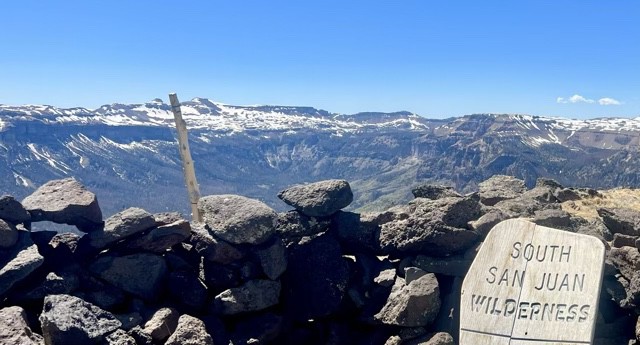
Day 39: 25 May, 15.2 miles today, 633.3 miles total, South San Juan Wilderness, CO
I spent much of the previous evening struggling with the Garmin inreach device I’d been carrying for the entire CDT (almost) without incident. I’d been able to leave it in passive tracking mode, which allowed Sean Meadow’s and my parents to follow our hike on a daily basis without either burning through the small battery or forcing me to remember to manually enter a waypoint everyday. But suddenly, for some inexplicable reason, the screen wouldn’t turn off, which would drain the battery long before we’d reached our next town. It was a maddening problem not because it was particularly severe, but because the cause was so obscure. Why the fuck was this happening now? I gave up messing around with the damned thing after a defeated half-hour, but what kept me up half the night was the memory of a 60 year old coworker of mine whom I had on several occasions watched struggle with the basic operations of a simplified smart phone. That mental picture was accompanied by a single, terrifying thought: “This is how it starts.”
It was with tears in our hearts that we packed up in the early morning, knowing that we were finally moving on from our plush suite, our cozy Chama home. We indulged in the well-appointed continental breakfast one last time, then pestered the owner for a ride to the trailhead. By 0830hrs, we were hiking again.
It was a brutal day in every respect: long, steep climbs and descends; uneven tread; mud on top of mud on top of mud; blown-down trees scattered across the trail; rotten, slippery, half-congealed snow; frigid streams and puddles; thin, oxygen-poor air; and breathtaking views the whole day long. We stopped after 15 miles, since that brought us to the most likely (and warmest, at 11,000’) campsite for many miles—but I was well done-in by the time I got there. We were all completely exhausted after having put in the number of miles we’d have done by lunch on a flat day. One day in, and the San Juan mountains were kicking our asses. But at least we could still laugh about it over dinner, as the sun sank behind a cliff and the temperature plummeted well before actual sunset. We were cold and tired, yes, but we still had our sense of humor—though of course, Colorado would have innumerable chances to take that from us in the miles ahead. We’d just have to deal with tomorrow when it came.
Day 40: 26 May, 15.8 miles today, 649.1 miles total, South San Juan Wilderness, SO
When we woke up in the morning, everything that wasn’t frozen was soaked in condensation—a consequence both of using a single-wall tent and pitching it at the edge of an alpine swamp. My shoes had become unmanageable blocks of ice, the laces so inflexible I had to pull them free with my teeth. When I shook out the tent, even I was taken aback by the giant piles of frost left on the ground.
We’d gotten an early start on the day, and even hiked later into the evening than we had the day before, all of which effort earned us an additional 0.6 miles over yesterday’s total. I’m not sure I can say the terrain of the San Juans is substantially more challenging than the more difficult stretches of the AT or the PCT, but I do know that by the time I reached those sections of those trails, I was a substantially stronger hiker. We entered these mountains unconditioned to gaining and losing significant elevation, unconditioned to walking on snow, unconditioned to strenuous physical activity at high altitude. In fact, most everyone was exhibiting mild symptoms of altitude sickness. Sean Meadow had a constant headache, for example, and even moderate physical effort left me feeling exhausted and sleepy.
We were still better off than the pair we met while we were taking a mid-day break to “yard sale” everything in our packs so the sun would dry our wet gear. They were on their second attempt at trying to find a trail to use to bail out, the first route having proven too socked in with steep, drifted snow to be passable. They were both showing signs of acute mountain sickness: severe headache, shortness of breath, insomnia, vomiting. The best treatment of course is to descend to a lower elevation, but that had proved difficult. They were optimistic another side trail we’d come across later in the day would be more accessible than the first had been. We didn’t see them again after that junction, so hopefully they made it out safely.
We spent much (most?) of the day bushwhacking in the general direction of the CDT, as we constantly lost the trail under the snow. It was fairly commonplace for each of us to wander in what seemed like the right direction, only to realize once we’d dead-ended that once again we’d misplaced the route. We very likely would have made better time if we hadn’t had to spend half the day tromping our own paths back to the CDT once we’d figured out our bearing—though probably not much, as the terrain was mercilessly slow even when we’re headed the right way.
It’s for that reason that my favorite part of the day was glissading down a handful of slow-covered slopes: not because going down a mountain on one’s butt is particularly fun, but because it was so much faster than walking. I could slide in a minute the distance it would take me ten to walk, and that was ten minutes of the day I didn’t have to spend on my battered, aching feet. I was one of the few willing to suffer a chilly bottom for the privilege of such glorious laziness, but it was worth it, every time.
Day 41: 27 May, 13.2 miles today, 662.3 miles total, South San Juan Wilderness, CO
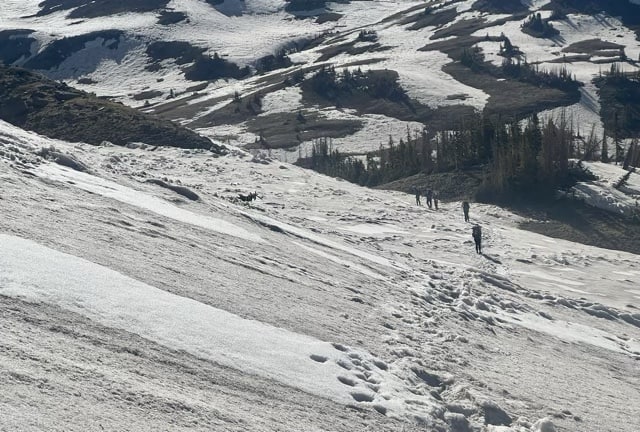
We came to the general consensus that the stretch of the CDT which passes through the South San Juan Wilderness is unequivocally more difficult than any hiking we had done anywhere else—the tricky thing is that it seems both inappropriate and unfair to call what we had been doing through this stretch “hiking.”
With an overnight low of only 38°, we were pleased to find that none of our belongings were frozen solid in the morning. Even so, the night chill had firmed up the snow on the mountain slopes, which made it better able to support our weight, and it made for a better gripping surface for our micro-spikes—the ubiquitous option for turning a pair of trail shoes into snow cleats. It made the avalanche chutes we had to cross that morning all that much safer, though no less stomach-churning for the durability of the snow we had to walk across. The cardinal rule in dealing with heights is “don’t look down,” though of course when walking across an avalanche chute you should absolutely pay extremely close attention to your feet and where you are putting them. The thing you need to train yourself to ignore is the vast empty space immediately to your side, as well as the distance you’d fall if you fucked up. Those details do not help you get across safely.
Safety can also be difficult to judge, however, even for people with a measure of experience. I would at no point in a thru-hike intentionally disregard my physical safety nor that of any other hiker, but I am as prone to misjudgedment as the next human, and a few miles after traversing the early morning’s steep chutes, I did exactly that. The CDT came to a chute similar to the ones we’d crossed earlier, but this time the trail blazers had chosen to thread the path straight down the fucking thing. Walking it seemed liked a slow form of torture, and from where I stood near the top, those who had chosen to glissade down were doing just fine. They actually weren’t, but I would learn that lesson the hard way.
I sat myself down on the snow, and held my poles tight at my side. My plan was to take the entire slide slowly, digging my poles in and braking the whole way down. The plan failed immediately, as I started building speed regardless of the amount of force I applied to my bullshit “brakes.” Within three seconds, I was completely out of control—but was still trying to use my poles to slow my descent, despite the fact that that approach was accomplishing absolutely nothing. I wasted enough time trying that demonstrably failed idea that I suddenly had an additional problem to contend with: I was fly straight for the people who’d gone done ahead of me, whom I’d assumed were far enough down to be out the way in the event something went catastrophically wrong. Something else I’d misjudged.
I started screaming at them “I CANT STOP I CANT STOP I CANT STOP,” and I ditched my poles which a) weren’t slowing me down and b) I was terrified would otherwise impale someone before this was over. One of the people managed to slide out of my way as I passed, kicking and clawing uselessly at the snow as I went, but the other I hit hard. I struggled first to reposition my body so I would hit her with my knees and not my spikes, and when we made contact I gripped some part of her hard (pack? shoulder? arm? I don’t remember), trying to keep us both facing forward and prevent us from spinning. She was already arresting with an ice-axe, so we slowed a good deal even as we slid together for dozens of feet. When I finally slipped by her, I’d lost enough momentum that my frantic kicking at the ground finally helped grind to a halt. I lay for a moment on the snow, watching my last full water bottle continue down, until finally it dropped out of sight.
I looked up at the woman I’d hit, some fifty feet above me. “Are you okay?” I called up. “Yeah, I’m fine!” she called back. “I…I’m really sorry about that!” “It’s okay!” she said. I gathered myself together and started making for a patch of dirt besides the chute. on the way I found an unfamiliar water bottle. “Hey is this yours?” I asked. It was, so I climbed up to her position and handed it to her. “I am really, really sorry about that,” I said, then collapsed on the patch of dirt to catch my breath.
Sean Meadow, sensibly, had walked down, and when she’d made her way to my level, she had my poles with her. “I didn’t see, did you try to self-arrest?” I just stared at her—good lord, obviously that’s what I should have done the moment I realized I was picking up speed, but instead I’d doubled down on my dumbass brake idea. “No,” I eventually mumbled. “I forgot.” I was such a lucky idiot. We still had a surprisingly long way down to go, but I walked the rest of it. At the bottom, I told Sean Meadow, “I feel so bad about hitting that girl. She must have been terrified.” “Did you tell her?” she asked. “Yeah. Twice. But it just feels so inadequate. Like, ‘oh hey, almost killed you, sorry about that, my b.’”
The scratches and cuts all over my arms, hands, and legs from the rough, hard snow would sting for the rest of the day.
The next couple of miles were almost not insane, though we did hit a run of snow obstacles—unmelted patches of snow frequently rising 3 to 5 feet from the trail and often overhung by the trees whose shade has kept them in place. These things are usually a real chore to clamber over, and this set was no exception, with a sharp drop to the side just for added excitement. When we came upon some friends a bit later, we stopped for a short break in the shade with them. “There’s a climb up ahead, followed by a big descent.” “I don’t mind what we have to do, as long as we get a break from the snow.” To that, we all agreed.
We did not get a break from the snow.
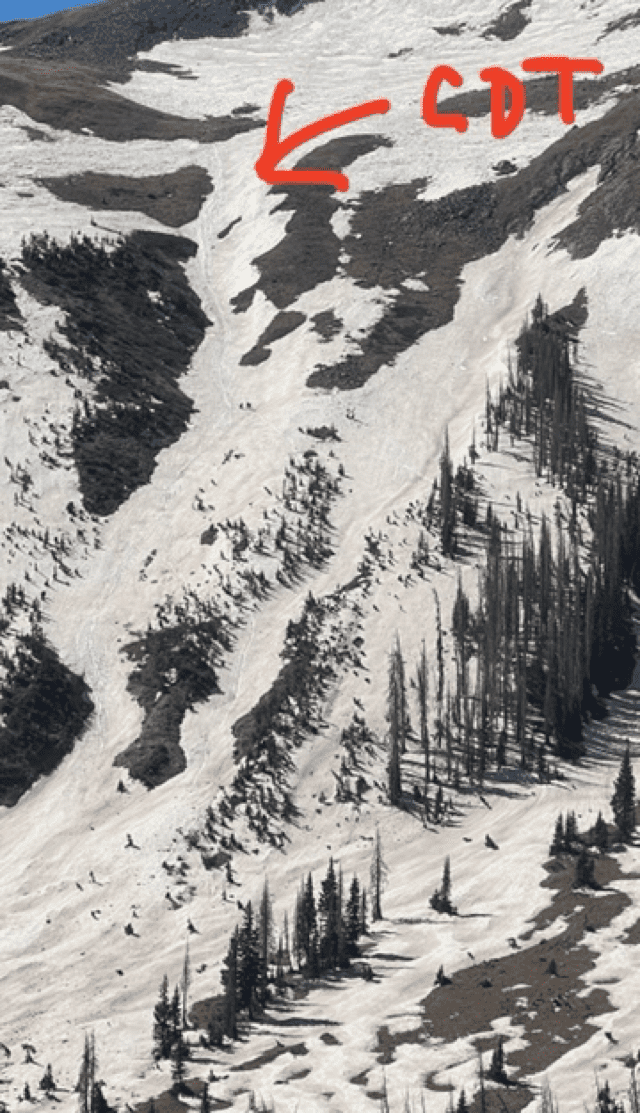
What we got was a series of truly nauseating avalanche-chutes to traverse, a feat which was getting slower and more difficult as the snow softened in the heat of the day. And then, after a half mile or so, the trail just dropped. Right down another steep slope, covered in snow. Through a forest. The going was painfully slow, every movement calculated, and then usually proven wrong. It was impossible to maintain our footing, but glissading was out the question. Even when we slipped, we built up speed with terrifying rapidity and had to scramble madly to arrest ourselves. Sean Meadow, ever the more adept athlete made better progress than I did, and eventually she was out of sight. After a few minutes, I couldn’t hear her struggling through the snow. “Sean Meadow!” I called. No response. “SEAN MEADOW!” I tried again. Still nothing. Fighting back panic now, I bellowed, “SEAN MEADOOOOOW!!” Finally, “Yeah! I’m here!” “Are you somewhere you can wait for me?” “Yeah, I’ll stay where I am.” I looked around, convinced we must have followed tracks in the snow far from the relatively safety of the CDT, because what we were trying to do was absolutely ridiculous and completely unsafe, but when I pulled up my GPS location, I was right on the Red Line.
There are situations you can’t bail out of once you’re in them, no matter how terrible they are. This was the single most terrifying and impossible to control situation I had ever been in while hiking—and I had been unable to slow myself while glissading by choice just that morning. The snow swallowed us, and it spit us out. Fully aware I wouldn’t be able arrest myself effectively, I slid down one patch by grabbing onto one small pine then another, praying I didn’t miss any as I went past. I slid myself intentionally into the deep pockets of soft snow at the bases of large trees, figuring I could climb out more safely than I could attempt to walk past. I was covered in wet snow from neck to toe, my shoes soaked clean through and my entire body stinging with cold. After what felt like hours, we hit a patch of grassy, open ground, where another couple of friends were taking a break. We’d made it down.
As we sat and ate lunch we tried to make sense of what had just happened to us. “That was the worst half mile of hiking of my life,” I said. “That wasn’t even hiking, though,” said Sean Meadow, “that was more like mountaineering—except if we were mountaineering, we’d have helmets and crampons and an established route and we wouldn’t be just going over some fucking hiking trail buried in the snow.” Other hikers started arriving at our little patch of not-snow. The first words out of the mouth of every single one were either a sarcastic “that was fun” or an earnest “what the fuck was that?” The only exception was Gin, the rare first-time thru-hiker on the CDT, who asked “Is this normal? Because it didn’t seem normal to me, but I wasn’t sure.” Her husband, an AT alum named Bubba, showed up a couple minutes later. “That was fun,” he said, “we all survived Pucker Peak.”
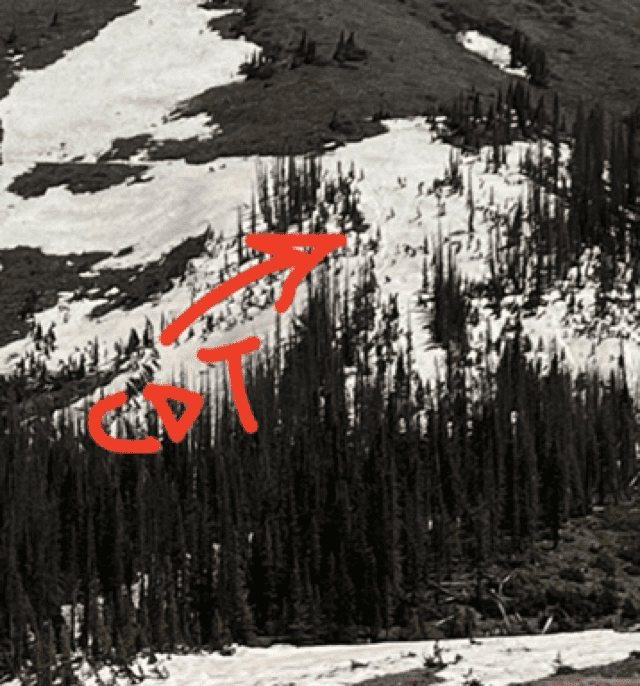
Most of the rest of the day was better. We found a side route that got us off the snow, by taking a much more gently-graded avalanche chute, this one actually littered with broken pines and other evidence of an actual avalanche sometime this winter. We climbed steadily for several miles, and even crossed a wide snow field without any serious impediments, though by this time we were sinking easily into the soft afternoon snow, or “post-holing.” We’d found a likely enough spot to make camp on the map, and we’re working our way toward it when we realized we’d have to climb sharply down another snow-covered slope. “Oh well,” I groaned, “I did want one more chance to die today before dinner.”
It wasn’t the climb down that was the problem, as we were back on rocky trail in a matter of minutes. It was the two avalanche chutes that followed, each with snow soft as room-temperature butter. Halfway across the first, I post-holed up to my thighs. Struggling to extricate myself, I felt my body essentially dangling on the side of a mountain, held in place only by the thing I was fighting to break up enough to pull myself out of—but not so much that I’d knock any of down the slope. The second chute was, if anything, worse, with a low, overhanging cliff face I couldn’t clear with my guitar sticking out of my pack. I had to lean uncomfortably far to the side and crouch in a way that gave me very little leverage to make it across. I had carried that instrument on my back from Damascus VA to Mt. Katahdin on the AT, and for the entire length of the PCT, but that was the moment I decided I would not carry it any further than the next town on the CDT.
It was a difficult day, one that did not even end as scheduled. Once Sean Meadow and I were finally bundled up in our tent—an ordeal in itself in the wind at 12,500’ we could not find shelter from—and we were finally cozy, the tent blew down, something that hadn’t happened to me despite all the nights I’d spent in bad weather. Overnight the wind slackened from the cruel ferocity that had collapsed the shelter, but it never stopped. Every time a gust blasted the tent, my eyes snapped open, fearful that we’d have to once again triage and field repair the tent, but this time in the dark. We needed to make some changes before moving on the next section of trail, but first we needed to survive this one. And that task was proving to be a great deal more difficult than any of us had anticipated.
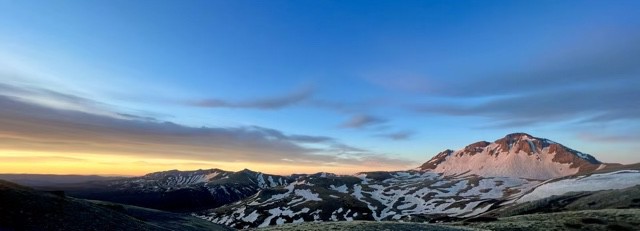
Day 42: 28 May, 15.4 miles today, 677.7 miles total, Rio Grande National Forest, CO
Sean Meadow, and I, and every other camped out in the godforsaken wind tunnel at 12,500’ had an absolutely miserable night’s sleep. The morning wasn’t much better, as the wind by that point was becoming a steady nightmare instead of the occasional (if frequent) bursts of violent activity that had kept us awake all night. The alpenglow on the surrounding mountains was truly breathtaking, but it was hard to enjoy while trying to keep warm in a wind that was constantly flighting to blow your breakfast pop tart out of your hands.
The morning’s hiking was, astonishingly, not technical or dangerous or even particularly difficult. It was just a nice walk in the mountains—though it was admittedly hard for me to get into it, exhausted as I already was from not sleeping the night before. The CDT, of course, ever the shithead prankster, had a few fun surprises for us, however. When we walked on from a pleasant mid-morning break, we found ourselves on an open, completely exposed slope—with an amazing, expansive view of the San Juans—where we were buffeted by 40kt winds with gusts that made it difficult to stand upright. I was convinced for the miles we hiked in the open that the guitar I had decided to retire the day before was going to snap in the wind before I could get it to the safety of town.
Once we cleared that and were back below tree line in the protective embrace of the forest, we had another snow-mush traverse during which we had to somehow walk around the trees without slipping on the soft snow down the incredibly steep mountainside. It was at least a much shorter nightmare than Pucker Peak had been the day before.
After we made it free form that, we had to navigate several miles of blowdowns so thick they looked like they’d been scattered over the trail deliberately. Some had been there for so long they were turning to pulp. It was like clambering over a sharp, pointy, splintery jungle gym only to walk 20 feet and climb over another one. It was exhausting work for muscles that were already stiff and sore from having been grossly overworked the day before.
Still, the day was cheerful, with three full trail families in the same bubble, all piling up together for breaks. It gave the mountains a kind of wholesome festival vibe, a sort of club you felt lucky to be a part of even if you weren’t sure how exactly you made it in yourself. There’s a camaraderie that comes from doing the same hard thing as the people around you, even if each of you is doing it individually. While I can’t speak for every hiker’s experience, for us there were no egos in the South San Juans, and every human in the thick of it with us had earned our respect, because we knew exactly what they had gone through in order to sit with on that log by the spring and talk shit about the trail.
We ended our day in a quiet, clear-cut spot just off the trail where the wind didn’t reach. Even though the odd gust might shake our tent, we were much better protected than we had been the night before—a fact brought home by the ceaseless roar of the wind in the trees on the mountains above.
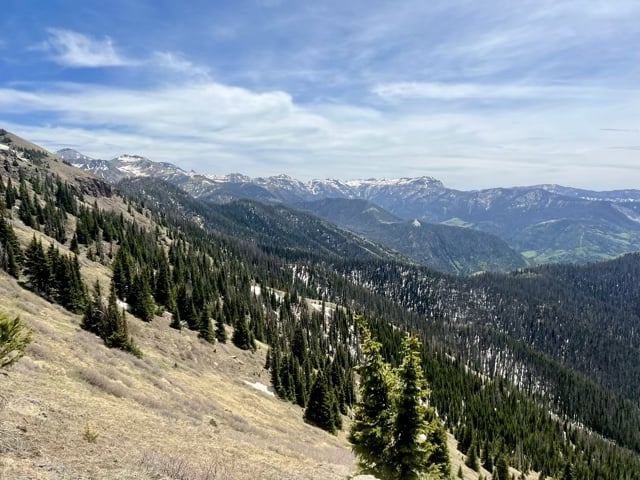
Day 43: 29 May, 5.8 miles today, 683.5 miles total, Pagosa Springs, CO
Our sheltered campsite would have made for a good night’s sleep but for the fact that my inflatable sleeping pad had a serious but discreet hole somewhere in it. 15 minutes after filling it, my hip would be digging into the rocky ground below. Sean Meadow had offered her sitting pad as an under-layer, and while it did help, I was still awake much of the night—either blowing the camp mattress back up once again, or trying to pretend that I wasn’t all that bothered by the feeling of the rough ground rubbing against my bones.
Still, I managed to doze throughout the night. I woke up to see Sean Meadow’s smiling face looking down at me, which was a bit disorienting since she usually remained tightly bundled in her sleeping bag until it was time to get up. “Good morning,” I mumbled, “what’s up?” “I got us a ride,” she said. Apparently she’d had cell service and had chatted with a friend from Antarctica who lived nearby. He would meet us at the next road crossing at 1000hrs and drive the entire group 23 miles into town.
We had a short day planned, but it would nonetheless require some maneuvering. Reports of conditions ahead of us were that the trail once again got sketchy a few miles before hitting Wolf Creek Pass and the road that would take us into Pagosa Springs, but that we could avoid that section by bushwhacking down from a ridge to the eastern shore of a small lake, from which we could road walk for an hour and get to the pass. Easy peasy.
Except of course it wasn’t. The trail up to the bushwhacking turn-off was littered with complex blowdowns. We were hiking as a group—8 of us clambering over the piles of debris in a row—but I was pulling up the rear, and the 3’ guitar I had jutting from my pack was once again proving to be a liability. I lost the others the first time I had to remove my pack to navigate a tricky blowdown everyone had passed under by simply ducking. I would have to do this several more times before I met the group, waiting to leave the trail and start picking our way over the mountain to the lake.
That task was, unsurprisingly, difficult—but it was at least blessedly free of snow. There were just a truly unbelievable amount of dead trees to climb over. It was slow going, but we eventually made it down to the water’s edge. A short balancing act across the debris amassed at the lake’s outflow, and we were on the road. An hour later, we were waiting at the pass.
We had to wait for a while, while a cold wind blew up the road from the southwest. It was uncomfortable, but it wasn’t so bad. We cheered a couple of cyclists who peddled up the long, winding road, turned around at the (not very) scenic overlook where we were milling around, and headed back down. A white-bearded local man whose son, we would find out, was currently on the PCT, pulled up in a jeep with a bag full of pastries from a nearby bakery and started cheerfully distributing them to us. It was our first taste of town since we’d entered the South San Juans, and it was hard not to wolf the entire thing down in three bites.
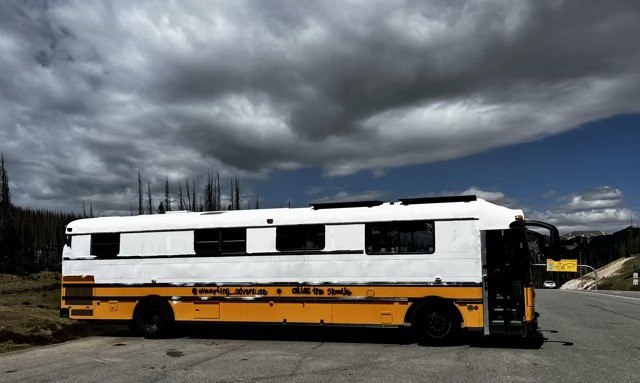
Sean Meadow’s friend had assured her that he would have room for all of us in his bus, a term we had assumed referred to a camper van or maybe an old Volkswagen. But when we finally crested the top of the pass and pulled into the parking area, we saw why it had taken him so long to get up there: he was literally driving an old yellow school bus. Our ride had arrived.
While his name hadn’t connected with anyone I could remember from our first season on the ice, I had expected to recognize Sean Meadow’s friend when I saw him, but could only vaguely place him when he came bounding out of the bus with his two dogs in tow. That turned out to be fine: when I reached out to shake his hand, it was immediately apparent he didn’t recognize me at all. It didn’t matter; he was gregarious and welcoming to all of us, ushering the group into the bus he and his wife had spent the winter converting into a tiny home.
I use that term instead of RV or camper simply because of how homey and cozy it felt. Four us sat on a full-sized couch, while the other four sat in the kitchen area next to the full-sized stove. The floors were hardwood and the walls were likewise likewise paneled. The was a tv across from us, mounted above a bookshelf filled with books. The roof had been removed and rebuilt to add height, a couple of large solar panels, and several skylights from which we could see the towering peaks of the nearby mountains as we rode to town. Sean Meadow and her friend caught up as we rolled along, with me occasionally dropping in the odd comment here or there, still unsure where exactly I fit into the conversation. Mostly, he seemed content to monologue about the area, pointing out areas with good skiing or common accident sites, and talking up a few places to visit in town, while we scratched the dogs and stared at the scenery.
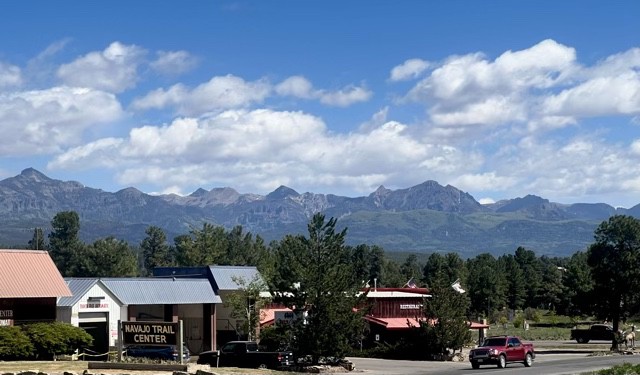
Pagosa Springs is a picturesque mountain village, an ideal hub for tourism. We were arriving in the middle of Memorial Day weekend, so the town was packed. Unlike most of the other visitors, we hadn’t come to soak in the hot springs or kayak the San Juan river; we had chores to do and decisions to make about the routing options that lay ahead. But we were hungry, so after dropping our packs at our hotel, we walked to a nearby diner called 2 Chicks & a Hippie, where we ordered breakfast, followed immediately by lunch. We had survived the South San Juans and now we had arrived in town. We had a lot to get done, but first thing we had to do was eat.
Day 44: 30 May, 0.0 miles today, 683.5 miles total, Pagosa Springs, CO
There is a phenomenon common—though not universal—to thru-hiking known as the trail family. A close-knit group of hikers, trail family dynamics are nonetheless tied to distinctly unromantic details like schedule and pace. People tend to make friend quickly on the trail; it’s an environment that encourages quick bonding and easy camaraderie—but you’re not going to see someone for long if she’s doing 25 miles a day and you’re doing 18. There is also a shared sensibility that draws hikers together into their separate groups: the people excited to hike a few extra miles to camp by a neat lake go one way, the people just looking for the nearest flat spot to the trail go another. But for me, the threshold between friends with similar interests and a similar pace who just happen to be in the woods together and a trail family is when the group starts to make plans together. Where are we camping tonight? When are weleaving town? What route are we taking?
Trail families are fluid. Members can come and go; especially on a trail with as many routing options as the CDT, sometimes people just want to go different ways. Even on single-path trails like the AT and the PCT, my trail families lost member who simply hiked ahead one day and never came back. I myself lost entire groups when I lagged behind at some wayside or other and never caught back. But there is nonetheless something special about having a collective to share any part of the thru-hiking experience with, a mix of personalities that compliment each other with their differences as much as their similarities, a group of people who notice when you’re lagging behind or when you show up to camp bleeding at the knee, who would happily help carry your gear through the backcountry if you slipped on a rock and fucked up your ankle.
As we entered the South San Juans, we had become a crew of seven: Unknown, a cheerfully fastidious man with a luxuriant beard who hiked fast but stopped often, and whose hiking clothes never seemed to get wrinkled, let alone dirty. PA, who was quiet and also pretty clean, who always left camp last but quickly passed everyone else as he breezed over the trail. Elf was a good-humored midwesterner who was more often than not the first to leave in the morning, as he tended to walk a bit slower than Unknown and PA—in fact, Elf was the hiker I saw the most of during the day’s walking, since he and I would usually be somewhere toward the rear of the pack. K. didn’t have a trail name as yet; she was the person I knew the least, but she seemed to know every other hiker on the CDT and was friends with most of them. Shorty, still in his twenties, was the youngest person in the group; a happy-go-lucky fellow, very little seemed to dim his enthusiasm for the trail and the community he found there, even when he overslept and lost the rest of us for a day or two. Sean Meadow and I, you already know.
It was when we were circled up at camp to eat the first night out of Chama that the term first came up. As Shorty took his place in the circle, he looked around at the rest of us and said, “well, look at this, a real trail family dinner.” It was the first night we’d all hiked and camped in this particular configuration, but it had a ring of truth to it.
Our association, strengthened over the next few days by hellacious conditions through which we’d walked, was more formally recognized when we met on the morning of our first zero day in Pagosa Springs at 2 Chicks & a Hippie to eat breakfast and discuss our routing options. Sean Meadow and I, a few minutes behind everyone else, walked up the hostess, who said simply, “they’re upstairs.” Shorty was staying with another hiker across town, but he’d be kept in the loop, and we’d meet up with him later that morning. At breakfast, the rest of us agreed to stay together and figure out a plan for the coming section as a group.
The first thing we agreed to was staying another day in town, which would give us more time to get information about conditions on the trail ahead and would help us delay getting into northern Colorado too early. It was early to be in southern Colorado as it was, even during a low-snow year, and the north of the state had just gotten another dump of snow. We discussed what we knew of the the situation on the routes available to us, but tabled making a decision until later. In the meantime, we had chores to do across town.
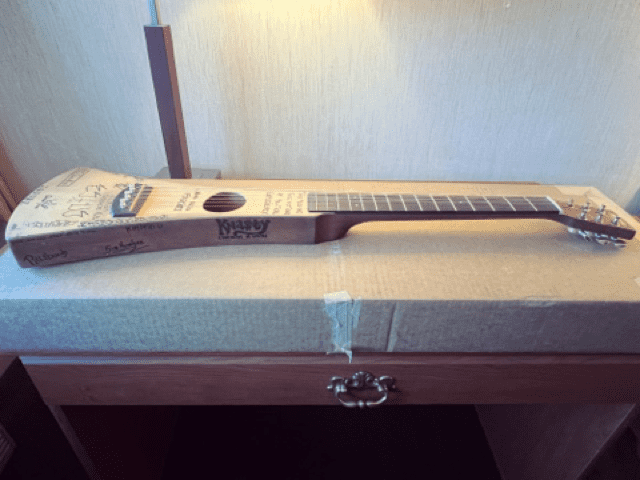
After meeting Shorty and hitting up a handful of outfitters (where we spent an embarrassing amount of money on niche gear) and a music store where I bought a waterproof ukulele for the price of three pairs of hiking socks, we had lunch at a brewery, where I brought out my Martin backpacker guitar, the 3lb hunk of wood I’d carried on my back for 5,000 miles on the AT, the PCT, and the CDT. It had made it to Pagosa Springs, but would make it no further, as I would be sending it home from here. One by one, they each signed it, adding their names to the one relic from each of my thru-hikes that I truly valued for anything beyond its utility. Awkward to hold and play, it was never a great guitar; and as a piece of backpacking gear it was ridiculously heavy and was so long that it’s size had become a liability over the previous 67 miles. It was time to send it home, but I was grateful to have gotten the blessing of my trail family before it went.
Day 45: 31 May, 0.0 miles today, 683.5 miles total, Pagosa Springs, CO
Our second zero in Pagosa Springs started much the same as the first, with a meeting at 2 Chicks & a Hippie to eat breakfast and discuss our routing options. Sean Meadow and I, a few minutes behind everyone else, walked up the hostess, who said simply, “they’re upstairs.” Shorty was staying with another hiker across town, but he’d be kept in the loop even though we wouldn’t leave our respective sides of town today. We’d gotten as much information as we could expect to, and we made our decision: we would hike the CDT Red Line, the longer, more dangerous and difficult option. We’d carry enough food that we could afford to take our time, and if we encountered any more exceptionally sketchy sections, we would stop to investigate any and all alternatives and, if we had to, proceed carefully and as a group.
And so, like that the die was cast. It was the option each of us had wanted to find a way to make work, but which each of us had been unconvinced yesterday morning we’d be able to. We would be entering one of the most notoriously difficult sections of the CDT, one that most alumni claimed was significantly harder than the one we’d just hiked. But its rewards were rumored to match its obstacles, and though we each steeled ourselves for the hard hiking that lay ahead, still each of us was looking forward to the challenge. All that was left was to buy enough food for the next 90 miles and to rest up. Tomorrow would be another big day.
Wow !! Very scary to read about your experience. Hope you are both doing well on this next trek
Think of you guys often.
Our last cruise excursion tomorrow requires us to walk up 350 cobblestone steps and we are already groaning
Be safe !!
Well, as one of the Moms I of course had to read on and while my heart was in my throat I am also wise enough to know you are capable, smart adventurers! I of course will be sending extra prayers of protection for all of you! Continue on a safe journey and I hope you have moments when you can let your guard down enough to replenish. Love ❤️
Whew! As the other Mom, I read this, glad that I knew ahead of time that it ended well. I’m happy that you’ve got a trail family; solitude is lovely, but true companionship is a gift. Wishing you joy in the beauty of the mountains and sure feet along the paths. ❤