Sean Meadow and I sifted through the fees hidden by a series of generic discount airlines before finally accepting the fact that the price for a round-trip flight to Mexico City would be roughly the same no matter what we did. We might as well, then, just book through a name-brand airline and enjoy the luxury of being allowed a carry-on. We were going celebrate New Year’s with a couple of friends from Antarctica, who would be heading down a couple of days before us. The North American Covid situation seemed relatively stable for maybe the first time since the start of the pandemic almost two years earlier—otherwise we wouldn’t have considered leaving the literal sanctuary that is Hawk Mountain. Nonetheless, our biggest concern at the time we bought our non-refundable, non-transferable tickets was that another brand-new strain of the virus would pop up somewhere to take the world by storm. And wouldn’t you know it, that’s exactly what happened.
The Age of Omicron dawned with alarming speed, and we spent the week after Christmas frantically googling what, if any, protective measures Mexico had in place and flipping back and forth as to whether or not we should go at all. Information on how the pandemic was being handled in Mexico was surprisingly scant; it had been easy, after all, to stay up on the latest guidelines and regulations from New Zealand, as well as the relative lack thereof from the United States—the two countries through which we’d passed since the Dawn of Covid in early 2020. Mexico, on the other hand, didn’t really seem to have much to say about it. In the end, it was the country’s low case numbers that persuaded us to go ahead and spend the holiday in CDMX. First, of course, we would need to get there, preferably without getting infected.
It is flatly unfair that the airlines make those of us afflicted with excess height pay an additional fee to sit in the exit row, as I would happily stick with whatever random coach seat was assigned to me if the legroom provided were not actually, measurably smaller than my actual, measurable leg. I have learned from experience that not upgrading will guarantee me not only an uncomfortable flight, but several days of limping afterward. All I am after is same basic accommodation given to shorter humans, but I have to pay for it. This financial inconvenience generally results in one of two outcomes: the fact that not everyone is willing (or able) to shoulder the cost of an “upgrade” to the sort of experience had by most everyone else means that from time to time I will find that I have the entire row to myself on what is otherwise an overbooked flight, and can stretch out as I please in every direction—as indeed happened on our connecting flight into Mexico City. More common, though, is the other outcome, in which the row is packed tightly with other oversized humans who, if they are American, tend to be as mindful of Covid protocols as they are of the personal space of others.1
Two things were immediately apparent once we had finally cleared customs and made it outside the airport, after I had filled out the declaration form incorrectly three times in a row and was sent to the back of the line each time. The first was that the aging and inadequate2 sewage system for this massive, sprawling city announces itself every so often in the form of a gentle breeze redolent with the smell of human shit.3 The second was that every one of the 25 million citizens of Ciudad de México was wearing a mask. The low reported rates of Covid infection in Mexico had been hard to reconcile with the government’s apparently hands-off approach to vaccination and mask wearing until we got here and saw every local wearing masks any time they were in public and not actively eating or drinking. Even outside, on the sidewalk or in the park, and even when no other people were immediately nearby. The vast majority of people going mask-free on the street, we would come to notice, were arrogant Gringos who had brought their entitled sense of defiance along with them as they came to partake in the New Year’s celebration of another culture.
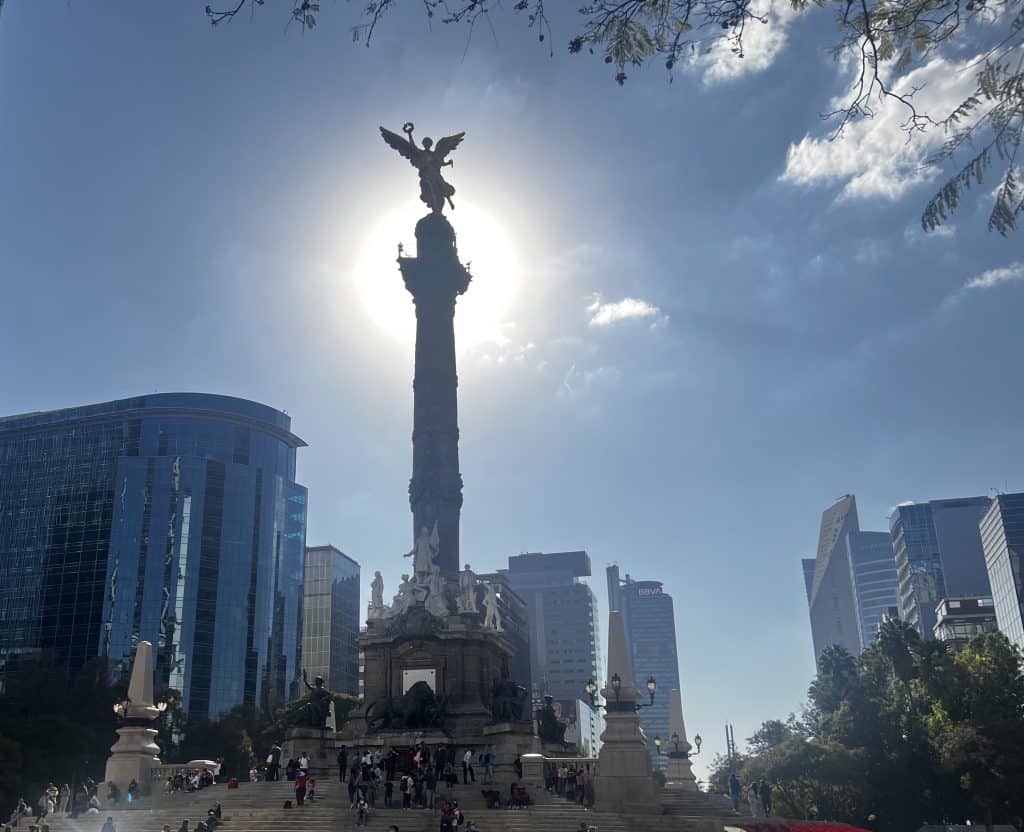
And when I say that the people of Mexico City were wearing their masks all the time, I mean that they were actually wearing them—they didn’t put themselves through the hassle of covering half their face only to render the endeavor completely useless by sticking their noses over the damn thing, nor were they accenting their outfits with a stylish, medical-grade chin ornament. Rather, they actually wore their masks, keeping both nose and mouth covered, as if they were making some sort of an effort at slowing the spread of a worldwide pandemic. We noticed this as we pulled up to the charming apartment our friends had rented in the Condesa district, just a short walk from the hilltop castle on the eastern side of the Bosque de Chapultepec. We noticed it as we stepped out for tacos al pastor that afternoon, again as we walked to the fancy4 restaurant where our friend B. had made reservations for dinner, and yet again as all of us struggled to interpret the gesturing of the waiter, whose mask rendered his words—spoken in a language in which none of us was precisely fluent to begin with—all but impossible to understand.
We did our best, and toasted each other with cervesas, champán, and pink specialty margaritas made with cotton candy. We ate and laughed as a pair of giant axolotls smiled down at us from the mural painted over our table. We’d already started on our second or third round of after-dinner drinks when a pair of straight American couples came in and took the table by the balcony. They were easy enough to ignore until the dudes stepped onto the narrow platform outside and lit up a couple of rank-smelling cigars. The light evening breeze blew the smoke into the dining room, and soon the place had the homey aura of a small tire fire. The duo put out their cigars after their girlfriends made a fuss about the literal stink they were causing, but the vibe had been irrevocably changed, and anyway we were all getting restless after sitting in one place for so long. We paid up and started wandering the streets of Mexico City, looking for a bar somewhere with an open table.
It took a while, but we did eventually find a place with room for us. The ambience was noticeably different here, the sort of place where the music plays so loudly you have to yell to hold a conversation, and where you’re patted down for weapons on the way inside. The tables around us were filled with middle-aged locals, drinking heavily and talking loudly, while a young couple in the corner made out with a sustained vigor that was impressive, even given their youth. We ordered a bottle of Don Julio and waited for the countdown to midnight and the traditional doce uvas de la suerte, or twelves grapes of luck. Each grape represents a month of the coming year, and eating it is suppose to assure good fortune for that month. In Spain, the grapes are served in a bowl, and are meant to be eaten at midnight with each of the twelve tolls of the local church bell. In CDMX, at least, the grapes come in a drinking vessel, and are eaten at a less frenzied pace.
It was fitting in its own way that we had abandoned the fancy restaurant where we’d eaten dinner—which had been serving the 12 grapes in champagne flutes—and moved onto a decidedly less-tourist-oriented bar we had come upon more or less at random. This place gave us our grapes in red solo cups, followed shortly by celebratory champagne poured into the same. At midnight, we counted back from diez, then held our red cups high and screamed “¡Feliz Año!” with the rest of the bar. We toasted each other, then those at the tables around us. “¡Feliz Año! ¡Feliz Año!” As we drained our cups, the party really started to pick up. But we’d been on the move since early that morning and we were plum tuckered. So we did the crowd around us goodnight as the electric mariachi band downstairs broke into its first, raucous number, and we headed back to the apartment to sleep.
The rest of our stay in Mexico City was, for the most part, pretty relaxed. We spent an afternoon wandering an outdoor market that stretched for miles along the Avenida Paseo de la Reforma, coming home with bellies full of tacos and a bottle of pineapple mezcal that cost the equivalent of $8USD. We toured the castle on the neighboring hill. We walked the neighborhood, stopping at various holes in the walls to eat. And for the most part, we ate well. Then we went out for a bite following an evening spent drinking Tecate in oversized plastic cups while watching the live drama of lucha libre unfold before us, and our culinary tour of CDMX took a rather less pleasant turn.
Despite my egoistic determination not to be just another Gringo whose trip to Mexico would be largely defined by a bout of gastrointestinal distress, the tacos de carnitas I ordered at the dive bar5 around the corner from the Mexico City Arena would take those ambitions and flush them down the toilet, so to speak. My mom would call it “Montezuma’s Revenge,” but this wasn’t so much the inability of my body to adjust to the microorganisms indigenous to a foreign culture, but rather a single instance of poorly-handled food that could honestly have happened anywhere. The meat was dried out and chewy, and in retrospect I have reason to suspect that it had been prepared several days earlier and had been stored improperly ever since. Worst of all, I had happily shared the contents of my plate with everyone at the table, and we were each affected in proportion to how much of the bad pork we had eaten. I may have already been coping with some low-grade tummy problems since our arrival, but it was those fucking tacos that really turned me inside out.
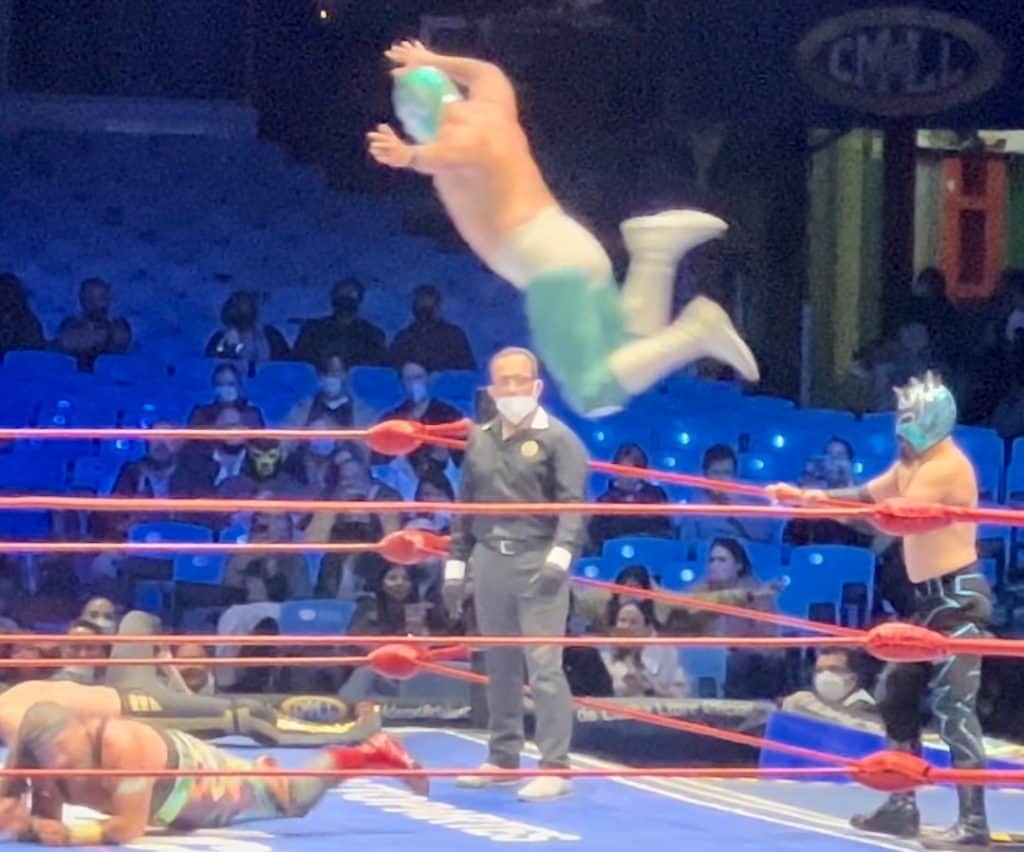
this ref is maybe the one local I saw not wearing his mask properly
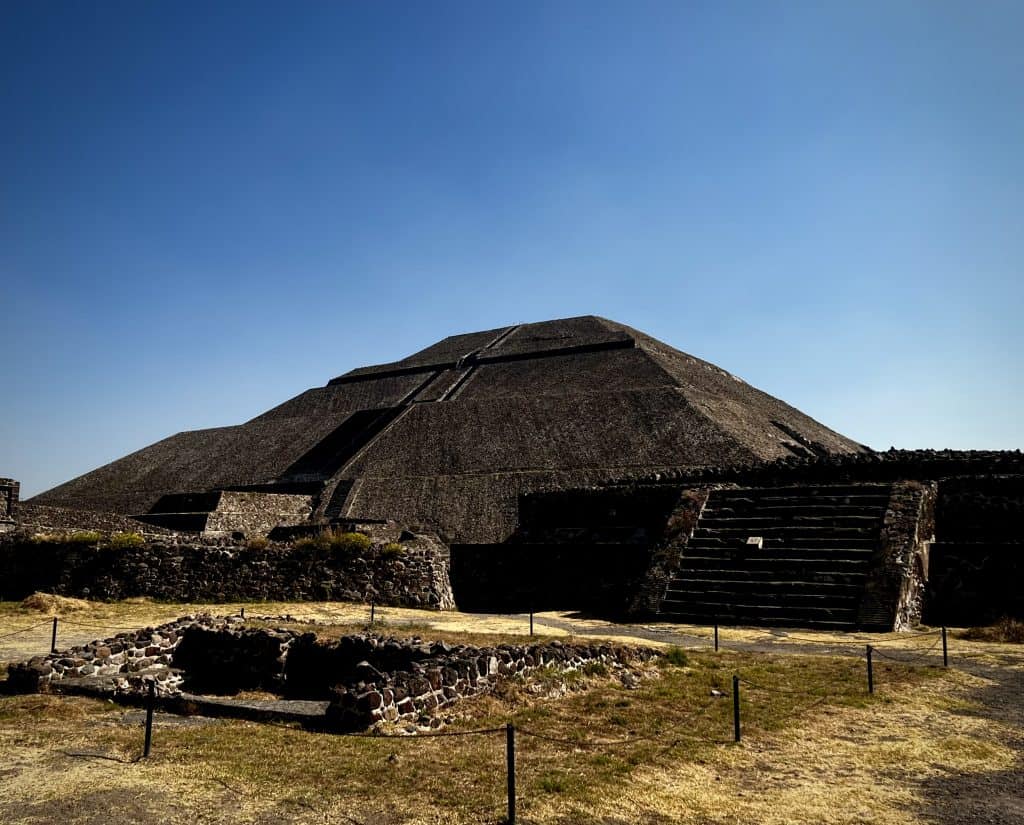
Thus is was that I spent our last two days in Mexico shitting my head off, though I did at least manage on the last day to hold it together long enough for a visit to the enormous complex of temples at Teotihuacán.6 The site is a legitimate marvel, and well worth the effort, even when your entire party is hobbled by gut pain. It’s for this reason that I think I my appreciation was more of an intellectual exercise than a true experience of awe, though the large mingling crowds of souvenir vendors and other tourists may also have had something to do with that. Nonetheless it was a positive mental picture of CDMX to carry with me as we began our trip back to the states painfully early the following morning, trying desperately not to poop myself while waiting for the results of the mandatory pre-flight Covid screening.
The food poisoning only worsened in the days immediately following the incident of the terrible tacos, and the day we flew home was the most disagreeable one yet. Worse than the embarrassment suffered by having to horrifically and noisily void oneself a mere 10 feet from the extremely pleasant and accommodating bathroom attendant—in what was otherwise a gloriously clean and private stall—was the realization that the automatic flush didn’t work on this particular unit, and there was no manual lever to clear the bowl. After my third trip to his domain, I gave the attendant every last peso remaining in my pocket. Then I started scouring the terminal for anti-diarrheal meds, or at least something with bubbles in it that might give me some psychosomatic comfort, if nothing else.
The condoms for sale in the snack shop by our gate in the Benito Juárez International Airport seemed ludicrously optimistic to me. Clearly many more people than I’d realized could not resist the lure of fucking in a cramped and filthy airplane toilet, or there would be no market demand for an item that would otherwise be easy enough to pick up at a gas station or a drug store once you’d gotten to where you were going in the city. As I currently could go only an hour at the utmost without blowing up the facilities nearest to me, I could only hope that my next urgent visitation would not be held up by any number of couples trying desperately to convince themselves that they were actually having an enjoyable experience while attempting to cum in public. It was only after a second visit that I realized the same shop also had cigarettes and beer for sale.
We had a lengthy layover in Miami, where we holed up in one of the lounges and tried to nap, or at least eat our fill of the free airline-grade snacks available. It was most definitely not new to me by then, but I was nonetheless struck by the casual disregard Americans have for the pandemic and any attempt to slow its advance, especially as the Omicron variant was by this time raging from one end of the country to the other. Coming as we were from a nation whose citizenry had taken such measures seriously, it was jarring to be surrounded once again by a people that just didn’t give a shit—or if they did, continued to struggle with even the most basic principles of the process. A young man in the lounge in Miami sat in a chair talking on the phone for an hour, his face barren of covering of any kind until he got up to go to the bathroom. At that point he donned his mask, removing it once more after returning to his seat. Why even bother at that point, bro? What do you imagine you’re going to accomplish?
We’d be at my parents’ house for a single day before we’d drive south in a rented SUV to St. Augustine, Florida to begin our bike ride into the West, across many of the parts of the US most hostile to vaccinations, hand-washing, mask-wearing, social distancing, or doing anything, really, to acknowledge the legitimacy of the virus. It was a day I’d spend alternating between feverishly packing my panniers and frame bag and sprinting to the bathroom, wondering all the while which had the been the more reckless choice: traveling internationally in the middle of a worldwide pandemic, or coming home?
1. I’d like to give a shout out to the grown man sitting next to me on the flight from Atlanta to Dallas, who kept his mask pulled down any time the flight attendants were out of sight so he could pick his nose the entire fucking time we were in the air.
2. This is not to pick on Mexico City. CDMX, like cities the world over, has struggled to develop the infrastructure to support a population that has grown faster than city planners could anticipate. Seattle, for example, has the road space to accommodate only approximately 10% of its current population (a figure which I know sounds like hyperbole, but—trust me—isn’t). Mexico City has, among other things, an overburdened sewage system, which regularly fails during the rainy season due to something about conditions of the local soil I don’t really understand.
3. Which still smells better than New York in the summer, if we’re being honest
4. Well, fancy for me.
5. Also home, incidentally, to the smallest/grossest toilet I would encounter in Mexico.
6. Though the protracted ride back in rapidly thickening traffic was an uncomfortably close call.