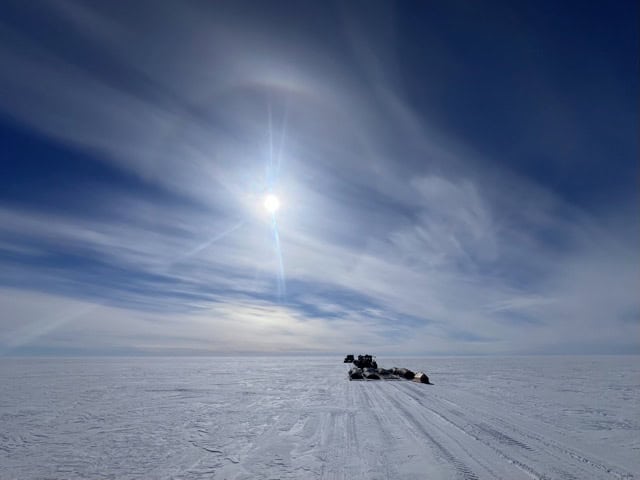
The following is the personal account of a single, long-winded individual’s experiences living and working in Antarctica. No part of it has been reviewed or in any way endorsed by the United States Antarctic Program or the National Science Foundation, or any other public or private organization, institution, contractor, or company associated therewith. The views expressed herein are the author’s alone, for good or for ill.
Day 45: 19 December, 49 miles today, 695 miles remaining to McMurdo, elevation 1,979 feet, the Leverett Glacier
In a typical year—as much as any year on the South Pole (overland) Traverse is typical—there are three expeditions made to deliver fuel to Pole. SPOT 1 leaves first, completing its round trip back to McMurdo as quickly as possible so the crew can turn and burn its way back to Pole with a load of freshly filled bladders as SPOT 3. In between, the crew on SPOT 2 makes a single out-and-back to Amundsen-Scott, and, without the pressure to make two separate 2,080 mile journeys in one season, moves at a far more laconic pace. This allows them to actively work on the trail along the way, replanting flags, smoothing out some of the rougher sections, and doing whatever maintenance they can manage.
The 2024-2025 austral summer season wasn’t a typical year, however. SPOT 1 and SPOT 3 were staffed and tractored more heavily than usual—and more than the camp was built to accommodate—since SPOT 2 wouldn’t be going to Pole at all. Instead, they would spend the peak summer months parked on the lower Leverett, rerouting the trail to the Polar Plateau, which had flowed over the years along with the glacier until the flagged path no longer resembled its original course. It was a big project, one that would require weeks of scanning, drilling, and blasting, and would result, hopefully, in a more streamlined trail that was faster, easier, and safer than the one SPOT 1 had climbed over a month before. Now that we were descending, we would cross paths with SPOT 2 for the first time—us, as we were heading home to recoup and refuel, them as they were just setting up camp along the glacier’s foot for the season.
The morning we climbed down the Leverett was sharp and clear as I stepped blearily from the living mod and took a look around, the shoulders of the great mountains guarding the valley just visible at the the edge of the uniform blanket of clouds covering the sky. By the time we’d finished breakfast, however, visibility had shrunk, and we would have to make the descent in a negative space of flat light, bordered by an undifferentiated field of white. Most of the SPOT 1 crew would start down immediately, leaving those of us with more complicated loads—particularly camp and the cargo sleds—behind to prep them while three tractors from SPOT 2 crept up the glacier to join us. Every load had to be tagged down, and having those extra few tractors come up to help would save hours of waiting for some of our to make it all the way to the bottom just to putter all the way back to the plateau.
Tagging is, in a way, the opposite of tandem pulling. In a tandem pull, two (or more) tractors are tied to each other at the front of the load, and the combined strength of both machines is what moves the weight forward; in tagging, one vehicle pulls the weight of the cargo on its own power, while the other is tied to the back end, and is there to act as a sort of rolling anchor. I had done variations of this maneuver in McMurdo, but never anything on this scale. Shortly after I had checked and tightened every net, strap, and buckle I could reach on the train of polar garbage I was hauling north, the trio of tractors from SPOT 2 arrived. I had a brief discussion with my partner—the SPOT 2 mechanic, a no-nonsense kiwi who was generally nonetheless cheerful—while we were pinning his tow rope to the back of the third sled in my train, and we set of for the base of a glacier whose boundaries we couldn’t see.
We were ten minutes into the two-hour descent when I got a true sense of why this part of the trail was always done in pairs. I was checking my load in the mirrors, and was shocked to see both of my towing cables slack, slithering through the thick layer of freshly fallen snow like frightened snakes. I wasn’t pulling the garbage at all: it was sliding downhill entirely on its own, and the second tractor, matching speed with me in an effort coordinated over the radio, was holding it back. The process only became more complicated as we continued down, and a series of side slopes tried to the garbage train away, the two tractors holding either end onto the trail as the load flexed to the side in a giant capital C. Nothing in our system was designed for this kind of enormous sideways stress, but at that point there wasn’t anything to do but trust that every cable, rope, paulstra pad, and ski would hold, since the momentum of a break would carry the load and any tractor attached to it god knows how far down the steep, slick grade. This was exactly what the SPOT 2 team had come to the Leverett this year to fix. The original trail hadn’t included anything nearly this sketchy, but the route had shifted by a mile and half in some areas—there were sections of the glacier that moved some four feet per day. We could only hope that by the time came back through this area as SPOT 3, we would find a gentler path to the plateau and back.
We it safely to the bottom of our sharpest incline and trundled our way to the SPOT 2 camp. There was snow falling thick and heavy in the valley, big fat New-England style flakes that looked promising, but would soon enough prove to be poor material for snowball construction. The ghostly shadows of Mt. Beazley and McLean Peak glided in out of view through the hazy white veil as we pushed on, but for the most part the rocky walls remained hidden from view. The crew that had already made the descent had been busy, moving a few thousand gallons of fuel into SPOT 2’s bladders, where they would hold it for us until we returned to pump it back to one of our loads and onward to Pole. When we arrived, we met our friends with big smiles and excited chatter about our two respective journeys across the ice to this single point, but it wasn’t long before the two traverse teams set about transferring ownership of the Prinoth from our caravan to theirs. There were spare parts to move and barrels of special lubricant to hoist across the temporary alley created between our two mobile camps—while their lead operator stood on the platform in the space where the drum would go, trying to pelt each of us with loose snowballs despite his terrible, terrible aim.
We had miles yet to go that day, so after a late and hasty lunch, we clambered into our tractors and hooked back onto our loads. As our odd, industrial parade crept by the SPOT 2 camp, the entire crew spilled out of their combined kitchen/living mod to wave us on—or so I thought. As 308 passed slowly in front of the small gathered crowd and I raised my hand to wave, a flurry of poorly-packed snowballs began to rain all over my machine. This, I would later learn, was the traditional SPOT 2 salute, and while the tufts of spattered snow would soon melt from the heat of our Challengers’ overworked engines, we would carry the image of our compatriots’ gleefully laughing faces into the great white expanse that awaited us below.
Day 46: 20 December, 54 miles today, 641 miles remaining to McMurdo, elevation 383 feet, the Ross Ice Shelf
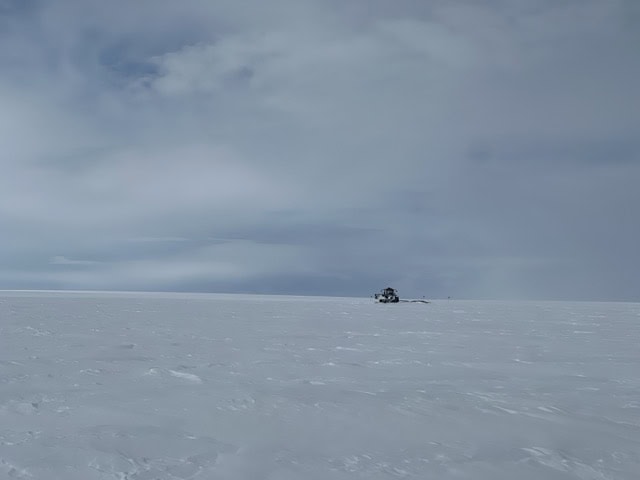
I slept the sleep of utter annihilation. For probably the first time since we had climbed up the Leverett headwall, I was dead to the world from the moment I closed the curtain around my bunk until my alarm went off in the morning. Waking was a struggle, like trying to claw my way out of a deep hole, slick with mud. I had expected better sleep once we’d returned to sea level-ish, but this was something else entirely—a kind of living burial. I couldn’t wait for the end of the day so I could do it again.
The ice shelf had warmed a great deal since we’d last driven its vast, subtle contours. It hadn’t been unusual on the Polar Plateau to see water dripping from the tractors in the middle of the day, as the thrumming inferno in the engine melted the ice and snow kicked up and sprayed all over the machine by the spinning tracks, but most of it would have frozen solid by the end of fuel circle—or anyway, what hadn’t been chipped away. It was a shock to walk out into the warm, overcast morning to find liquid water still pooled in 308’s tracks, as icicles on the living mod melted with a steady drip behind me. Now that the temps were in the positives (at least in the Fahrenheit scale), we would be able to dispense with the warm-up mile at the start of each day’s travel, since the machines would never have a chance to get truly cold. The SPOT 1 supervisor, crossing his tees, checked in with the mechanic foreman at the morning meeting. “Do we still need a warm-up mile, or can we start the day at full speed?” The response was a simple nod, then, “Balls to the wall.”
And so it was. For a while. We took off into a light snow falling across the summer-softened trail, barreling through the swirling flakes in what felt like the first uninterrupted burst of steady driving in weeks. We made fantastic time all the way to the 1000hr load check, which happened to be right at the waypoint where we’d left our largest fuel cache for the journey home. Picking it up should have been as simple as hooking one of the heavier tractors onto the CRREL tool and driving away, but even from a distance it looked like it would be a bit more complicated than that. We had taken a gamble, opting not to spend the hour or two it would take to build a quick berm to keep the load out of the drifting snow while were away, and as we approached it already seemed that we may have lost. When I finished up checking on the garbage sleds, I went over to help the operator who would be towing the load once it was free, and what I found was even worse than I had imagined. While we’d been gone, all the snow that had fallen or drifted onto the CRREL tool had melted as the steel frame baked in the constant, relentless summer sun, then frozen as it had dripped onto the snow. The fuel cache had been locked into a block of solid ice.
The process that eventually unfolded looked a little something like this: chip away at the ice around the CRREL tool for a while, then try to pull it free with a tractor; when that doesn’t work, chip a bit more off, then add a tractor to the front. We were three tractors in when I heard a massive CRACK! behind me and my tractor started easily rolling forward. I hoped desperately that it was the sound of the fuel load breaking free, and not the sound of the skis being ripped off the frame, before the operator behind me said over the radio, “the tow rope broke.” This statement, while accurate, proved to be something of an understatement. The thick black rope, as big around as a can of soup and rated to over 100,000lbs, had exploded somewhere between my hitch and front of the Challenger behind me, littering the snow with a carpet of black tufts which stirred gently in the light breeze. We went back to chipping at the ice block while we waited for another tractor to arrive with a 200,000lbs rope, a couple more shovels, and another pair of hands. In the end, it took six people and four tractors before we finally got thing free. By then, it was already time for lunch, so we just drove up to the kitchen mod and headed indoors.
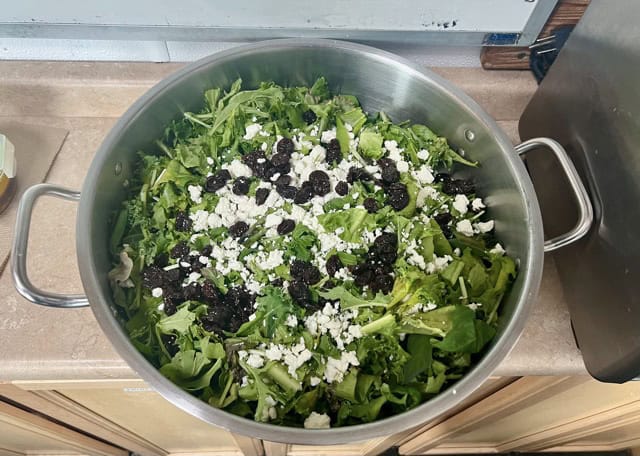
It was my turn to cook that evening, so I had the option to trade out for the afternoon with the mechanic assigned to tractor 303—who had, at that point, been stuck riding inside camp for weeks. This I took, and gratefully, settling into my bed as the living mod lurched into sudden and violent life when the caravan starting rolling for the afternoon. Naps, I had found in middle age, had become fitful, light, and cruelly short, but the moment I stretched out in my darkened bunk I was gone, in a state of blissful unconsciousness I hadn’t known since general anesthesia had relieved me of the obligation to live through the removal of my wisdom teeth some 26 years before. I awoke, refreshed and ready to dress with the remaining bags of leafy greens the supervisor had harvested from the South Pole greenhouse. These had been picked at for the last several days, but no one had yet tried to turn them into a meal, and these precious specimens were threatening to turn, forsaken and uneaten. This would have been an unthinkable, unforgivable waste of freshies—Antarctica’s rarest and most valuable commodity. This I could not abide, so as the rest of the crew worked to fuel the tractors, I set about sautéing a small mountain of snap peas and bok choy before building the most ridiculous, luxuriant salad within at least 500 miles. Arugula, lettuce, kale, and basil, shredded and piled high and tossed with goat cheese, vinaigrette, and dried cherries. We burned through all our fresh veg in one glorious orgy of greenery. Our tummies might later rebel at this sudden bloom of chlorophyll and fiber, but that was a problem for another day. This night, whatever it was, was for celebrating the harvest of this bounty—and like each green leaf on the menu, we were not going to let it go to waste.
Day 47: 21 December, 76 miles today, 565 miles remaining to McMurdo, elevation 301 feet, the Ross Ice Shelf
Never over the course of eight separate deployments had I seen so much fresh snow. Actual precipitation was something I might count on two or three times per year, and then most of these were more dustings than blizzards, a handful of light flurries. What we hit coming home from the Pole was something else entirely—heavy snowfall, falling off and on for days. It was like a snow monsoon. The low clouds and the flake-choked air hid the great rocky spires and glaciated shoulders of the Queen Maud range, allowing us only the occasional glimpse of a silhouette through the curtain of white as this continental jewel slid into the distance. It was something of a disappointment, but now rolling into the seventh week of the expedition, most of us were just ready to get to McMurdo, ready for a day off with no agenda and nothing to fix, ready for a long, hot, uninterrupted shower.
The recent windfall of thick, wet snow had buried the trail we had compacted going south (and that SPOT 2 and Heavy Science Traverse had further tamped down as they had passed this way in our tracks), leaving us with a trail the consistency of white mud. The machines bogged down in the sticky, soft mess, and any load with a bit of heft had to be pulled in tandem just to make a few miles through this pristine bog. Even load checks were a slog—the moment you stepped off your machine, your boots would sink up to the ankle in mashed potatoes, which gave each footstep neither traction nor support. Some, in desperation, might try walking in the tracks left by the skis carrying the camp mods or the cargo loads, but these ruts, though much firmer than the surrounding snow, were slicker than HMW, and all but guaranteed you to slip right onto your ass. But at least the stuff packed nicely into snowballs.
I had been up late the night before—everyone had. Most of the crew had been out at an extended fuel circle, trying to disperse the weight of the fuel cache we had picked up over two bladder sets in the hope that two fairly heavy loads would pull faster than a single super heavy one. I might have been spared that part of what one of the mechanics referred to as the evening’s fuckery, but as the cook I had to wait until after everyone had had a chance to eat before I could clean up. As a result, I walked through the next day like a man swimming a dream, slow, uncoordinated, and confused. By the time we passed back through the Shoals shortly after the 1530hr load checks, I was fighting for my life just to stay awake. This eight-mile stretch of trail, where the ice shelf flows over a series of what would be underwater islands if this ocean were melted, is one of the more treacherous sections of the entire journey: the narrow strip of snow marked by evenly-spaced green flags is safe, but the broad, unassuming fields of ice just a few feet to either side are littered with massive, thinly-bridged crevasses. This is not the place you want to be nodding off, as just a few seconds of inattention can land you and your tractor in a giant pile of shit, but I just could not keep my eyes open. The solution I hit on, after weaving wildly across the thin band of safe passage, continually snapping back to consciousness in a panic, was to play high-energy music at inappropriately loud volume while shoving fistfuls of wasabi peas into my mouth, until the piercing fire in my sinuses made my eyes water. I kept this up until my face was a smoldering ruin, but I made it safely to the north side of the Shoals—another hour closer to my bunk, closer to Ross Island, closer to Sean Meadow, closer to home.
Day 48: 22 December, 79 miles today, 486 miles remaining to McMurdo, elevation 260 feet, the Ross Ice Shelf
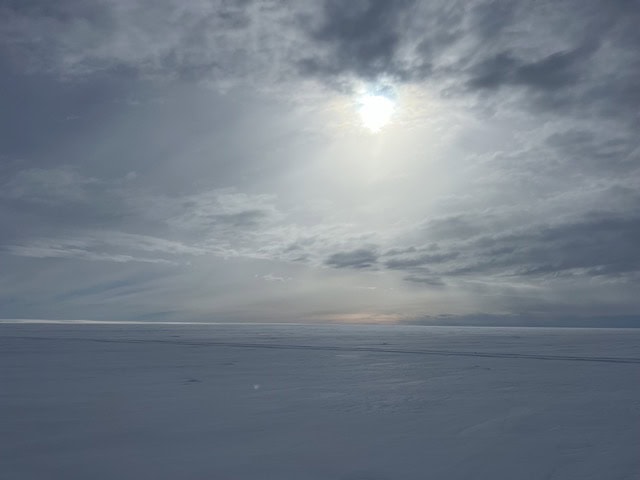
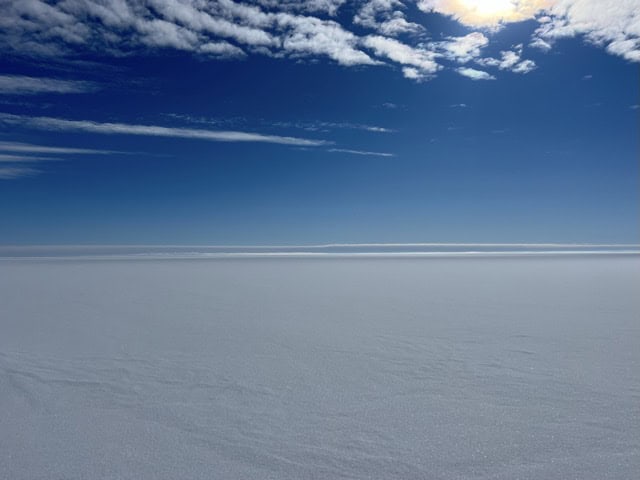
The Transantarctic Mountains, obstinate as ever, remained hidden behind a wall of clouds even as they shrunk into the southwest—while the ice shelf before us, a limitless landscape of flat, empty white stretching on for hundreds of miles, opened up all the way to the gray horizon. Distance is impossible to judge in such a place, and this lack of perspective plays tricks on the eye. You might see hills to the northeast, gentle slopes rising 500’ in stacked pitches, no more than ten miles away, and then remember that there is nothing in that direction but more of the same unbroken, chalky plane; those are clouds. Antarctica is Earth’s largest desert, and the only one without spines, spikes, claws, stingers, fangs, pincers, or teeth. Every living thing in the desert is bred for hostility and pain, but outside the coasts Antarctica has no native life. What it has instead is nothing: lots and lots of nothing. Antarctica is a desert of the mind. When Frank Herbert, obsessed as he was with the arid regions of the world, set his epic Dune on a barren planet of sand and struggle, he created an inspired litany which began, “I must not fear. Fear is the mind-killer. Fear is the little death that brings total obliteration…” This is, perhaps, appropriate to the terrestrial deserts with which Herbert was familiar, but the desert of the ice shelf is something truly alien, truly foreign to the existence of human life. The mind-killer in such a place is not fear. The mind-killer here is boredom.
Around the time we passed the halfway point on our route between the Pole and McMurdo, we also passed the last turn we would make until we reached the Shear Zone, almost 500 miles to the north. We were now past the Swamp (aka the Marsh), Sastrugi National Park, the Leverett Glacier, and the Shoals; past every significant obstacle between us and the end of our journey but distance. What remained was a long, long, long, long, long drive in a straight line across country more desolate than anything even in Herbert’s imagination. There were no great worms, resilient tiny mice, or a hardened native population; there were no dunes, no hills, no distant peaks. Nothing but a flat white line in every direction—the heart of what the late Antarctic writer Nicholas Johnson called the Big Dead Place.
We had already made this passage once, laden with diesel and cargo bound for Pole. Now, as we began the northward crossing of the ice shelf in earnest, we carried only enough fuel to take us home, a few thousands pounds of trash, and the hope that once we had made it through this void, we would turn our inner eye to see the path of our tedium, our monotony, our boredom, and find that where it had gone was nothing. Only we would remain.
Day 49: 23 December, 87 miles today, 399 miles remaining to McMurdo, elevation 153 feet, the Ross Ice Shelf
We had entered this long stretch across the white wastes on the summer solstice, when the ever-circling Antarctic sun had reached its apogee and begun its long, imperceptible spiral toward the horizon. These were the dog days, when heat became a bigger problem than the cold. I had only seen the temperature at McMurdo rise (barely) above freezing a handful of times at McMurdo; now we were seeing it here, hundreds of miles from the protected cove into which that station had been built. +1°C doesn’t seem like much, but as it is the literal point at which substance comprising our road stops being a solid it was kind of a big deal—though one we could do absolutely nothing about. It did mean we would have to keep a closer eye on our engine temperatures, as the machines worked harder in the mush than they did on firm, compacted snow. We peeled back the flaps over our tractors’ grilles, letting as much of the warm air flow into the engine as possible, and were forced eventually to slow down when the temps continued to climb into the red.
Even with the heat turn off, our bunkroom became stuffy and hot. I woke up covered in a thin sheen of sweat, finding the floor piled high with my bunkmate’s blanket, socks, sweatpants, all kicked off in discomfort in the middle of the night. There was little relief to be found outdoors: when the sun eventually broke through the clouds, it met the skin with all the gentleness of a smelting plant. This is where the hole in the ozone layer is, after all, and sunlight has an intensity here that is muted even in the world’s most scorched environments. There is no escape from the terrible summer heat in the greenhouse of the tractor cab. 308 had a functional air conditioner, which put it far above several of the other Challengers in the fleet, but it really only served to take the edge of—and then only if I’d had the presence of mind to start it before the sun had cooked the air intake. Opening the door or the back window could help if the wind was blowing just right, but most of the time would only serve make the situation worse, since all that really did was let the overwhelming heat of the overworked engine pour into the cab, along with the hellacious racket being put out by the tractor’s six massive cylinders.
I had taken to spending most days riding in a t-shirt and gym shorts, throwing on boots, pants, and a hoodie whenever we stopped. Most everyone else kept their pants on—though legends persisted of a former operator who had driven through this part of the summer in his undies, perched atop a bucket of snow he would shovel full at each load check. No one on this traverse had yet to resort to such extremes, but we still had several long days stretched out before us. We were getting tantalizingly close to the end of the journey, racing toward a couple days of rest on the other side, and the desperation bred of having a goal so near yet still out of sight was wearing everybody thin. How that might develop as the last miles dragged on was anyone’s guess, but I was ready to white-knuckle my way to the finish, sweating through my shorts and onto the pink towel I had found at Pole as I grinned intently through the stultifying heat and drove across the empty horizon, into the never-setting sun.