The following is the personal account of a single, long-winded individual’s experiences living and working in Antarctica. No part of it has been reviewed or in any way endorsed by the United States Antarctic Program or the National Science Foundation, or any other public or private organization, institution, contractor, or company associated therewith. The views expressed herein are the author’s alone, for good or for ill.
Day 40: 14 December, 72 miles today, 968 miles remaining to McMurdo, elevation 9,533 feet, the Swamp (aka the Marsh)
I was awoken in the wee hours of our last morning at Pole by what sounded like someone furiously mowing the lawn outdoors. I tried for a while to get back to sleep but eventually gave up and pulled on a hat and a hoodie to head over to the station for an early breakfast. The first thing I noticed when I stepped outside was the small DC-3 airplane parked next to the ceremonial pole, which was packed a tight throng of tourists sporting bright, almost neon-colored parkas. A few of them stared at me as I emptied my pee jug into the u-barrel at the back end of camp, which was when I noticed the LC-130 Herc parked at the end of the skiway. It was strange that I had missed it: Hercs never shut their engines down at the South Pole, and the noise of the spinning props as I meandered over to the station’s 6-inch thick, weatherproofed front door was terrific.
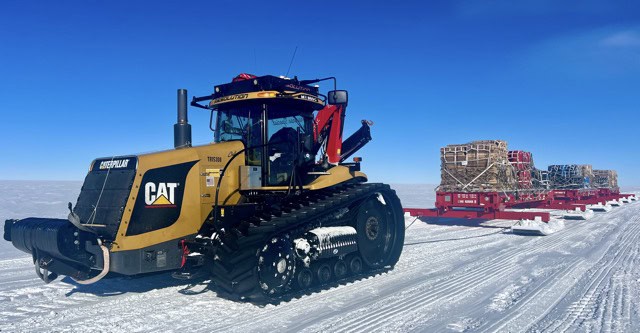
The LC-130 had brought the parts the mechanics needed to complete the repairs to 303, but too late. The ailing tractor had already been returned to its set of red plastic skis and tied in a train with the Prinoth, which would be towed until we crossed paths with SPOT 2, who would use it to reroute the trail up the Leverett. Now that we had proven the existing SPOT trail for the year, we were no longer required to have the expertise of a mountaineer, and ours would be staying behind at Pole to join up with the Heavy Science Traverse team when they left the station for their camp in The Dunes, about 100 miles or so further into the heart of the Polar Plateau. One of our mechanics and one of our operators had been hired as one-ways, and had left on the one other Herc we’d seen the week we’d been at Pole. That left us with five operators, five mechanics, one supervisor, and ten working Challengers. Two tractors would tandem pull the camp train the whole way home, one would pull 303 and the Prinoth, one would pull the small load of fuel that would carry us to our first cache, three would married sets of empty fuel loads, two would be free agents, running at the back of the caravan in case anyone needed help. 308 and I would be cargo duty once again, but instead of parts for the neutrino detector or helium for weather balloons, we would be hauling three 40’ sleds worth of garbage, to be processed in McMurdo and then shipped to the States.
I found my load parked in a part of Summer Camp that had been very helpful to the Polies who had unloaded everything I’d brought them and loaded it back up with their trash, but left me with no plausible way out. Sharp turns with a 40’ trailer are all but impossible, and I had three. The only option was to hook one of the free tractors up to the rear of the train, to keep the sleds from sliding into any of the neighboring buildings as I took the widest turn I could across a side slope—and then to pull the last sled into line when it still didn’t quite clear the corner. It was a sight, this long parade of tractors and trash, navigating a maze of small, wooden buildings, oversized cardboard boxes, parked loaders, and implements, but eventually we wormed our way to the other side and I was cut free on the path out of town with my new load in tow.
We had worked our frozen asses off at Pole, but the feeling that morning was like the end of a weeklong vacation. We were leaving the wonders and limited comforts of this small fragment of civilization and headed home—though home in this case was a mobile camp roving the snow-blown wastes of an uninhabited continent—and there was a bittersweet edge to the polar air as we got our tractors in line and crossed the foot of the skiway. That feeling didn’t last long. We settled back into the rhythms of life on the trail, surprised by how different things felt on this side of the journey. Most of us were towing vastly lighter loads—even the trash was light and airy compared to the equipment I had lugged on the way down—but the biggest difference was in the trail itself. We had waded through thick and relentless powder the last hundred miles of the way to Pole, struggling against its pull the entire way. Now the compacted tracks we had made on the way south had hardened into something resembling a rough, uneven road. We screamed northwards across the Swamp (aka the Marsh), covering more ground on our first day back on trail than we had on the last three days coming down. It seemed like a completely different place, until we unhooked our loads at the end of the day and gathered the tractors for fuel circle, every one of them sinking in the loose fluff as we pulled off the established trail. It was an amazing first day, a promising start, but we still had a long, long way to go—and we had already learned that pretty much anything could happen to us along the way.
Day 41: 15 December, 70 miles today, 898 miles remaining to McMurdo, elevation 9,488 feet, Sastrugi National Park
One of the more unique joys to life on traverse is an incinolet that is already well into a burn cycle: the seat is toasty warm, even on the coldest of mornings, and when you’re finished there is something satisfying in catching a glimpse of your paper-wrapped dumpling bursting into bright-hot flame in the split-second before the trap door snaps shut. It felt good to be back on trail, to be making such incredible progress north after the long grind south, but the adjustment was taking longer than I’d have expected. It was as if the comparative indolence of station life had erased the tempo of the trail from my mind, like we had been camped beside the pole for a month instead of barely a week, and a routine that should have felt hard-wired by now seemed strange and difficult to comprehend. I was literally caught with my pants down one load check, having stripped to my lowest layer to cope with the unbearable heat of the afternoon sun radiating through the cab. When the call came to stop, I had to scramble into a thick bundle of insulated layers in my cramped quarters before going out to inspect the load of trash I was carrying—the cab was an oven, but outside the glass door we were still on the Polar Plateau.
By early afternoon we had cleared the Swamp (aka the Marsh), flying down the compacted snow road we had built coming the other way, and had seen our first small sastrugi. The trail became rough and uncomfortable, and driving it at speed was like going on the world’s most tedious carnival ride. The tractors bucked and swayed, coming every few minutes to a drop that always seemed harmless enough before it slammed all 30+ tons of machine to one side or another with a sudden jolt that threw you half out of your seat and knocked your bones sickenly into one another. This was the price of making good time through this section of trail, even with the blade work our crew had done just a couple of weeks before. It was a relief to stop for an early afternoon load check when we came up to the fuel cache we’d left the day 303 had officially shit the tub. It would take a few extra minutes while an unloaded pair of tractors hooked up to the half-empty fuel load and pulled it onto the trail—and after making sure the garbage I was trucking to McMurdo was still in excellent garbagy condition, I sat sprawling in my cab with my feet up and the door open, relishing the stillness as the frigid air mixed with the sweltering atmosphere of the cab to create an environment that was almost comfortable.
We were coming in toward the end of the day when an urgent call came over the radio. My cab unit had been giving me trouble all day, becoming increasingly distorted and difficult to understand, but I could still make out this transmission: “Stop! Stop! Stop! The Prinoth is loose! The Prinoth is loose!” We had been traveling in tight formation, keeping close to one another’s tails even as the trail tapered through the growing fields of sastrugi, and now half the column had to come to a sudden, unexpected stop. The Prinoth had broken free of its train behind 303, and was now sitting inert in the dead middle of the narrow trail. One particularly bad jolt had snapped the 1” hitch plate welded to the vehicle’s back end, leaving it stranded as an impassable obstacle in the road until a new towing system could be rigged. We were all caught off guard, lulled into a sort of afternoon trance despite the hostile terrain. Misfortune is a beat in the rhythm of the trail, but we were still out of practice, and it was disorienting to find ourselves with something to fix so soon after leaving for the backcountry. “Man, I’m not ready for this,” I said to one of the mechanics. “Pole made me soft.”

Day 42: 16 December, 53 miles today, 845 miles remaining to McMurdo, elevation 8,671 feet, Sastrugi National Park
When the mechanic foreman studied 308’s failing radio in the evening, he couldn’t find the source of the problem, so he stole the entire unit from 303 and swapped them out. This was a problem for McMurdo comms to sort out. My handheld’s shoulder mic had died at Pole—packed with snow, or just too sensitive for long-term exposure to the cold—and now that unit was hard to hear from its place below my hip. At least I had a functional radio in the cab.
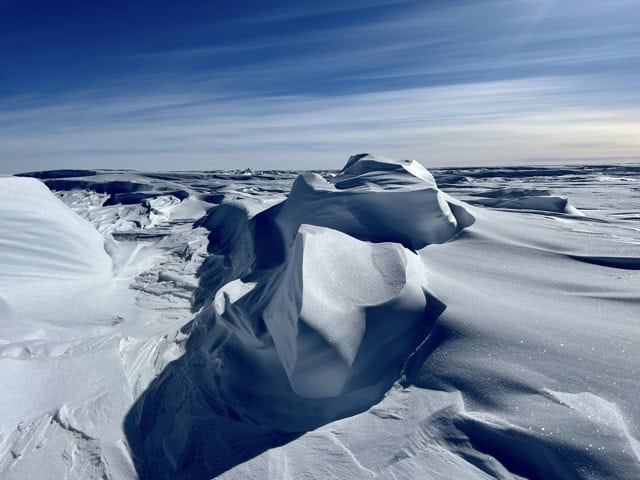
The tour back through Sastrugi National Park was slow—at least compared to our first day through the Swamp (aka the Marsh). All day long, we were thrown around the cabs of our tractors like tennis balls in a dryer, until our bones began to ache in anticipation of each small bump. The worst knocks were hardest to predict: you would brace yourself as you crested a particularly sharp-looking dip in the trail only to glide cleanly over the top, and drop with skull-shaking WHAP! over some tiny bump you hadn’t even seen. But at least this time through there was a view. We’d passed most of the way south through this area in a white-out, blind to everything but the closest, most prominent features of the park. Now, when we weren’t being jostled or banged around, we could squint through our blunt-force headaches at the carved wonders stretching off into the distance. Reminiscent of the sandstone structures in Arches or Bryce Canyon, sculpted by the wind with baroque curves and ornate twists, the Sastrugi are true natural treasures—fragile ones that we savagely mowed through in cutting our trail across the plateau, yes, but it was obvious why some prior generation of SPOT had half-jokingly designated this expanse as a national park.
As we came around a bend in the trail, heading now roughly NW, a low wall of distant ridges appeared on the horizon: the Transantarctic Mountains, marking the edge of the Polar Plateau. We were still days away from this landmark, if all went well, but it lifted the spirits to see the mountains once again. We had had nothing but trouble on the plateau, and here we could at last see the point where these troubles had begun, and where we felt sure—perhaps superstitiously—they must surely come to an end. I was studying the peaks in the distance when the radio burst into life: “Camp stopped! Camp stopped!” The caravan came to a slow halt, as all the tractors in line closed the distance to the vehicles in front, and we began to piece together what had happened as the chatter on the radio continued. The camp train was being pulled by two Challengers, and had been having a pretty smooth time of it until the transmission in the lead tractor faulted without warning and the vehicle stalled. The 20’ tow rope used to tie the machines to each other doesn’t provide much in the way of stopping distance, even at only 9mph, and the second tractor slammed into the first before the mechanic at the wheel could bring it to a stop. It wasn’t much more than a fender bender, truth be told, and thankfully nobody was hurt—but the momentum of even a “light” 55,000lb tractor is immense, and in the literal middle of nowhere there is no such thing as an inconsequential accident. The entire procession was stopped until the damage could be assessed, a few quick field repairs put into place, and both machines made safe for continued use. Only a hitch pin and a couple of counterweight plates had been lost between both tractors, which was about as easy as you could hope to get off in a collision between two giant machines. The real cost of the small accident to the traverse was time.
Whatever luck we had earned back on our difficult southern crossing of the plateau had been burned up at Pole: toward the end of the day, as we were eagerly counting down the miles of sastrugi remaining on this trip, the convoy came to another unplanned stop. One of the skis on one of the empty fuel loads had been twisted almost clean off its CRREL tool by the warped terrain. It was, fortunately, a simple repair, requiring only a fresh paulstra pad, a few new bolts—but it also required more time. This patch of intricately corroded snow would be as far as we would go that day. There was nothing for it but to fix what we could and set up a fuel circle to empty out the load we’d left the station with. Draining a bladder in the field is the same process as defueling at Pole, but without any of the conveniences that make it not a gigantic pain in the ass. There is no groomed slope that lets the diesel flow to the valve end of the bladder, and rarely are there enough people in place to run the squeegee brooms, hold up the corners to drain the fuel toward the hose, fill the tractor tanks, and run the pump. To make matters worse, the wind had finally found us again, after letting us be for so long that most of us had stopped carrying extra layers around with us. Our Polar honeymoon had at last come to a bitter, snowblown end.
With the fuel load emptied, it would have to be joined in a train with two others—a fact no one had considered as we had set up the fuel circle. There was no room behind campo to bring the already mated pair forward, which meant the single would have to be taken back. CRREL tools and HMW sheets can only travel forward, however, so the only way back was long, wide curve through a field of sharp, steep sastrugi. Even empty, fuel loads are not made to handle terrain that openly hostile and belligerent, so I took the detour at a crawl, anxiously watching as the inflated bladders slid wildly on the sweeping, pointed features behind me, while the tractor dipped and yawed on the ones in front. The sastrugi passed by with godawful slowness, until I finally reclaimed the smoothed-over trail a hundred feet behind the set we were going to tie this one to. Then all that was left was for the other operator on the job and me to remember how to tie the right knots, as our hands grew numb in the wind blowing hard and heartless over the scooped and hollowed snow.
Day 43: 17 December, 51 miles today, 794 miles remaining to McMurdo, elevation 7,745 feet, somewhere on the Polar Plateau
There is a phenomenon, not unique to Antarctica—though this is the only place I’ve ever personally seen it—called saltation. When the conditions are right, as they often are in the deepest south, the wind blows the fine, dry snow across the ground in thin rivers of powder that never rise more than a couple of inches above the surface. My first year on the ice, someone told me these slithering crystal streams are commonly called snow snakes, though I have no idea how widespread that term actually is. It is, in any case, a mesmerizing dance; one that typically (though not always) hints at worse weather to come.
Walking into breakfast after firing up 308 and leaving it to warm up, I noticed the snow snakes darting through the sastrugi and paused to watch them flow around cornices and through sharp bends. This is how the sastrugi are made, an erosion of the hardpacked firn too slow for the human eye—though practically instantaneous on the timescale of the similar processes that shape sandstone into canyons, hoodoos, arches, and mesas. The sastrugi have the feel of something permanent, but in truth they are carved and winnowed, buried and excavated continually, and the field you encounter on trip through the plateau is likely to be completely different from the one you might see only a couple of months later. There was a moodiness to the air as I continued up to the kitchen mod. Clouds had spread unevenly across the sky, like a cake without enough icing. The wind cut the skin and showed no sign of abating. Whatever window of pleasant weather we had enjoyed was definitely over.
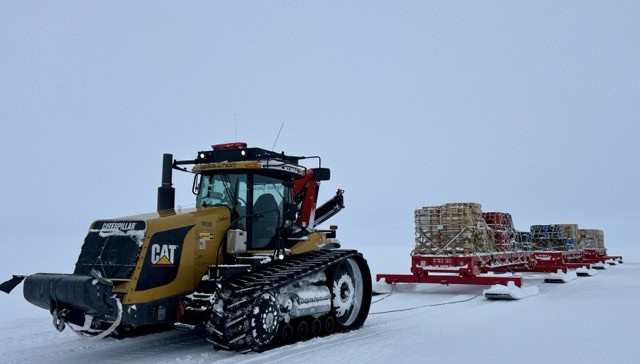
Nor was there sanctuary to found in the climate-controlled cab of the tractor—we had come to the northern expanse of Sastrugi National Park, which I hadn’t remembered as being substantially more treacherous than the rest of the place (and might not have been when we last through this stretch three weeks before), but which was on this pass fucking brutal. The ground was hard and slick, the rolling terrain abrupt and sharp, and the game of the morning was to find the gentlest path across each feature. As the day ground on, bump after bump after bump, the clouds grew thick, filling in the patches of blue sky with a uniform paper white that obliterated all definition in the snow and made the rises and dips harder and harder to see, until they disappeared altogether. The operator of the free blade CAT at the front of the column had been doing his best to clear a path for us, but there was just too much for one tractor to smooth out. He did take the worst out of our way throughout the morning, but as the light became flat he was able to accomplish less and less. Our convoy’s second free blade was bringing up the rear, replacing trail flags that had been buried under drifts (or mowed down by the hard edges of an errant fuel load). That operator had his work cut out for him; there were sections of trail with no flag in sight even to mark his line with. That we had made it through this area in a whiteout seemed like a small miracle, to say the least.
The day wore on much as the previous two had, with the occasional stop for yet another malfunction or repair. Our progress slowed until it seemed as if we really would never make it clear of the park, that we might be stuck in this torturous blank page of a place forever. Every time I thought we must surely be coming to the end, another series of rollers would throw me around the cab like dice in a cup. This stupid drama played out again and again, becoming a kind of mental routine, until at last it didn’t. It wasn’t gradual, but it also wasn’t clear that we had finally made it through—especially in the flat light. All that happened was that I was braced for yet another jolt, and it didn’t come, and then it kept not coming. The road was far from smooth, and 308 continued to pitch and jostle across the rolling snow, but the relentless hard pounding had stopped. We had cleared the northern boundary, finally free of tedious excitement of Sastrugi National Park, just as the weather stopped its day-long flirtation with a full white-out gale and fell on us in a curtain of blinding sideways snow.
Day 44: 18 December, 50 miles today, 744 miles remaining to McMurdo, elevation 7,319 feet, somewhere on the Polar Plateau
It had always made me profoundly uneasy when friends tell me they love me. I assume this has something to do with my upbringing, the naked discomfort on my father’s face when trading those words with his children—or his son, at any rate. Saying it in a platonic context is not something that’s ever come easily to me. I’ve never, to my memory, initiated it, and most of the time when it’s said to me, my only response is awkward silence. I don’t know how to respond, and I freeze, which I can only imagine is an excruciating and disappointing way to have your heartfelt expression of affection met. This is perhaps why I never heard back from a friend from the AT after we met at a brewery for a couple of beers. We gave each other a hug on the way out the door, and when he hit me with a casually masculine “Love you, man,” I offered only a pained smile. “Yeah,” I think I said, eventually. “See you later.”
Even before my alarm went off in the morning I could hear that the previous evening’s wind had blown itself out—the ghost-like whispering and gentle swaying of the living mod that had lulled me to sleep had stopped and the silence weighed over the dark room like a wool blanket. That muted quality to the air followed me as I clumsily got got dressed, pulling on a series of thick layers, and headed outside. As I stepped off the stairs and onto the snow, I was struck by the odd absence of sound as my foot pressed into the fluff. I looked around, taking in the drifts scattered around camp and the great piles amassed all over 308; none of it looked quite right. It was all too soft, too billowy, too gentle for Antarctica’s usual sand-like granules. It took me a minute to see the flakes slowly wafting down from the ceramic bowl covering the sky—it was snowing, and everything around me was buried in several inches of fresh powder. Actual snowfall in Antarctica is rare. The continent is the world’s largest and driest desert, and though almost all the land is covered in the stuff, very little of it comes from the sky. Most of it is blown in on the wind—where from remains an unanswered question not even the veteran specialist the SPOT 2 supervisor referred to as Dr. Snow could hazard a guess at—and, as in most deserts, when precipitation does fall, it is always an event.
The fresh snow was wet, heavy, and thick. This was skiing snow, christmas decoration snow, snowball snow. This was a gift that fell to earth and transformed even a place literally made from a mile and a half of flakes compressed by their own weight into the planet’s largest chunk of ice. The snow continued to dance in the air as we started our caravan north once more, driving into the flat light that erased all the detail in the ground and the sky, and even the line that usually divided them. We drove inside an opaque, nacreous snow globe, following our GPS displays and the nubbins of green flags marking our path, buried almost out of sight by a few years of blown drifts—while the operator pulling up the rear of the caravan spent the day running up and down the steps to his cab, furious planting fresh flags so we could continue to find the trail when we came back this way in a couple of months.
We were approaching the top of the Leverett Glacier, which we would follow down to the Ross Ice Shelf. There were a few loose ends to secure before we made the descent—mostly tying sheets of HMW loosely together to keep them from sliding every which way as the married, empty fuel loads were pulled down the steep, cascading slopes. The small red sleds carrying the fuel pumps, called doghouses because of their resemblance to those structures, had to be rigged with soft anchors—pieces of old webbing, or crap strap, tied into a series of knots and rigged to drag under the sled and tame its wildest impulses. It was easy enough for me to walk up and give a hand to the operator pulling the load ahead of me—which had a doghouse tagged onto one of its sheets—during the 1000hrs load check, once I had established that all the garbage on my sleds hadn’t gone anywhere. I showed him what I remembered of the knot the supervisor had recommended for this purpose,* and we had two anchors rigged before we had to climb back into our cabs and start rolling again. He and I had become friends over our long trek to the South Pole, but I was still caught off guard when he said, “Thanks for you help. I love you, dude.” He held out his first, as I fought to squash my impulse to run away, or else ignore this moment of human connection in the hope that it might go away.” I hit his fist with mine. “Love you, too, buddy.”
We stopped about a mile and ahead half short of the Leverett. We would have to tandem every load down, we didn’t have enough tractors to do it all in one go, and while it was still barely 1600hrs, there wasn’t nearly enough time even to take one half of our cargo down and return to camp. It was our first early day on trail, and the weather was still warm and calm, the snow still gently falling in small, occasional dumps. I treated myself to a shower, heading off to my bunk clean and refreshed and secure in the knowledge that whatever else the morning brought, the crew of SPOT 1 would handle it together—and when we finally made it down the wide, flowing glacier, we would find our friends from SPOT 2, starting their work for the season at the bottom.
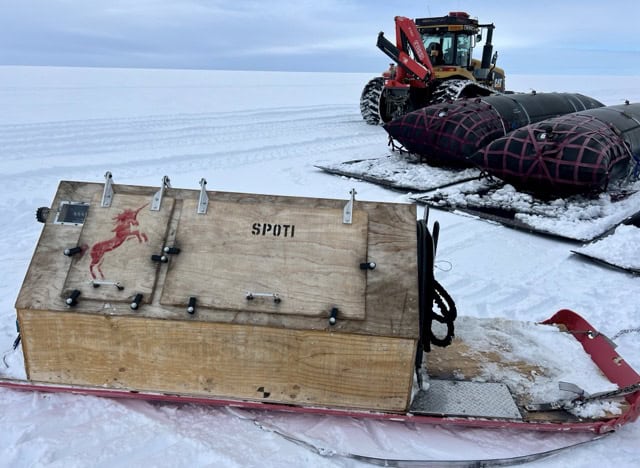
*the alpine butterfly, a knot so graceful you can tie it onto a rope while wearing mittens—but god help you if you’re trying to tie a series of them onto a piece of crap strap even barehanded