The following is the personal account of a single, long-winded individual’s experiences living and working in Antarctica. No part of it has been reviewed or in any way endorsed by the United States Antarctic Program or the National Science Foundation, or any other public or private organization, institution, contractor, or company associated therewith. The views expressed herein are the author’s alone, for good or for ill.
Day 26: 30 November, 16 miles today, 132 miles remaining to Pole, elevation 9,612 feet, Sastrugi National Park
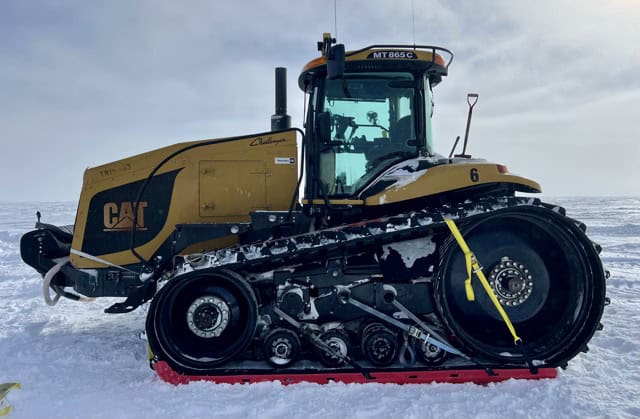
The news at the morning meeting was grim. A fourth tractor had lost the blower motor for its cab heater. The three spares that had already been installed (including in 308), so the poor mechanic stuck driving that machine would have to rely on a space heater that kept blowing a fuse the rest of the way to Pole. Once there, a replacement motor should have arrived from McMurdo—assuming any flights had made it down—but this would be the last one on the continent until an emergency parts order eventually arrived. If anyone else lost heat between now and our return to Ross Island, they would shit out of luck.
We were informed, as well, that at the rate we were burning through chemical hand warmers, those would be depleted well before we made it back home. I was stunned. I had only used them twice during the whole traverse so far, and then only while working outside in the rancorous cold. I suspected that the mechanics, most of whom had come to Antarctica this year for the first time from the so-called Sun Belt of the United States—and all of whom regularly worked outside regardless of the conditions—had been leaning extra hard on these warm little packets to make it through the long, frozen days. We had brought along twice as many as had been standard, and I wondered if maybe this sense of abundance hadn’t contributed to a feeling that these were in limitless supply. Understandable as all of that was, if something didn’t change quickly, we soon wouldn’t have any.
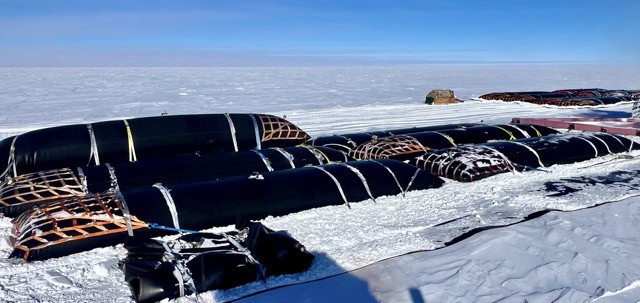
We were hopeful that we might finally see the end of Sastrugi National Park by the end of the day, but as the morning drained into the afternoon, the hardened ridges and waves continued to stretch southward as far as we could see. There is no telling where the boundaries of the ablation zone lay season to season, and as the first traverse to pass through this region this year, we wouldn’t know where it was until we got there. What we did know was that we had climbed a few hundred feet above the elevation at Pole, making this an ideal time to bleed air from the fuel bladders. The bladders get bled when they’re filled at sea level, and again at the top of the Leverett Glacier, but air continues to expand with the decrease in atmospheric pressure that comes with altitude—a phenomenon familiar to anyone who has ever bought a bag of potato chips in the Rockies, each one on the shelf blown up tight like a party balloon—and it’s important to squeeze out every last little puff, lest a stowaway pocket of air cavitate the ancient delicate fuel pumps at Pole.
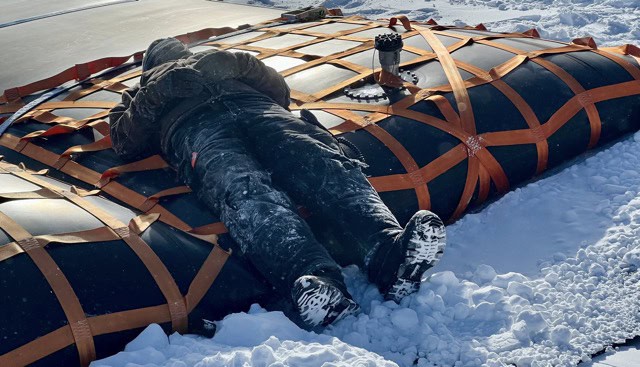
Shortly after lunch, the lead challenger started losing tension in one of its tracks, making it pull to one side while being unable to turn toward the other. This was a serious problem, bringing the caravan to a halt while a pack of mechanics sought to find a solution. To make use of the time, the three remaining blades without track issues were unhooked from their loads and sent down the trail to smooth out the next few miles’ worth of sastrugi. This left the operator of the fourth blade up toward the front with me, and all four tractors’ fuel loads, which we set about giving their final bleed before the gradual descent to Pole. Each of the bladders has a valve right in its center, and when loaded with 3,000gal of fuel, there is enough internal pressure to force out any any air when they’re opened, until the vent starts spitting a thick spray of diesel. The half-empty bladders on the other hand, those that have been used to fuel the traverse along the way, will not push anything out when opened, and require a more inventive approach to purge of any remaining air. The solution hit upon some years ago is for one person to crack open the valve in the hose coupling at the tail end of the bladder while another one lays down across the width of the bladder and rolls down its length, forcing the air toward the opening. While the mechanics clustered around the ailing tractor and the three other blades smoothed the trail ahead, the other operator and I took turns rolling over bladders, spinning ourselves dizzy until the hiss of venting air finally stopped. It was perhaps the strangest task I’ve ever had on any job, playful almost, if it wasn’t for the constant cold and the sharp stink of diesel. The air was filled with a fine mist of small ice crystals, which floated and twinkled on the breeze—a thousand dancing points of light. So we worked on the plateau, rolling over a bed of fuel, until the other blades returned and the mechanics gave their ok for us to continue on into the glittering afternoon.
Day 27: 01 December, 0 miles today, 132 miles remaining to Pole, elevation 9,612 feet, Sastrugi National Park
When I came back into the kitchen after getting 308 checked out and fired up for the day, I found the mechanic foreman in the corner of the room, crouched under the coffee machine. He was squatting the way people do when stressed or worried, and some instinct takes over telling them that radically changing their posture will help. His eyes looked strained and wet, as if he’d barely slept. “Dude, are you all right?” I asked. He didn’t answer, but continued staring into the middle distance, until finally, softly, he said, “God it smells like wrong dog in here.” He had tried this joke at dinner a few nights before, and nobody had bitten. But this morning someone played along. “What’s wrong dog?” the question came from the far side of the table. The foreman shook his head. “Fucking everything, dog.” he replied.
The good news was that through some miracle of ingenuity, the blower motor for tractor 303 had been repaired. Unfortunately, the rest of that machine was fucked. It had been running unevenly, suddenly losing power while accelerating, a making a god awful racket all the while. When I later asked two different mechanics what had happened at two different times, I got two answers that both began with a primer in how diesel engines work, and went on to explain something about fuel entering the combustion chamber at the wrong part of the cycle that made sense to me at the time, but which I can’t for the life of me cogently reproduce here. Suffice it to say, as the supervisor did at the start of that day’s morning meeting, “Tractor 303 has shit the bed.” It still technically ran, and we could still technically use it, but not without the very high possibility of tearing apart its very recently replaced engine. The mechanics had stayed up late into the night just trying to get to the root of the problem—and had gotten up early to get back to it in the morning—but whatever it was, it was a much bigger job than could be handled in the field. Until it could be taken apart in a proper heavy machine shop, that tractor was dead.
What this meant, in practical terms, was that the machine had to be rigged to be towed—just another inert piece of cargo, albeit a single piece that weighed 55,000lbs. The fuel load it had been pulling would need to be dispersed to other fuel loads, the contents of each full bladder transferred into a series of half-full bladders until the only thing we left behind was a small cache that would carry us to the fuel load we had left on the toe of the Leverett. In itself, this problem was not incredibly rare: most years SPOT ends up towing a vehicle for one reason or another, and has to find some way to cope with the fuel it was carrying. This, though, was a particularly full load, and finding space to pump it all into was a gargantuan task. The supervisor had records of how much had been drawn from each bladder during each fuel circle—though these would prove to be only as reliable as the as the notes taken by the operator running the pump at the end of a long, tiring day—and he worked out detailed a schema across two white boards while the rest of the crew got all the loads and the pumps lined up and prepped.
Two teams would run the defueling operation, one outside working in the cold while the other warmed up in the kitchen, waiting for their turn to bundle up. These would coordinate with the supervisor over the radio, running hoses to specified bladders and pumping the exact number of gallons each had room for. A third team of blades was dispatched south to groom the trail (as much as was possible). Since they would staying in their warm, cozy cabs, their only guideline was to turn back at 10 miles, or the end of Sastrugi National Park—whichever came first. The fourth team, one of the other operators and me, would work with the mechanic foreman to get tractor 303 rigged onto a pair of skis made of thick red plastic. We were directed to come inside to rewarm as needed.
The rigging required to keep the skis from slipping out from beneath the tractor was not especially complicated, but once the machine had been driven in place on top of them it took the experienced members of our small group a little while to remember how it worked. Once the basics had been settled, however, the whole thing came together fairly quickly—though a lot of the rigging required a level of dexterity that reduced me to working in my thin liner glovers, quickly slipping my hands into my insulated suede mittens to warm them whenever I could. It was as fine a day to work outside as anyone could hope for on the plateau. The sky in all directions was the pale gray of woodsmoke, but the air was mercifully still. The only drawback was that without a breeze to carry it away, our task was accompanied by the lingering smell of burning human shit as the incinolet worked its way through the morning’s accumulations.
By lunch, 303 was rigged and had been pulled into line with the camp train, which by now was easily over 200’ long. The broken tractor, the toolshed, the kitchen mod, the gen mod, the living mod, and the sheets of plastic carrying Fawlty Towers,* H2,** and a platform with 16 u-barrels would all have been far too much for any single tractor, but the tandem team that had been on camp duty ever since we’d climbed the Leverett would be more than up to the task. In the afternoon, the blades had returned to camp—having smoothed out 10 miles of trail without ever finding SNP’s other side—and the operators, along with the mechanic foreman, joined in the defueling operation. The ski team, now down to two, was dispatched to do an extra-thorough load check on each of the fuel loads, inspecting every tie-down and strap on every bladder set and replacing any that were broken, frayed, or ripped. It was tedious work, made difficult only by the narrow mountains of snow we had to dig out to get a good view of the tie-downs on the plastic sheets. I was forcefully reminded that my body was still very slowly adjusting to the change in elevation. “I keep thinking I’m acclimated,” I wheezed to the other operator at one point, “then I walk 100 feet and can’t catch my breath.”
The weather continued to improve as we worked our way over, around, between, and through every bladder in the caravan. While still always, endlessly, permanently cold, the sun had broken through the clouds, driving them off until the sky was cleared for the first time in well over a week—at least since our first day on the plateau. Defueling the ailing tractor’s load had taken all day, along with the other ancillary tasks I’d been on. The entire team was worn to the bone, dead tired, starving, and stiff. It had been the hardest working day of the journey thus far, and we hadn’t made it a single mile. We stuffed ourselves at dinner, rolling breakfast burritos from a massive skillet of spinach and eggs, and piling our plates high with corn dogs, joking with one another about the cold and the ever-present stink of diesel. It had been a hard day, but now that the incinolet’s vapors had cleared, there was a spreading sense of optimism in the air. If the weather could turn around after all this time, maybe our luck would, as well.
*The amusing name given to the 4-person bunkhouse being used as a sort of living annex
**The completely inscrutable name given to the heated shed that housed the traverse’s second incinolet and whose unused shower and bunk space were used to store goods that couldn’t be frozen
Day 28: 02 December, 12 miles today, 120 miles remaining to Pole, elevation 9,623 feet, entrance to the Swamp
We knew we were somewhere near the end of Sastrugi National Park—we just didn’t know how near. The boundary between the ablation zone, where the snow is sculpted into hardened, treacherous monuments, and the accumulation zone, where the fine, dry snow collects and lays like quicksand, is vague and changes from year to year. The transition into the Swamp—also frequently called the Marsh—is gradual, like the flowing of one ocean into another, and it’s hard to say when exactly you’ve crossed from one into another. This was just more likely than not to be the day that we would make that crossing.
All of the remaining fuel loads were substantially heavier than they’d been before the redistribution of tractor 303’s supply—many now coming close to weight they’d started with back in McMurdo. Getting started was a slog, as these freshly burdened tractors had to first pull their bladders through the loose powder chewed up by the defueling operation. Even 308, which had been pulling the cargo load without complaint since ceding the toolshed, couldn’t make it through the snowy rubble without a tow. Once we had cleared the worksite, however, things immediately started looking up. True, nobody was running at the capacity they’d enjoyed on the ice shelf, but for the first time in over a week the caravan was moving steadily—almost. As the sastrugi diminished into gentle ripples across the face of the Polar Plateau and we gradually waded our way into the Swamp (aka the Marsh), every tractor was literally pulling its own weight. Except one. Tractor 305, usually the most stalwart of the bobtail CATs—i.e., the Challengers without a blade, a crane, or a winch—could not build any of the momentum on which the rest of the convoy was coasting across the snow. The mechanic at the wheel tried every combination of engine speed and gear ratio he could think of, looking always to point his machine onto the most solid part of the trail he could find, but again and again he was carried off into another powder trap and stuck, calling for a tow.
Optimism is always unfounded—otherwise you simply know that things are already going well. But our optimism at the end of the day—which persisted even into the late morning—seemed especially groundless at midday, when one of 305’s bladders rolled on a bump in such a way as to reveal to the person behind him a long crack in the plastic underneath. This was the cause of that tractor’s woes, since breaks in the smooth plastic create a surprising amount of drag. It was also a critical failure in the bladder transport system, one that would have to be remedied at once, lest the sharp edge of the crack slice into rubber containment vessel above and release a few thousand gallons of precious diesel into the environment. A halt to caravan was immediately called, and a small team prepped to fuel the generator while a larger production to defuel the bladder atop the crack was organized. For only the second time, I was assigned to control the hydraulic pump from my tractor, and this time I felt confident enough to run it at full speed—despite the fact the crane mounted on the back of 308 made the person standing at the gen’s tank almost impossible to see. I did manage to catch the signal to stop pumping in time, but when I hit the switch to kill the pump, nothing happened. In a panic, I slapped at the thing until the flow meter on my display fell to zero, turning my head in time to see the geyser of diesel erupting from the tank, spraying the operator at the nozzle in the second and a half before it subsided.
Having done a poor job at one task, I made my way over to the troubled fuel load to do another. The SPOT 1 supervisor was laying on his side, frantically clearing snow from the underside of another bladder with his channel-lock pliers as I approached. Before I could say anything, he let loose a full-throated “FUCK!” and stomped off to regroup. I didn’t have to ask—he had found another cracked sheet. Our momentary pause had become another major project. This was going to take the rest of the day.
And so, for the second day in row, we worked again and again in the endless cold to move fuel from one bladder to another, instead of moving across the ice as planned. The weather remained as pristine as ever we would see on the plateau—unmanageably frigid, but clear and with as light a wind as blows in that barren expanse. That much was a blessing, but morale was nonetheless starting to fray as we spent another day emptying bladders on uneven ground, trying to lift the heavy, slick rubber high enough for the fuel to drain toward the hose coupling at the back end. Once again, every last human was beaten into exhaustion by the labor and the cold, and we were numbly breaking down the pump setup at the end of the day when the supervisor—not ungently—reminded us that we still needed to fuel our tractors. The miles we’d made in the morning had already been wiped from our memory by the day’s long effort. We had started this traverse with such speed and such force. Where had all our luck gone? When would this string of misfortune end? We were frazzled and slow, zombies stumbling over one another in the snow, but we still had one job left to do. We gathered our tractors into a mass that sort of approximated the shape of a standard-formation fuel circle if you squinted at it right, and started fueling and chipping the machines. I had only just shimmied under 308’s belly to clear ice from the tracks when I noticed a steady drip coming from the pan above my head—a thick, honey-colored fluid that hung in thin strings between beads was puddling onto the snow. My tractor was leaking oil.
Day 29: 03 December, 28 miles today, 92 miles remaining to Pole, elevation 9613 feet, the Swamp (aka the Marsh)
The leaking hydraulic hose in tractor 308, I learned the following morning, was a known issue. The hose was old and worn and needed to be replaced—only a replacement hadn’t yet been obtained due to the predicable but overwhelming difficulties in getting parts to Antarctica. It was a slow seep, one that had built up in a hidden corner of the tractor’s belly pan until I parked at the right angle for the accumulated puddle to start making its way out onto the snow. It wasn’t a problem, I was assured, and the fact that the hydraulic oil was still reading at the top mark of the sight glass verified it.
We had entered fully in the Swamp (aka the Marsh), the prominent sharp-edged sastrugi had become mellow humps of soft snow. It looked a lot like the ice shelf had—though the consistency was a great deal mushier—flat and wide, the wind-formed features of the landscape so subtle you could almost say there were none at all. But like a deep lake on a calm day, there is nuance if you look for it, and the small crests and drops gave the landscape a kind of definition highlighted by the sun. It was the nicest day we’d seen since climbing onto the plateau. Even as a thin, flat blanket of clouds coasted in for an hour or two we could see far into the endless white distance, and the wind was mercifully still. I would later find out the temperature had been a consistent -32°C; but the wind makes all the difference, and my big red parka quickly became far too hot for working outside.
The Swamp (aka the Marsh) gets its name from the consistency of the snow that accumulates in the region. Soft and light and seemingly without a bottom, it swallows the treads of the Challengers. It’s like trying to drive through uncooked instant mashed potatoes: there’s just nothing substantial for the tracks to grab onto. As we pulled into a loose formation for lunch, half the tractors were struggling to pull their loads through the fluff—some of them barely moving at all, leaving behind deep furrows in the snow. For the two having the hardest time, keeping a constant speed of even 1.5mph had become all but impossible.
I was climbing the steps to 308’s cab after lunch when I realized something was wrong. Usually, I would set my pee jug on the steps while I readied the tractor to get back to work, then pick it up on my way to the driver’s seat, but this time it wasn’t there. I had left it back in the bathroom in the kitchen mod, which was even now being prepped to roll. I headed back at the slowest dead sprint I could have imagined, pouring all my effort into covering the 200’ back to the kitchen as quickly as possible. Like trying to run in a dream, my hulking boots and thick overalls lumbered through the light powder with all the speed of running underwater. Even so, I was wrecked by the time I made it to the kitchen, gasping at the operator who had just raised the stairs and was tying them in place with a bungee cord. “Pee jug…still…inside,” I panted. He laughed, then climbed up the frame of the sled and cracked open the door, yelling at the mechanic who had once driven 303, but now was left to ride inside the camp all day as his tractor was towed in front. In a moment, I was reunited with my vessel, and, humbled, hobbled back to my tractor, where I collapsed into the cab. I’d made it back just in time for the parade to begin, calling myself in as ready to go before remembering with a sudden pang that I had unhooked 308 from its load in case anyone had needed a tow into lunch and had never put it back on. While the tractors in the front began to creep forward into the afternoon, I once again sprinted from my stairs, running around back and hooking the cable bridle back into the hitch. I had almost left the cargo load behind.
It was evident from the start of the afternoon that we weren’t going to make it very far in these conditions, so the supervisor paired each of the remaining fuel loads to pull in tandem, while camp—which was already being pulled in tandem—and the cargo load continued on. The tandem fuel teams were much faster than us, so they passed us easily, even though they’d had to stop and reconfigure themselves into teams. We passed one of our last waypoints shortly thereafter: the small 4×4 wooden monument marking the last 100 miles to the South Pole. The radio exploded with excited chatter. We were getting close, after all our pain and toil across the last 150 miles, we were getting close. We had also crested the last long climb of the traverse, and even though the rest of the journey would be spent fighting our way through the Swamp (aka the Marsh), it would literally all be downhill from here. With the sun back out and shining cheerfully across the empty land, it was hard not to give into the cheerful whoops and hollers as we entered the final stretch.
As the others returned to bring up the second round of fuel loads, those us pulling camp and cargo set the stage for the evening’s fuel circle so everything would be ready to go, fueling and chipping our own tractors so they’d be out of the way when everyone else returned. While we were finishing up, we overheard a broken, static-ridden conversation being carried on ten miles back up the trail. The mountaineer, not usually an equipment operator, had gone back with the group to be trained in the intricacies of tandem pulling, and had lost his phone somewhere in the soft carpet of the Swamp (aka the Marsh) in the vicinity of the fuel loads. It was a tragedy every person on SPOT 1 could feel, a personal anxiety shared by each and every one of us, finally realized. The supervisor, up at camp, leapt into action, borrowing one tractor from another operator and scooping up 308 and me to run back north and grab the last fuel load so the mountaineer and his partner could focus on looking for the phone. We were only part of the way there when the mountaineer called and persuaded him to turn back—they were already hooked up to the load and were already doing everything possible to track the phone, which was very, very probably already irretrievably lost to the Marsh (aka the Swamp). For a moment, though, we had had two Challengers, free of any cargo and without any sastrugi to worry about, throttles open as we sped across the untread fields just off the trail, the tractors swaying gently as they tore through the powder and threw up great plumes of snow from the furiously spinning tracks. Two giant crane CATS, racing full speed into the sun, as the still plateau slipped by beneath our tracks.
Day 30: 04 December, 23 miles today, 69 miles remaining to Pole, elevation 9,449 feet, the Swamp (aka the Marsh)
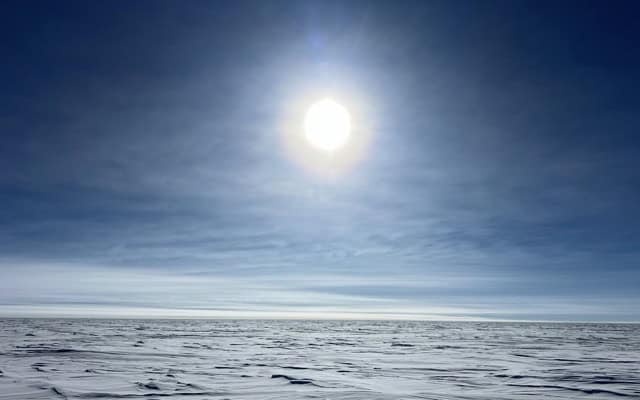
The weather, if anything, was only getting better. It was sort of an eerie feeling, this natural sense of calm ease, especially after the two weeks we’d gone without ever seeing farther than 500 feet on a good day. It was seductive, getting up each morning to an endless horizon, high blue skies with garlands of cirrus clouds that passed by like cheerful neighbors, and most importantly, no wind, but it was hard not to let yourself be seduced. I had already hung my awkward big red up in the living mod. It was the surest sign that I had let myself by taken in by Antarctica’s famously mercurial weather, but the freedom that came with shedding that thick, cumbersome down cocoon for a hoodie or a work coat was intoxicating. Doubtless I would be shackled to the parka whenever the wind inevitably picked back up, but for now I would revel in being able to see my feet and turn my head as I looked out each morning over the gentle, sun-dappled waves of soft snow that flowed outward forever in every direction, my view unimpeded for once by goggles or sunnies that were instantly fogged by breath forced upward by thick, protective buff.
The soft snow of the Swamp (aka the Marsh) was much less hospitable than the weather. Pretty to look at, it nonetheless preyed on every tractor regardless of the load it was towing. Even unencumbered, every Challenger left massive furrows in its wake as it trundled around camp, creating a minefield of tracks a foot deep or more for tractor and human foot alike. Hooked up to a fuel load, the firmest section of trail was still an impassable mire for even the heaviest CAT, and so the eight remaining bladder sets were pulled in tandem almost from the start of the day—after a brief experiment that ended before the first single tractor had gone a quarter mile. The camp train, which was now bogged down by addition of the ailing tractor tied to a set of make-shift skis, had to be pulled from the night’s campsite onto the trail proper by a third tractor: mine. It would surely have been a sight, 100’ worth of Challengers tied to 100’ of camp modules, but as we were at the back end of the caravan, there was no living thing in dozens of miles to see it.
At fuel circle, great, hulking snowmen rolled up around the fuel pump: white, 12’ giants that slowly revealed glimpses of yellow paint as small mountains of snow were scrapped from their bodies. There were walls of ice, where the snow had been melted by the heat of the engine, only to refreeze as it was kissed by the thin, frigid air. Chipping the tractors had become a Herculean task, and even with the strenuous effort of the entire crew, the Challengers emerged from the circle with their most vital parts cleaned and broken free, but looking nonetheless like they’d just emerged after being buried in the snow for 20 years. We were tantalizingly close to Pole—just a few dozen miles now—but moving at a crawl. None could say if we might make it there in two days or five. All we could do was to keep wading through the loose powder, taking the miles, and the days, as they came.
