The following is the personal account of a single, long-winded individual’s experiences living and working in Antarctica. No part of it has been reviewed or in any way endorsed by the United States Antarctic Program or the National Science Foundation, or any other public or private organization, institution, contractor, or company associated therewith. The views expressed herein are the author’s alone, for good or for ill.
Day 16: 20 November, 16 miles today,* 295 miles remaining to Pole, elevation 7,382 feet, the Polar Plateau
The SPOT trail from the Ross Ice Shelf to the Polar Plateau (and thus to Pole) follows the meandering cascades of the Leverett Glacier. The route is proven, safe, and, importantly, passable by a small fleet of ag tractors towing 200,000lbs of diesel apiece. But only just. The last 12 miles up the Leverett vary between steep and gnarly, with each of the gnarly sections designated as hills for planning purposes, even though the whole thing is basically one big slope. The grade for most of these last miles is no more demanding than what we’d seen in the previous couple of days—though even that had been too much for several of the tractors in our convoy—but the hills would be too much even for the heavier tractors pulling the lighter loads. This is why every load, with only very rare exceptions, is carried to the top of the Leverett by two tractors pulling in tandem, tethered from the front of the tractor hooked up to the load to the hitch of the tractor in the lead. The operators coordinate gear changes, engine speed, and engine load over a dedicated radio channel, while the lead tractor coordinates movements with the other teams climbing the glacier. You don’t want to be too close to another pair of tractors in case something goes wrong and you need the space to get around them. And something usually goes wrong.
My partner, one of the mechanics who had made it down to McMurdo only just in time to leave on SPOT 1, and I would take my cargo load to the plateau in the morning, then return to retrieve his fuel load in the afternoon. Four other pairs would start ahead of us towing bladders, while the tow truck stood ready to jump in and help any team that needed aid. The mechanic foreman would stay behind and prep the camp modules for the rigors of the ascent, while the supervisor cooked us pizza for lunch. Neither my partner nor I had done this before, so we relied heavily on the route guide the supervisor had written that morning and painstaking walked us through, hill by hill. The second hill was the steepest, the gnarliest of the gnarlies, and the one where most teams had the most trouble—but we would at least have the first hill as a sort of trial run before facing the true test of the Leverett.
As it happened, the first hill was a breeze. We sailed up the thing without even slowing down, our 200’ of cargo no more of a burden than a ribbon in the breeze. This gave us all the confidence we need to hit the second hill with all the gusto and bravado of old hands, who knew each twist of the trail by heart—even though we could hear that the team in the lead, substantially the most experienced, had gotten bogged down ahead of us and were struggling to continue the climb. We came to the bottom of the second hill, and could see the other pairs working their way around the leads, who were inching their way up while the tow truck stood off to the side, ready to jump in. We had learned over the past few days what it felt like to lose traction on a climb, and how to compensate for it, so we charged ahead without slowing, confident that we could react quickly enough to save ourselves if and when the conditions turned against us. We could not.
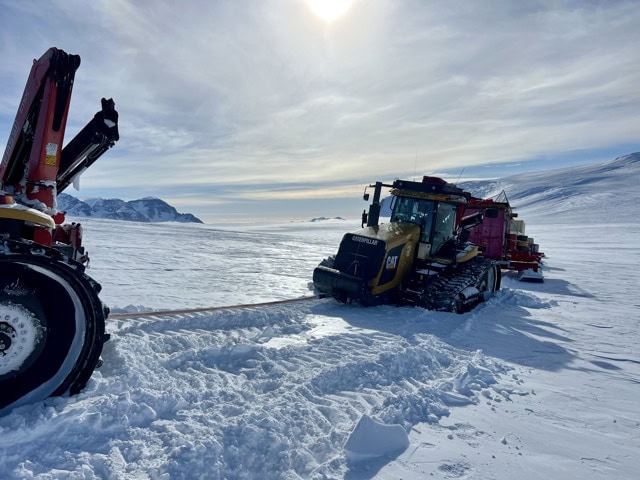
Anyone who has lived in a state that sees heavy winters has gotten their car stuck in the snow—or better yet seen someone else do it. The spinning motion of the drive tires only digs the wheels farther and farther into the fluff, and the more you try to drive your way out the situation the worse it becomes. The same thing happens in the Challengers, but this version of the problem is prodigiously muscled, homicidally angry, and high on meth. The tracks act like massive chainsaws: when the 3-inch treads stop providing traction they rip the snow out from under you, and the only thing you can do is stop the machine before you dig yourself in too far to get pulled out. The mechanic and I were cruising up the second hill when all of sudden we were sunk into the side of the glacier, our tractors buried up the steps before we could stop them. We tried a few different means of extricating ourselves, but without untethering the load—on the steepest section of the entire trail—we were completely stuck.
The operator in the tow truck had been watching the whole thing go down, and had even switched his radio over to our channel to monitor our conversation. The moment we admitted defeat to each other and said, “we should probably call for a tow,” he leapt into motion, driving over to meet us and hitching his tractor to the front of the train. Even with three tractors pulling in tandem it took a couple of slow, agonizing tries to creep out of the hole, but eventually we inched our way out and once again found ourselves atop a patch of packed snow. We left the 3-fer rigged together, figuring it would save us more time than stopping on an incline, and so we powered our way onto the polar plateau, where all the other teams stopped to photograph the three tractor parade coming up behind them.
The ride back down was much easier—it’s what mountain bikers call bombing the mountain—though the bone-jostling abuse the uneven terrain inflicts on a tractor going even 10mph is a significant deterrent to letting the machine get going much faster than that. Still, when you’re used to making 7mph on a good day, 10 to 12 feels like flying, and the expansive view from the top of the Leverett made it feel like we really were coming down from the heavens, coming to alight somewhere between the arms of Mt. Beazley and McLean Peak. After gorging on run-of-the-mill frozen pizza turned into gourmet works of gustatory art by the supervisor’s broad culinary imagination, we headed back up to the top with our second loads—with camp pulling up the rear. We had learned our lesson that morning, and the mechanic’s fuel load put up a great deal less resistance on the hairier climbs than the cargo sleds had. The only obstacle we faced on the whole ascent was the same pair of experienced operators who had, once again, found a soft spot on the steepest hill, gotten bogged down, and were climbing their way out of their own mess by driving across our path. The choreography required to let them pass was like some kind of slow-motion aerial ballet, given how smoothly the maneuver went. We passed by the deep, rutted hole we had dug into the glacier that morning, and I marveled that we had ever gotten out of it.
When we were all at the top, parked in formation for fuel circle and all a bit light-headed from the noticeably thinner air, one of the other operators, and older fellow from rural New York, wandered over to me. It was much colder at this elevation, and he was bundled up in a way I hadn’t seen since winfly, his face a narrow sliver peaking out between layers of fleece. “You know,” he said, “what we did today, climbing the Leverett on the plateau, fewer than 400 people in the world have ever done it. Think about that! And now you’re one of them!” I had no idea where he pulling that number from, but the more I thought about, the more reasonable it actually seemed. Almost 700 people have been to space. Over 6,000 people had successfully summitted Mt. Everest. But in the history of the world, fewer than 400 people had, in way or another, climbed the Leverett. I looked around at the sweeping rivers of ice, slowly, slowly swirling, cascading, and tumbling into the sea bed below, and, under my own fleece buff, I smiled.
*technically, two 16 mile ascents and one 16 twelve mile descent for a total of 48 miles driven today—but we made it only 16 miles closer to Pole, and that is the only number that counts.
Day 17: 21 November, 29 miles today, 266 miles remaining to Pole, elevation 8262 feet, the Polar Plateau
The Polar Plateau is fucking cold. Much of that is due to the angle of the sun at the earth’s poles, of course, but a lot of it also has to do with the elevation, which is almost entirely ice. The East Antarctic Ice Sheet, of which the Polar Plateau is but the westernmost feature, is the largest mass of fresh water on the entire planet, and in some places is almost three miles thick. We wouldn’t ever reach that altitude on this journey, but even a few thousand feet has an exaggerated effect at this latitude. In the polar regions, the air is thinner at elevation that it would be somewhere warmer, usually by one or two thousand feet’s worth of gain. I don’t understand the science well enough to try to explain it, but I’ve been told it has something to do with the temperature of the air compressing the lower layers (rather than the more intuitive notion that this is an effect of the centripetal force of Earth’s rotation on the atmosphere). In any case, the air at 8,000’ is as thin as it would be at 9,000’ to 10,000’ nearer to the equator, depending on the day.
So part of it is the latitude, part of it is the elevation, and part of it is the wind, which has nothing to break it across the span of the entire plateau. When we dropped the first loads on the plateau the day before, the wind was uncharacteristically still, and I merrily bounded around the cargo sleds (until I got winded in the scant air) in my hoodie. When we returned a few hours later and we gathered the tractors for fuel circle, a slight breeze had picked up, and I was forced to humbly crawl into my massive red USAP parka before I could continue working outside. As we wrapped up for the day, I was struck by how solid a surface it seemed, as though the trials of the previous few days were finally over. As we started rolling the tractors the next morning, however, we were faced with a less rosy reality. The snow in this high desert is dry and fine, with a consistency something like sand. It doesn’t sinter or compress as well as its wetter siblings—even the questionable stuff you find on the Ross Ice Shelf—so the soft, marshy conditions we found on the Leverett Glacier would be the norm from now on. Our fifty mile days were behind us; we would have to battle the rest of our way to Pole.
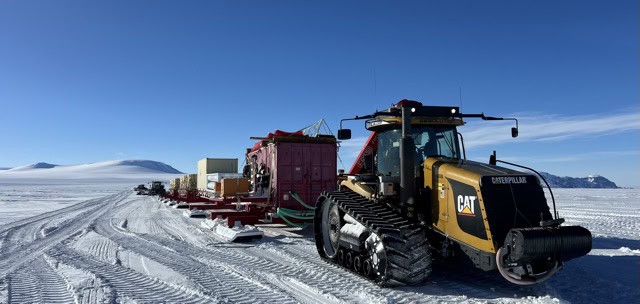
Traction wasn’t the only complication facing the fleet of Challengers: the machines labored in the cold with such obvious difficultly that you began to feel sorry for them. They started rough and took ages to even out, and every change of gear was a trauma that drained the engine of all its strength. Starting with our first morning on the plateau, we began the practice of the warm-up mile, where no vehicle would exceed 5mph until the entire convoy had driven one full mile, and even after that the tractors behaved strangely. Unsurprisingly, it was a battle to keep 308’s engine temp hot enough to stay within operating range, until it finally did warm up. At that point, it was working so hard in the insubstantial air that the struggle became trying to keep it cool. Now that going outside was usually kind of painful, I found that I was continuously leaning out onto the catwalk to adjust the tractor’s air intake. Every few minutes I was assaulted by the frigid wind tearing across the ice as I opened the door to fix the flaps—and it hadn’t even gotten really, truly cold yet.
I had it relatively easy, especially once the Prinoth had once again taken the toolshed off of my load and left me with only the three cargo sleds. The SPOT 1 supervisor spent all morning trying to find a combination of fuel loads and tractors that didn’t leave half the caravan bogged down in the powder, and by lunch we’d made it only 7 miles. He hit on a good mix at lunch, however, and we spent the afternoon trying to cover as much ground as we could, though in the white-out that rolled in we did end up veering from the flagged trail onto a completely uncompacted stretch of snow, where we noticed as soon as we lost it the benefit of driving along a route that had been at least minimally compressed by years of prior traverses. The plateau was going to be something of a slog, every challenge amplified by the cold, but we were still in good spirits. But we still had a fair ways to travel, and a lot could happen in the barren interior of the continent. We would just have to meet it as it came.
Day 18: 22 November, 34 miles today, 232 miles remaining to Pole, elevation 7830 feet, the Polar Plateau
The morning’s drive was low-key frustrating. It wasn’t terrible enough to qualify as actually difficult, but just aggravating enough that it was impossible to relax into a groove. The light was flat-ish, not the true blank page effect you get much of the time, but the edges had been softened on most lines in the snow—just enough that I had started the day with a pair of blu-blockers, which helped with visibility only just enough to tolerate the sickly orangey-green hue they painted the world. Lord knows I still couldn’t see most of the bumps in the road I was running over until the machine pitched forward, sending any loose items (hat, gloves, a collection of bolts resting on the console) flying around the cab and making any use of my pee jug a rushed, high-stakes gamble. We were coming up to the northern border of Sastrugi National Park, where these features would grow prodigiously in prominence and quantity, but we weren’t there yet. This was only a sampling of what the next few days would bring.
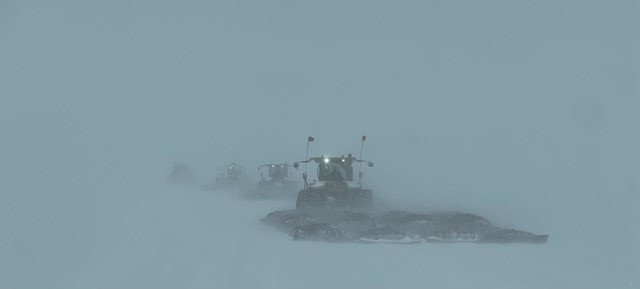
The wind had picked up by the 1000hr load check, making me enormously happy that I had chosen to bring my USAP-issued big red parka, a coat so bulky and warm as to be effectively useless in McMurdo. But here, on traverse across the Polar Plateau, where I would regularly jump from the broiling greenhouse of my tractor cab to the wind-dominated wasteland of the Antarctic mainland it was the perfect garment, since it kept me toasty and warm without having to layer beneath it. We tightened up our formation as we continued into the worsening white out, but soon every operator was relying almost entirely on their GPS to navigate: outside the windshield, in the swirling, blinding maelstrom, all directions were meaningless.
I was near the front of the caravan, right behind the camp modules, which were being pulled in tandem by two of the mechanics. We were actually doing a fine job, keeping to the trail and moving at a fair clip, considering the conditions. I would check my bearing on the garmin’s compass arc, then find the tracks of the Prinoth at the front of the convoy, then look for one of the flags placed every quarter mile to confirm we were still on the right path, then check my distance to camp up ahead. I had become lulled into a sort of hypnotic rhythm—GPS, tracks, flag, camp, GPS, tracks, flag, camp, GPS, tracks, flag, camp, GPS, tracks, flag—when camp suddenly veered off to the right, well away from the flag-line. At first I thought they must have seen something I missed, but eventually I realized they’d lost the tracks they’d been following. With two tractors pulling their load, they might not even notice they’d left the lightly-compacted trail and were driving across softer snow, but the tractors behind them wouldn’t get very far in that fluff. “Hey,” I called on the radio, “where are you going?” We spent the rest of the way to lunch gradually bringing the camp back to the flagged route.
Lunch was hectic. Rather than attempt the standard parking formation in the dense blowing snow, we parked the loads in a straight line then brought all the tractors around camp. Since I’d typically been at the ass-end of the parade, I’d usually pulled up at mid-day too late to help fuel the generator at camp, but today I was one of the first on the scene. I jumped in, but the howling of the wind and the roar of the encircling tractors drowned out my handheld radio and I was left guessing what exactly was going on. We got the tank filled, despite my accidentally stopping the pump before it was done, and headed in for a quick bite.
It was pretty easy to hook back onto the cargo load after lunch, but it was parked less than a hundred feet from camp and you could sort of make it out in the blizzard. It took a long time for the entire crew to find their fuel loads, sort themselves into the order in which we’d travel for the afternoon, and pull forward into a tight configuration. As everyone struggled to find their place, I looked out into the puke-tinted void* and thought about how strange it was that this place, this dot in the middle of an endless expanse of nothing, was seen by human beings only briefly, a scant handful of times every year—and for millennia before that, nothing. We were sitting on a mile and a half of snow that had accumulated in slow drifts blown on winds like this over the course of eons, in total isolation, unwitnessed and unknown. This was a world almost completely outside the consciousness of any living thing of any kind for almost all of its existence—a sort of synecdoche for the evolution of the Earth, the Milky Way, the vast reach of the universe itself. In passing through this place, we would come to know it only for an instant—fleetingly and superficially—before we would vanish once again into the swirling powder, small apertures of reflection and perception, drifting in a stream of space and time and catching only the barest, insubstantial glimpse of this strange miracle as we passed it by.
We crawled south throughout the afternoon, holding in tight parade formation and moving slowly to keep one another in sight as the visibility slowly tanked. When we stopped at the end of the day, the wind had become savage and it was hard to see even 100’ ahead. I was up on the cooking rotation, so I headed straight to camp once I had unhooked my load for the night. I ran into the living mod to grab a couple of things, and then made the twenty second walk to the kitchen. Since it was only a short way, I hadn’t bothered to wrap my face in fleece before stepping out into the cold. The walk was brief but miserable, the blowing snow hitting any patch of exposed skin like a shotgun blast of rock salt. The forecast for the next few days wasn’t good, though, so whatever else could be said about the weather, this was going to be our lives for the immediately foreseeable future. As ever, there was no way out but through.
*still wearing blu-blockers
Day 19: 23 November, 0 miles today, 232 miles remaining to Pole, elevation 7830 feet, the Polar Plateau
The weather was no better in the morning. In fact, it was terrible, but we were going to try to plow on ahead, as the forecast for the next few days only looked worse. The wind, though still not strong enough to be considered gale-force, was nonetheless fierce and mean, like a starved and tortured animal. It felt almost spiteful, the way it tore through clothing and ripped at the skin, filling any unsealed pocket with snow and coating every zipper with a spray of incredibly fine powder, which melted from body heat and then refroze into a solid mass of ice, locking you into your outerwear even after you’d gone back inside. I passed one of the other operators on my way to empty my pee jug into the u-barrel at the other end of camp, and when I returned to the kitchen two minutes later—having successfully poured into the funnel the half of my piss that hadn’t been violently sprayed into the Antarctic wilderness—I noticed that his footprints had been obliterated by the savage, driving wind.
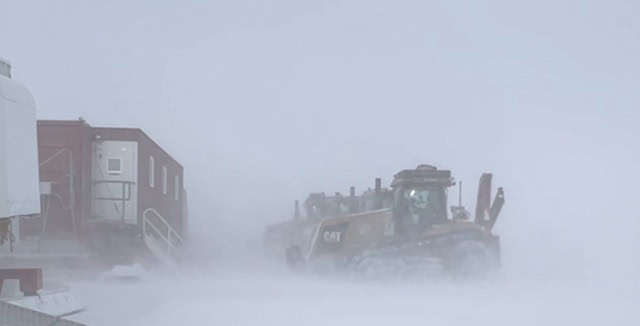
Visibility was, at best, questionable as we set out to find the loads we’d left spread out a safe distance behind camp. The layer of snow sweeping across the ground hid the drifts from view, and it was only after falling repeatedly on my ass that I memorized where they were and could safely make it from one of the mods to another. As we climbed into our tractors and started back down the trail, the Challengers were cloaked in snow, making them appear like the ghosts of slow, lumbering giants come to haunt the frozen plains. We were lined up alongside the fuel bladders when we were called to a halt—the crew up ahead trying to bump camp forward was having a hard time. The blowing snow had gotten worse just since we’d left the warmth of the kitchen, and it was becoming obvious that it wouldn’t be safe to try to mount a full-scale traverse in these conditions. In fact, the process of repositioning the toolshed and one of the fuel loads so they would be clear of camp when it was finally repositioned away from the mounting drifts turned out to be difficult and complex enough: while that was going on, the rest of sat in our tractors and waited. All told, it would be three hours before we would make it back to a camp that had only slid forward about 300 feet.
While I was waiting, a particularly fierce gust of wind grabbed ahold of the fabric flap keeping 308’s engine warm in the dreadful weather and didn’t let it go. I jumped out of the cab to secure it in place, and was frozen through by the time I’d clambered back in a minute later. I turned the knob over my right shoulder to crank the heat all the way on, and was met with a hollow, disconcerting silence. I tried a variety of combinations and settings, but nothing I did made any difference. The blower on my cab heater was dead. As the minutes dragged on, what little residual heat the cab had had dissipated. The snow that had blown in during the few seconds I’d held the door open still littered the floor, and the windows were slowly icing up with condensation. I opened a packs of toe and hand warmers, stuffing them into my boots and mittens as I sat. When we were finally led in formation back to camp, I was too excited for a hot cup off to walk carefully across the uneven, invisible ground and bound toward the kitchen, only luck keeping from sliding once again onto my backside.
We were taking a zero. We would move camp as needed, but we would not be trying to resume the traverse that day. That gave me the first chance I’d had in weeks to take a real nap, and, full of fresh coffee or not, I was determined to take advantage of it. This was the first day on trail any of us had had with even a few hours free of responsibility, and we used the afternoon to relax. Toward what would have been the end of the, we once again had to bump camp forward to free it of the new mounting drifts, and once again I found myself in the cold cab of a tractor, waiting for the mods to be repositioned to another flat enough spot farther down the trail. It took a while to find just the right spot, where neither of the sleeper buildings was set an uncomfortably cockeyed angle, and it was with great relief that I finally was given clearance to approach camp and park. Visibility hadn’t gotten any better, however, and I almost lost the tractor 50 feet ahead of me along the way. I had almost caught up with the front end of the tractor pitched forward before suddenly dropping several feet, hitting the ground with a violent jolt. I had just run over a mid-sized sastrugi. I was just processing that fact when I hit another, and then another. We were somewhere on the northern boundary of Sastrugi National Park—I could only hope that when we finally entered it, we would at least be able to see where the hell we were going.
Day 20: 24 November, 11 miles today, 221 miles remaining to Pole, elevation 8101 feet, Sastrugi National Park
After breakfast the next day, when one of the operators stepped into the shower closet to make a deposit in his pee jug, it was discovered that the shower had backed up. The outflow had frozen up, leaving an inch of standing graywater on the floor of the shower. The metal pipe running from the drain had a heat trace, but the last couple of feet was just a length of unprotected 3” rubber hose. This is what had filled with ice, likely over the course of several days. One of the mechanics fixed the issue by removing the hose and beating it against the side of the building until the ice cleared—problem solved. For the time being, anyway.
The conditions outside were better, though still far from good, the weather having improved overnight from nasty to only gross. We could at least see from one end of camp to the other, which was enough to shake the ice from our spurs and get back on the trail. My tractor still didn’t have heat in the cab, but that was least of my problems as the first thing I found on walking up to it was a large, frozen puddle of coolant on the snow. On further inspection, I found that I still had enough of the essential fluids to run the machine, but when I turned on the display in the cab, I found that the electric engine heater had failed, so I would have to run the occasionally-functional diesel heater before I could safely fire it up. Thankfully it worked, and ten minutes later I was able to crank the starter. The engine sputtered and coughed into life, and the display went out. I knew the controls well enough to bring the engine up to its warm-up speed and run the hydraulic fluid through its warm-up loop blind, but there was no way I could actually drive the thing without the information on the now-empty screen. For the time being, though, the best thing would be to just let it get warm while I got another cup of coffee.
A lot of the machines were floundering in the morning’s cold. It was a couple of hours before we were ready even to begin the work of finding our loads and breaking them free of the drifts that had blown in over the last day. 308’s display came back to life after a simple restart of the vehicle’s electric system, and I made my way back down the trail along with everyone else, following the breadcrumbs left behind on our GPS maps. The cargo load, still one sled shorter now that the Prinoth was pulling the toolshed, had nonetheless lost three of its massive skis to the storm, and it took one of the other operators and I a fair bit of effort and time to dig them out. “Oh well,” panted, leaning over my shovel, “at least I’m finally getting a bit of exercise. And anyway, shoveling in the wind is still warmer than sitting still in that fucking unheated cab.”
We cleared the front of each buried ski, carving ramps for them ride up and out of the drifts, but even so we couldn’t break the sleds free with both our tractors pulling in tandem. We needed a third, and by the time another Challenger was free I’d lost all the heat I’d built up shoveling. As we slowly dragged the cargo load out of the snow and up toward camp, I pulled the hood of my big red up over my head. My breath poured from my face in great, steaming clouds, and without the blower, the glass walls of the cab were growing thick with condensation, which froze quickly to ice. We spent the entire morning just getting ready to leave—it wasn’t until lunchtime that all the loads were pulled free and checked over, the generator was fueled, and each of the needy vehicles had been given a field repair and was ready to roll. I had stuff my boots and mittens with chemical foot and hand warmers, but I was slowly losing the fight against the cold. It was with incredible relief that I headed into the kitchen for lunch, while a trio of mechanics took advantage of a relative lull in the wind to replace the fan in my tractor’s heating system.
After an hour in the warm kitchen and a hot meal of poor man’s pad thai,* I was ready to get back to work. The mechanics had worked their magic, and once again the cab of 308 was fit for human habitation, and as the fleet was readied for departure from the patch of ice we had called home for the last day and a half, I luxuriated in being able to sit in my tractor without my parka, letting the warm air play against my palms or blow my stiff, greasy hair back on my head. We were entering the next phase of our journey to Pole, a section of trail spoken about with awe and dread back in McMurdo, known as Sastrugi National Park. There was widespread apprehension for the road ahead among all the first-timers. I had been among them when we had discussed the challenges of the next hundred miles at the morning meeting a couple of days before—but now I was just grateful to be able to feel my fingers.
Sastrugi National Park is not actually a national park. It’s the unofficial SPOT name for an ever-shifting region of the Polar Plateau populated by thousands and thousands of sastrugi: hard, wave-like ridges of ice-like compacted snow with hard, complexly angled geometries, that typically rise a foot or two or three from the surface, but in some cases can grow** as high as six feet or more. SNP covers roughly 100 miles of the trail to Pole, though the borders shift from year to year and no traverse can predict when they run into it—nor indeed how severe, steep, or widespread the current season’s crop of sastrugi will be. Even so, it is incredibly obvious once you’ve entered it: the topography becomes wild and variated like the surface of a lake during a storm, and the ground underfoot becomes shiny and mirror-slick. There’s a hard crust that is difficult to walk across without falling straight on your ass, but is also thin enough to shatter at once under the weight of tractor. Crossing this sea of massive speed bumps is one of the great challenges of any journey to (or from) the South Pole, something which is discussed endlessly in preparation for, but which nothing can truly make you ready for.
And we weren’t ready. At least, few of us were mentally prepared for the sudden drop in a pace that had already slowed dramatically since leaving the Ross Ice Shelf. Worse than the slow climb up the toe of the Leverett, this region was one massive tiger trap, swallowing the giant lumbering CATs one after the other. The standard traverse formation in this area is to put the blade tractors in the front, so they can blunt the hard edges of the more prominent ridges as they pass, and for this reason the trail here is narrow. Now that two tractors had been dedicated to pulling the camp mods, there was no readily available tow truck, so ever time one of us got stuck, their neighbor had to uncouple from his own load and drive over to help pull them out—while every person behind them sat idling in the clearing weather. The sharp, hard sunlight leant an optimistic cast to the afternoon, even though the last mile was a hard-fought slog that took two hours to cover. It was like the white out of the last couple of days had been a confusing dream from which we were gradually waking up—but one that was sure to recur, sooner or later.
The NSF jealously guards the route for the South Pole (overland) Traverse. The broad strokes are widely known, but specific waypoints are kept quiet, and any published maps are diligently scrubbed of latitude and longitude.*** This is done largely to discourage tourists from using the trail, though of course they still do—it’s a proven, well-marked route, scanned by ground-penetrating radar, flagged, and maintained each year by the repeated passage of hundreds of tons of equipment. Colin O’Brady famously used the SPOT road to assist him in his skied, self-aggrandizing half-crossing of the continent, though most tourists don’t try to make a career out of it. Skiing across Antarctica is an incredibly expensive lark, available only to extremely well-heeled members of the leisure class, so it isn’t often that the crews delivering fuel to Pole see evidence of their passage. But it does happen from time to time. Late in the afternoon, as we were battling our way into SNP proper, a call came over the radio from the Prinoth in the lead. “Uh. Hey, guys, there’s…there’s a pile of human shit on the trail over here. Looks like someone’s been through this way already this year.” As I drove by the scene, I could see he was right. The proof was unmistakable—though “pile” was perhaps a strong word for the consistency of what we found in the dead-center of the trail. Wherever that tourist is now, I hope that their diet has improved.
I was completely exhausted. At fuel circle, I was easily distracted, so focused was I on fantasies of snuggling into my dark, warm bunk. When all the tractors were chipped and fueled, the other operators stood in loose clusters chatting happily in the stiff breeze. “All right guys,” I said, “I’m going to bed.” But as I bounced and banged my way across the uneven ground, I could make out the lone silhouette of the SPOT 1 supervisor, working on his own to replace a thoroughly ruined paulstra pad on the kitchen mod. I parked 308 in its place next to the living mod, glanced longingly at the building that held my pillow and blanket, sighed, and walked over to offer the supervisor my assistance. No one should have to struggle alone, especially in an environment as hard and cruel as this, and especially not at a job this maddening and needlessly difficult. This pad was utterly destroyed—even worse the one we had replaced down on the ice shelf a week before—and pulling the twisted steel free of the frame seemed a task beyond the meager tools we had brought with us into this desolate and terrible place. But still we threw ourselves fully into the work, as the cold, wind-blown hours passed and the sun crawled across the pale blue sky of the empty Antarctic summer night.
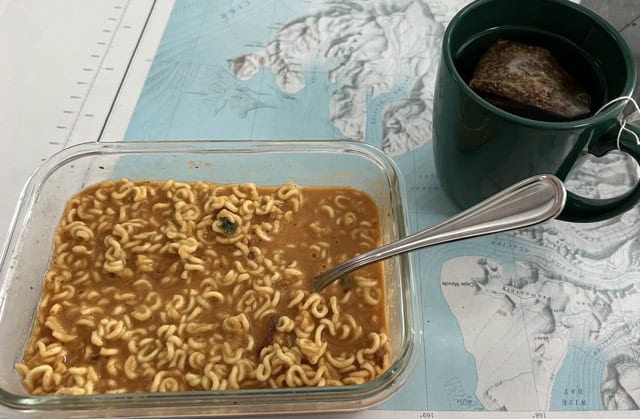
*ramen noodles mixed with a generous scoop of peanut butter
**Sastrugi National Park is an ablation zone; the sastrugi themselves are not built by the collection of drifting snow but by its scouring. With the looser, fluffier powder scraped away by the wind, what is left are these denser fins of concrete-like snow.
***This despite the fact that all of this information is readily available to anybody with access to google.