The following is the personal account of a single, long-winded individual’s experiences living and working in Antarctica. No part of it has been reviewed or in any way endorsed by the United States Antarctic Program or the National Science Foundation, or any other public or private organization, institution, contractor, or company associated therewith. The views expressed herein are the author’s alone, for good or for ill.
Day 01: 05 November, 22 miles today, 1,018 miles remaining to Pole, ambient temperature unknown,* McMurdo Ice Shelf
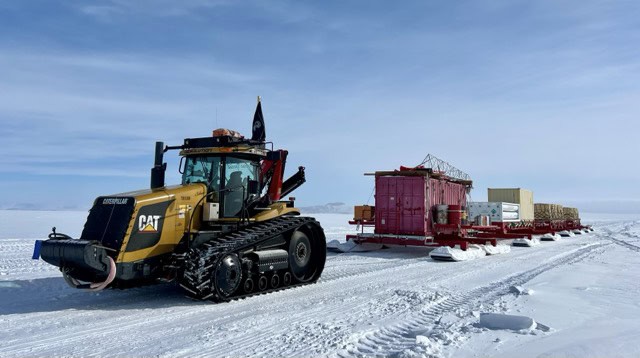
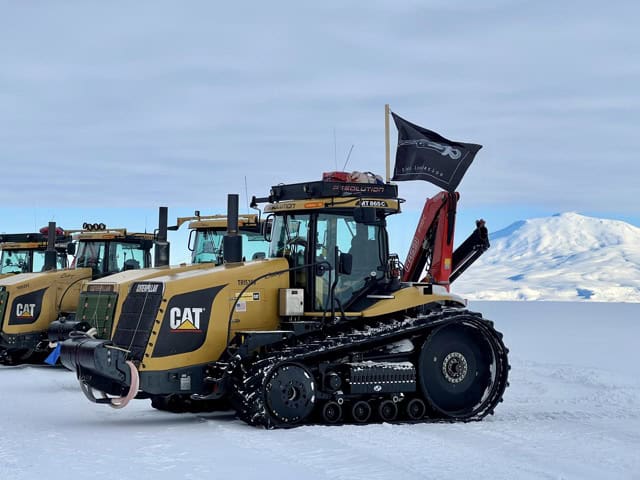
The first day of the journey was warm. That means something different in an environment where your work clothes include a wool base layer, a fleece shirt, wool socks, and quilted overalls than it would in, say, Tampa. In all likelihood** the actual temperature was still well below freezing, but as the SPOT 1 crew bopped around SPOTSA moving last minutes odds and ends into the living mod I kept shedding outerwear everywhere I went—coat in my tractor, hat in the kitchen, gloves on my bunk, hoodie somewhere or other. There was a light dusting of snow coating each of the towering yellow Challengers, and the air was cloudy with small, thin flakes of the stuff, though whether it was coming from the sky or was being blown on the light breeze was impossible to tell. Visibility wasn’t necessarily great, but neither was it terrible, and without anything left to delay us we gave each of our tractors its morning inspection and fired them up for the day.
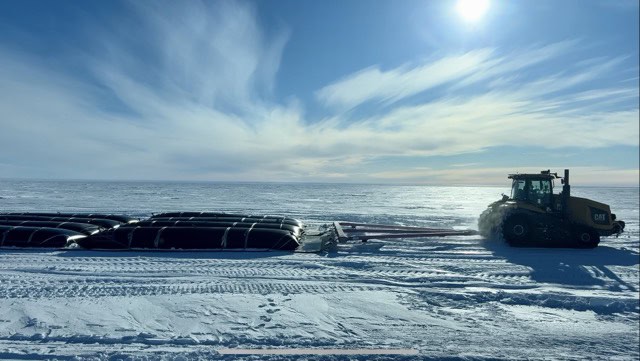
The whole day on trail was almost a sort of practice run, but one that ended with us several hours closer to the South Pole. The traverse supervisor gave lectures throughout on how to pull our loads, how to space ourselves across the trail, how arrange our vehicles for fuel circle and the basic steps of the fueling dance, how to park at the end of the day. Most of us had never been on trial before—or had only gone as far as the Shear Zone, towing a lighter, simpler load. We would find a groove eventually, but in the beginning it meant that the majority of the crew would be slow and easily confused, standing around at times just trying to figure out what was happening around us. This was at least as true for me as for the others, since my cargo was unique and every one of the finer details of pulling a fuel load didn’t apply to me. The bladders, for example, were hitched to the tractors through a beefy metal triangle with skis called a CRREL tool,*** and coming to a stop with one of those was a gradual process. Each of the four sleds I was pulling in tandem were connected with a bridle made from thick cables, and in order to leave enough slack in the train to pop each sled free when I started again, I had to come to a sudden stop and let each piece slide forward a few feet. I learned early on that I had to the let all of the fuel loads pull well ahead of me to give me enough space to pull off this maneuver.
When the mods were packed and the tractors were warming up, I walked over to the cargo sleds to look them over. We would stop twice each day just to do a load check, making any necessary adjustments before moving on, and I had yet to figure out a process to inspect every piece that might need attention. It would be too much to cover in 15 minutes, and at some point—soon—I would need to work out a system so everything got checked regularly, if not twice daily. But this morning I had all the time I needed. As the ten fuel-towing tractors trundled off through the occluded air toward their loads, becoming an evenly-spaced row of black dots stretching off into the dim white veil of blowing snow, I pulled on every piece of restraint, tightening straps and checking pads until I was satisfied everything was in order. I was the last to leave SPOTSA, behind the lead mechanic, who was pulling the camp mods, and the supervisor and the mountaineer, who would lead the traverse with Prinoth—one of them driving, while the other monitored the trail with the GPR, making sure the path was safe for the rest of us to drive. By the time everyone was hook up to their loads and ready to leave it was well past noon, so we broke for lunch. I knew it was important on the first day to establish the habits that would carry me through the remainder of the traverse, but having an opened family-sized box of wheat thins sitting before me outweighed all of my good intentions. At least it wasn’t donuts.
The traverse truly got underway once we’d had our fill of crackers and spicy ramen. The blowing snow had cleared and sky opened up endless and blue, and we called out over the radio as our tractors began their treks across the ice. I was in the back of the convoy, and so it was part of my job as the last one to leave to confirm that everyone was in motion. “308 is rolling,” I called, identifying my ride, “all tractors rolling.” And with that, we were finally headed to Pole.
*Unfortunately, as it turns out, the SPOT 1 camp doesn’t have a functional outdoor thermometer—at least one that I ever knew about—thus destroying my dream of tracking the daily temperature throughout the traverse. With any luck, though, the one I ordered online will arrive in McMurdo before I leave for SPOT 3.
**Again, no thermometer
***Cold Regions Research and Engineering Laboratory, which designed the thing
Day 02: 06 November, 50 miles today, 968 miles remaining to Pole, Ross Ice Shelf
I’d had the bright idea that I would get up painfully early every morning on the trail and have the kitchen to myself in the quiet hour or so before anyone else dragged themselves out of bed. The principle was sound, but I learned that my timing was off as I blearily lumbered into the kitchen to find five other people already in it. So much for having a warm space to work out in the mornings. At least the weather was still quiet and warm and I could do a few push-ups next to my tractors while it was warming up for the day. That probably wouldn’t be true a lot of days on the ice shelf, but it definitely wouldn’t be a tenable practice once we reached the polar plateau. By then, I figured, I might just count not freezing to death as exercise enough.
We reached the Shear Zone about an hour into the day. Once all the tractors were in the Corral (“308 has stopped, all tractors stopped”), we each did a load check and then slipped on our harnesses. We didn’t plan on actually roping up, but it was protocol to be ready to in case something went wrong as we crossed the belt of mitigated* crevasses. It was a slow process, each tractor keeping its speed low and entering the danger zone only once the tractor ahead of them was well underway. I considered how different it felt to be pulling cargo through this stretch than it had to work on foot (though anchored to a vehicle) just a few weeks before. Then it had been a simple matter of clipping in before you stepped onto the snow, but now any problem that needed foot travel to solve would bring a stop to the whole train of tractors and fuel bladders and would require a rescue plan. I kept an eye out for any sign of open crevasses, but only caught a glimpse of one of those we’d worked on earlier in the season, still unfilled just a couple of feet from the edge of the trail.
We made fantastic time once we were through the Shear Zone—officially clear of the McMurdo Ice Shelf and onto the gargantuan expanse of the Ross Ice Shelf—rolling over the miles at a steady clip in a straight line SSE. It wasn’t long before the sunlight beating through the glass walls of my cab began to become oppressive. The Challenger’s cooling system is perhaps its least impressive feature, and I soon found myself stripped to my t-shirt and long johns. Changing in and out of quilted overalls laden with tools can be tricky in a space not dominated by a control panel and a steering wheel, but it’s still possible even with those conditions, and is worth it for the comfort it affords, even at the cost of whatever dignity remains in the middle of nowhere, Antarctica. It also makes peeing into a jug that much easier, and is probably worth the hassle of wrestling the bibs off and back on for that alone.
Time is sort of meaningless when the sun never sets. True, it circles the sky in predictable daily patterns, but the USAP’s use of the New Zealand time zone has more to do with office hours in Christchurch than anything to do with whatever time it may or may not be on the ice. Though the difference fluctuates with the semiannual shifts of two opposing daylight saving regimes, at the time that SPOT 1 set out from McMurdo on what was ostensibly election day back home, we were 18 hours ahead the US eastern seaboard. As we shuffled into dinner after fuel circle on the first full day on trail, the first poles had only just closed and the results were being tabulated and announced. I’d been sick with dread over the election for months, but had been able to forget it in the excitement of setting out on a grand new adventure. Now, though, the cruel vulgarity of American politics had broken through that fragile membrane of joy with a feeling like being doused in cold water. I ate quickly without really tasting my food, washed up, and changed out of my work clothes and into my snow pants and trail runners. I ran to the north—the course that had already been GPR’d and was cleared for recreation—toward distant, vanishing Mt. Erebus and McMurdo, and away from the news, the election, the grim, desperate future. I ran across the hardened, slippery snow, dodging the ruts we’d made with our tracks on the way in, away from the endless, empty horizon we were driving into, away from it all, away from everything.
*exploded
Day 03: 07 November, 55 miles today, 913 miles remaining to Pole, Ross Ice Shelf
SPOT 1 was still finding its footing. Of the 14 souls making the journey to Pole, only 6 had ever done it before. The other 8 of us had yet to adapt to the flow of life on trail, and required continual trainings and reminders to keep us on track. Having fired up all the tractors at 0630hrs to let them warm, we met each morning in the kitchen at 7 to discuss the plan for the day. What started as a quick assessment of the previous day’s work and an overview of the next 12 hours devolved into a lengthy description of the camp chores that fell to the day’s house mouse, a position that rotated throughout the crew so nobody got stuck cleaning the toilets for the entire traverse. The first two days the job had fallen on old hands, but as I was next in the lineup, the supervisor felt it was time to walk all the new people through the process.
The weather was once again spectacular, sunny, bright, and warm—but not so much as to soften the snow under our tracks into mush. From the first mile, however, the path was clotted with bumps, little compacted snow drifts that constantly jostled the bones and made keeping a consistent speed impossible. And since I had chosen this day to rededicate myself to the art of hydration (always a challenge in Antarctica), I was forced to learn the complex dance of managing one’s tractor and peeing into a jug, aiming at all times to avoid making a splash by moving the body along with the roughness of the road and trying to time the release for just the right moment, while trying to steer around the most violent obstacles ahead. We would eventually face much more brutal terrain than this, of course, but this variation of “smooth” was one I hadn’t been prepared for, at least not after two nights of troubled, patchy sleep, and I was worn out by the time we stopped at midday.
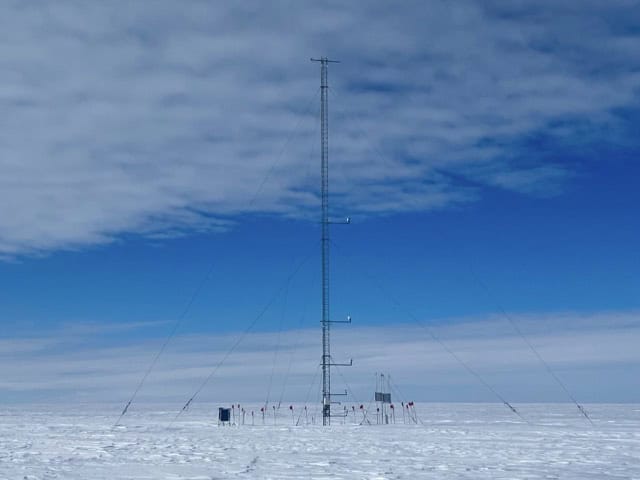
We broke for lunch at a site listed on USAP flight manifests as TALL TOWER!, which I had always adored for its commitment to capital letters and officially designated exclamation point—though several riggers had assured me it was their least favorite work site, because it is literally a 100’ tower in the middle of nowhere with a few bland weather instruments scattered along its height. We were far enough away from Ross Island that Mt. Erebus, the looming, fuming giant at McMurdo’s back door, had become a faint white pimple on the horizon, and we’d almost lost sight of Minna Bluff, a peninsula of peaks reaching out from the mainland into the ice shelf. We were coming into the long, empty stretch of our path to Pole where we would have no landmarks, and no variations in the flat white nothing stretching on in every direction. But here, at the edge of this void, was a tower, and the supervisor’s obvious excitement at stopping at this milestone for lunch was fairly infectious, despite the bleakness of the news from the states, which was clearly weighing on several of us, but which nobody discussed, or even alluded to.
Since I was on house mouse, I broke away from fuel circle as soon as my tractor was fueled and chipped of ice. The job really wasn’t that bad, I just didn’t know how anything worked or where any of the supplies were. The two biggest concerns, emptying the pan at the base of the incinolet into a bin labeled poo ash and filling the snow melter with fresh snow, were actually pretty simple once I had figured out the basics—or was shown by the more experienced operator who was on cook detail that night. By the time everyone else started filtering in, the cook had a meal laid out in the kitchen, and I was just wrapping up the chores. It had come out at lunch that this was the mechanic foreman’s birthday, so while he sat down to eat his slice of banofee pie, everyone in the small trailer sang to him, as one of the other mechanics held his bic lighter over the pie for him to blow out. It was a human moment, a spark of connection in the midst of a frozen, dead ocean, one that could not be touched or distorted by any force, from Antarctica or America.
Day 04: 08 November, 56 miles today, 857 miles remaining to Pole, Ross Ice Shelf
I was the first person on SPOT 1 to get stuck on trail. The snow in Antarctica is extremely dry—so dry that if you try to melt it in a stove without seed water it will actually burn. It will compress under weight, and the wind blown surface can be hard as concrete, but that takes time. When freshly disturbed, it has all the structural integrity of sugar. The SPOT 1 supervisor knew this, which was why, after having me park my load just behind camp the night before, he asked me to make sure I could pull it free before all the other tractors had hooked up to theirs. I also knew this, but even so figured that the 10 feet I pulled it forward was good enough. It wasn’t, a fact which I only discovered twenty minutes later when the entire convoy had started, and when I tried to drive across the torn-up, rutted mess we’d left at camp and my tracks started spinning. I wasn’t going anywhere.
There are some calls you dread making over the radio. I uncradled the mic, but shook my head and sighed before keying it. “308 is stuck.” This brought the entire train of tractors to a halt, while the one just ahead of me uncoupled from his fuel load and drove back to where I stopped, my left track dug two feet into the powder even though I stopped moving almost as soon as I’d started. I ran the tow rope from the front of my machine to his hitch, and a couple of minutes later I had all four of my sleds back on the relatively firmer surface of the trail. It wasn’t a hard or complicated process, or even that time-consuming in and of itself—it was getting the other tractor back off its load, back over to me, back to the convoy, and back on its load that was dreadfully, painfully slow. By the time we were all moving again, I had easily cost us four or five miles of the day’s total—though the rest of the crew were generous about it, knowing their time would also come. “308 is rolling” I called, “All tractors rolling. Finally.”
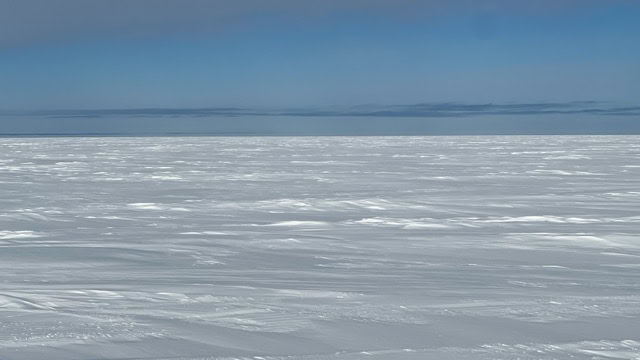
The morning I got stuck was also the morning we finally lost sight of Mt. Erebus and the gradually thinning sliver of Minna Bluff and we became completely immersed in the impossibly flat geometry of the ice shelf—just a uniform white line in every direction. It’s an unearthly feeling, one I assume must be common to sailers once they reach the open sea, but it was a sort of threshold I had never crossed myself. This is the closest I’ll ever come to being on the surface of the moon, I thought, the endless expanse lonelier and emptier than any place I had seen before. This strange landscape would make up the lion’s share of the journey, and I wondered when it would lose its novelty, but the whole day was spent marveling at the absolute strangeness of this sense of nowhereness. The surface of the ice shelf is blanketed in small, hardened drifts, like the small, erratic waves of a large body of water on a calm day, but frozen in place. It’s like driving into a still photo of the ocean.
I was on dinner detail that evening, though the first step in that process was unhooking from my load, a task complicated by the meltwater that had dripped from the back of my tractor and into the large hitch pin, where it had frozen solid. It took several minutes of beating on this cold chunk of steel with a large, heavy shackle to break it free. That would have been a lot easier with a hammer, I thought as I finally wrenched the pin loose. I dropped it into its nest beside the hitch and looked back at my load where, not forty feet away, was the SPOT 1 tool shed.
Having lost several precious cooking minutes breaking ice from my hitch, I raced into the kitchen still dressed in my heavy, quilted work bibs. I had a plan, but the moment I opened the first cupboard to put it into action an unopened glass bottle of soy sauce came flying out and exploded across the floor. I set the glass shards aside and mopped up what I could with a truly massive wad of paper towels, but most of liquid was absorbed into the weird-like surface of the floor. The premade butter chicken I heated in the frightening industrial microwave was spectacularly bland, but the frozen broccoli I’d seasoned with garlic and butter made up for it, and the diced fresh onions and sweet potatoes I’d sautéed were a treat we wouldn’t have for much longer. What I was most impressed with, however, was how quickly I was able to get the meal together, get everyone fed, and clean the entire kitchen. I was sweaty and grungy in my work clothes, but was pleasantly surprised to see that I had I still had plenty of time to feed the snow melter and get in a shower and still get to bed at a reasonable hour. I quickly changed out of my work gear and jogged back to kitchen mod, where a line for the shower had formed in the bathroom. I was gross, yes, but I was too tired to wait around. If I only got up a few minutes early, I figured, I could easily shower in the morning.
Day 05: 09 November, 51 miles today, 806 miles remaining to Pole, Ross Ice Shelf
I woke up earlier than usual in the morning in grubby anticipation of the shower that awaited me, only to find once I’d walked over to the bathroom that it was already occupied—at which point I gave up on the idea, washing my face in the sink and calling it good, for the time being at least. Even so, our fifth day on trail was when I began to settle in, when the rhythms of life on traverse began to click. I was starting to make fewer adjustments to the routine I was trying to establish, to the way I had my tractor set up, to the way I approached each load check. Everyone seemed a bit more comfortable with the flow of work, and with each other, than we had in the first few days. It felt like we were finding our groove. I didn’t even get stuck as we were leaving camp in the morning.
That sense of flow didn’t falter when one of the operators reported a burning smell coming from his tractor as we pulled together for lunch. It was a shift in the current, but one we were learning to ride as a group. I had come to favor checking my load at the start of lunch rather than its end, to let the first wave of diners settle into the kitchen before trying to make a sandwich myself. It was as I was walking up to the kitchen mod that I saw the cluster of heavy equipment techs bunched tightly by the open hood of one of the Challengers. The foreman looked over at me as I walked up, one eyebrow cocked in question. “Don’t lose a turbo, dude. This one’s fried. We gotta replace it, but that’s it. That’s all we’ve got from here to Pole.” I looked around at the tight formation we took for mid-day break: 13 tractors, 10 fuel loads, a mobile field camp, and a train of cargo, patterned in a rough rectangle with nothing breaking the universe of snow but the small green flags marking the trail every quarter mile, which vanished quickly into the distance. It was a busy stop for the mechanics, all told an hour of driving time lost—most of which I spent in the cab of my tractor, my face buried in a guide to wilderness medicine.
Every day on trail ends in something called fuel circle. In the morning, the supervisor selects which of the bladders we’ll be pulling fuel from—which generally rotates to whichever vehicle is currently having the hardest time pulling its load. When all the driving is done and the loads have been uncoupled from their hitches, all the tractors back up into a rough semi-circle behind the chosen bladder set. A hydraulic-powered fuel pump is plugged into one of the tractors, as hoses are run to the selected bladder, and from there a nozzle is passed from one tractor’s fuel tank to the next. The pumps are beefy, driven as they are by the hulking engines of the massive Challengers they’re filling, putting out something over one gallon per second. The flow has to be controlled through the tractor powering the pump, since shutting the nozzle off under that much pressure is likely to blow one of the hoses out of it couplings, s the operator running the nozzle has to communicate with the operator running the pump with large, broad gestures. While one tractor’s 300-gallon tank is being filled, every other available hand is busy chipping the day’s accumulation of ice from the tracks and hydraulic ports of one of the others with shovels, spades, and ice axes. It takes an hour to fuel and clean all the CATs and get the entire setup broken back down and stored for the next day’s travel.
We had actually covered a fair bit ground, despite the long delay at lunch, and the weather was still fair. After fuel circle, with my tractor neatly parked in its bed beside the living mod, I changed quickly into my running gear and set out on the trail. The snow underfoot was thin and insubstantial, and each step drove my feet six inches into the powder, making the endeavor more of a grueling two-mile high step than a run. Still, after a long day in the cab, it was good to move, to drive my body across the earth in a vehicle powered not by diesel but by the peanut butter and crackers I’d helped myself to at lunch. There’s a release in physical movement, something fundamental to act of living. It’s why I could I keep running, past the parked bladders and cargo and into the open dome of the unoccluded sky, despite the nip of the light breeze or the drag of the soft snow on every sinking footstep. And it was with incredible relief that I returned to camp to find the shower open and waiting for me, a small rebirth in soap and steam. For once I would go to bed drained, renewed, and clean.