The following is the personal account of a single, long-winded individual’s experiences living and working in Antarctica. No part of it has been reviewed or in any way endorsed by the United States Antarctic Program or the National Science Foundation, or any other public or private organization, institution, contractor, or company associated therewith. The views expressed herein are the author’s alone, for good or for ill.
Amundsen-Scott South Pole Station—or simply Pole, as it is known among most Antarcticans—is a tiny blip of an island in the midst of an unfathomably wide sea of open ice and snow. It is a fragmented archipelago of run down quonset huts, ramshackle cabins, underground1 archways, storage berms, and vast piles of carefully stacked debris leftover from the demolition of the old geodesic dome in 2010, all culminating in the sleek new elevated station and capped by the red and white striped ceremonial pole in what is, basically, the facility’s front yard. Like everything else in Antarctica, it is a marvel of design, engineering, and improvisation; a miracle of human perseverance that defies god and nature in its ability to withstand the year-round horrors of the native climate; a thing that seems like it shouldn’t work, but, despite all the odds, does.
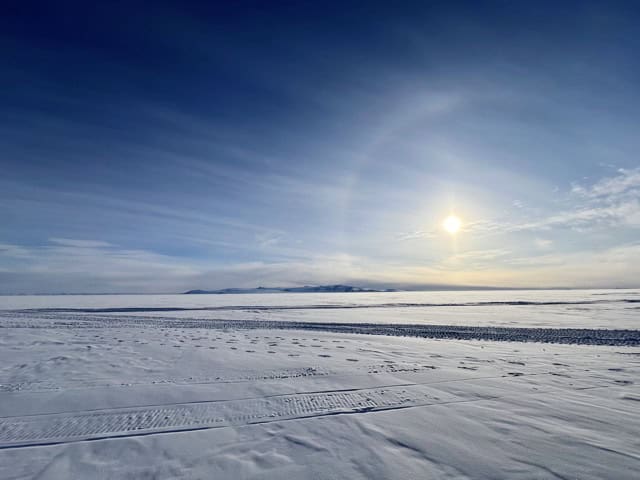
And the odds against it working are profound. It is not just the bitter cold, nor the violent, near-constant wind, nor the thinness of the air, nor its extraordinary aridity that makes the landscape of the polar plateau so deeply inhospitable, but also its extreme isolation. The vast rocky middle of the continent is entombed beneath the East Antarctic Ice Sheet, a frozen freshwater ocean miles thick in some places. This puts the surface at high elevation, irradiated by a sun shining relentlessly—and substantially less-filtered—through the hole in the ozone layer. The terrain up there is windswept and barren, a featureless white nothingness that extends into the horizon in every direction for hundreds of miles. It is perhaps the most forbidding, unendurable desert on the planet, and has been notoriously treacherous to cross since the so-called heroic age of Antarctic exploration. And somewhere in the midst of this expanse of negative space sits Amundsen-Scott Station. It is about as much in the middle of nowhere as it is possible to be.

The station is co-named for Roald Amundsen, who was the first person ever to reach the South Pole and who returned alive with his entire crew, and Robert Falcon Scott, who accomplished neither of those things. Too proud to use dogs bred for the purpose of hauling sleds across the ice, at least Scott was able to eat the ponies he brought instead to the Antarctic when his food caches failed him, before succumbing himself to the cold. Even since the days of that legendary race for glory, fame, and/or survival, the supply chain needed to support human life at 90°S latitude has always been an utter fucking nightmare. McMurdo, the program’s logistics hub and the station with the continent’s biggest population, has not only a runway that can support planes big enough to deliver over 100,000 pounds of cargo per trip, but also a sheltered bay large enough to accommodate the massive supply ship, which comes every year, as well as a giant, hulking tanker, which arrives every two years. Pole has none of these, and while it may only have a fraction of McMurdo’s population, those few souls nonetheless need food, equipment, building supplies, machine parts, and enough fuel to keep the generators running, the water plant melting ice, and dozers and loaders and tractors and trucks moving snow. The skied aircraft that deliver people to the station can be relied on to move most of that cargo, but the volume of fuel needed to keep the station warm and its inhabitants alive is beyond capabilities the USAP’s aging fleet of ailing LC-130 skiers. This is where the South Pole Overland Traverse, or SPOT, comes in.2
Diesel is the lifeblood of the US Antarctic Program. From the jet planes and the skiers, to the tractors and the loaders, to the generators in the stations’ power plants, to the boilers in each of its buildings, this fuel is probably the single most important commodity brought, at great expense, down to the continent. The thought of a thousand blackened pipes belching oily exhaust across the ice can be disheartening to anyone with rarified visions of the unspoiled Antarctic wilderness, but it should be noted that this footprint is tiny when compared to even the smallest town in the developed world, and massive strides have been made in efficiency since the early days, when the program was managed by the US Navy3—and that progress is being continually refined. Flying, to take one example, burns a mind-boggling amount of propellant, but from the establishment of a permanent encampment at the South Pole in the late 1950’s it was the only viable means of delivering fuel to the station. For five decades, best practice was to load an LC-130 with a few dozen 55-gallon drums, and to do that as often as was necessary to keep the lights on. By the time the USAP fell into civilian hands toward the end of the century, that meant a hundred or so missions per year, each one burning more diesel on the round trip flight than it delivered—until somebody one day had the wild idea to haul the fuel over the ice with a dedicated convoy of tractors. As it turns out, an overland traverse is vastly more efficient, and far more reliable, than transport by air.
This cross-continental movement of petroleum products is the whole of SPOT’s raison d’être—though it is also used each year to transport the sort of cargo that can be troublesome to carry by plane—and what was an untested dream 25 years ago has by now become an established fact of the Antarctic summer. Every year, two to three motorcades of yellow CAT Challengers leave McMurdo, skating southeast across the Ross Ice Shelf before eventually weaving their way up and over the Transantarctic Mountains and onto the Polar Plateau. One of these tractors tows a series of modules built from repurposed shipping containers that include generators, a tool shed, sleeping quarters, a kitchen, and a bathroom. Another tractor might be towing cargo tied down to 40’ flat racks riding on 8’ skis. The rest are each pulling eight 3,000-gallon bladders filled with diesel, netted and strapped to long, thick sheets of slick plastic that slides easily over the ice and snow. This industrial caravan travels just over a thousand miles across the Antarctic and takes anywhere from three to five weeks to reach its destination (though the return trip is reliably much faster). The drivers work long, tedious days, living in the frozen, empty backcountry with limited resources and no-one but each other for company. From the first moment I heard about it I was enchanted.
It isn’t necessarily an easy life, motoring all day across the barren wastes, living with a small group of weirdos in close quarters and near-total isolation, with nothing to look at but the subtle shifts in the ice and snow as the long miles pass—but for years this was the life I wanted, though it remained always just out of reach. How strange it was to return to this place, this haven on the shores of Ross Island, and to find it so radically changed by the shift of my own place within in it. The mountains seemed crisper, nearer somehow, the curves of their glaciated ridges prominent and bold in the shadows thrown by the low-laying sun. As the twilight of winter’s end was slowly erased by the blinding white of summer, I came back to McMurdo, to learn this job and to put in all the weeks and months of prep work it would take to get ready to make the drive to Pole. It would take countless hours in the deep and lasting cold before we would be set to leave, but no matter how frozen or tired I became I would be at peace in this terrible place, awed anew at the foreboding grandeur of the implacable wilderness I was soon to enter.
- Under snow, more accurately—the arches were also originally built on the surface decades ago, but have since surrendered to years of drifting and are becoming increasingly structurally unsound each year under the weight of more and more snow. ↩︎
- In its early days, the department was officially designated as the South Pole Traverse, or SPT—which acronym was typically spoken aloud with an o that had no antecedent, just to make it a pronounceable word. At some point along the way, the South Pole Telescope project officially usurped that sequence of letters, and SPT became SPOT as the word Overland was semi-officially added to the title in order to distinguish between the two. Formally, the new abbreviated name is stylized as SPoT, but, honestly, I don’t have the patience to screw around with that kind of artsiness in my acronyms. SPOT is good enough for me. ↩︎
- An organization whose commitment to Antarctic environmental sustainability is best summarized by their (now long-abandoned) practice of piling their trash onto an ice floe and letting it drift off to sea. ↩︎