Day 0 (again*): 23 May 2024, 0.0 miles today, 742.2 miles total, Grand Canyon South Rim
The best thing about modern airport toilets in that, no matter how frequently or how recently that have been professionally scrubbed, they are always so visibly filthy as to demand the use of those frail, disposable seat covers made of a single, delicate membrane which requires a person’s complete concentration and tenacity to unfold and perforate without tearing into uselessness. The second best thing is the automatic flush, which inevitably is triggered after the seat cover is placed but before you can actually sit on it and secure it with your butt, leaving you to watch helplessly as your hard work is literally flushed, unused, down the toilet.
Inconveniences aside, if you’re privileged enough to live with a certain level of income and a certain level of money, flying in an airplane can become routine enough that you don’t bother fusing with any of the details of your upcoming flight beyond what time you need to appear at the gate. To learn on the precipice of take off that your journey from Charlotte, North Carolina to Phoenix, Arizona will take almost 5 hours is to be reminded, in a small but sharp way, just how fucking big this country is. Living and working in one place narrows your perspective. That’s not a bad thing, as much of the beauty in the world can only ever be seen with patience and focus, but you do lose sight of just vast the world in which the tiny patch you inhabit sits truly is. I had wanted to return to the Grand Canyon and finish what I’d started the year before, to hike the section of the Arizona Trail that had been hard-closed and which I’d skipped rather than pouring days of effort into finding an alternate footpath around—but I also needed to see once again how small I was, how transient the life I’d built, how fleeting all the troubles that had come to occupy my brief days. What better place for such a perspective than the bottom of America’s biggest, most famous hole?
By the time we started getting ready for this trip, early summer had bloomed in our small nook of Appalachia. The winter and spring had been relatively temperate—though working outside, bringing order to furious geysers that had once been water mains had substantially lowered the threshold of what I considered cold—but the deciduous forest had remained depressed and bare until only a couple of weeks before we left. As we left, however, the greenery had returned in such riotous force that already it was hard to imagine the peaks surrounding Black Mountain as anything but sensuous and lush. Flying cross country makes the inanity of the single-climate planets in movies like Star Wars seem almost plausible: in the morning you practically wade through the mist to the front entrance of the airport in Asheville, and in the afternoon you wander into the urban blighted furnace of metro Phoenix.
The transformation of the landscape continues as you head north in your rented Kia Soul, the gradual rise in elevation taking you up and away from the sun-hammered scrub-brush of the Paradise Valley to the tall, waving ponderosa pine forests of the Colorado Plateau. It hardly seems real, this quasi-teleportation, and as we lay down in our tent surrounded by the excited chattering of this year’s crop of AZT thru-hikers, Sean Meadow and I marveled at the change we had brought to our surroundings through the simple act of continuous motion. Tuesday evening we collapsed into our own familiar bed after another day of work in our corner of western North Carolina, and Wednesday night we snuggled into our sleeping bags, several worlds away, our tired heads buzzing with the momentum and the delirious joy of being this close to the serenity of the western backcountry. For the next few days, at least, we’d be back on the trail.

*I’m not sure what to call a day before I actually start hiking when it occurs in the middle of the day count. It’s confusing, in general, to circle back to a hike I last walked over a year ago; this was the least convoluted way to approach that idea that my travel-hammered brain could conceive.
Day 39: 24 May 2024, 10.0 miles today, 752.2 miles total, Grand Canyon North Rim
I left the AZT in May of 2023 with a 30 mile gap in my otherwise unbroken footpath that I could repair at the time only by piecing together a rube-goldberg device of an alternate that seemed to me as exhausting as it did absurd, and ultimately not worth the effort. I left with a vague ambition to return “some day” and finish what I’d started—rim to rim hikes are popular with backpackers, trail runners, and day hikers with the pockets deep enough to walk from one $400/night lodge on one side to another $400/night lodge on the other, so I figured I’d find myself carried back to the Grand Canyon eventually. And likely that aspiration would have sat unattended on a shelf gathering dust for who knows how many years, except that Sean Meadow asked sometime during the short but bleak heart of the Appalachian winter, “So…are we going back to the Grand Canyon this spring, or what?”
I had done some poking around into the logistics, but out of little more than idle curiosity. Sean Meadow—not even a veteran of the rim to rim hike, but a rim to rim to rim—was the potter who gave the plan a definite shape and crafted it into a real thing, and over the course of a few nights, we had an outline, plane tickets, a car rental, and seats on shuttle to the North Rim. We would fly out to Phoenix, drive to the park’s south entrance, shuttle to the north side, and then hike SOBO back to the rental. This change in direction felt admittedly a little odd, as I’d hiked every other mile of the AZT headed north, but this allowed us the flexibility of not having a specific deadline to finish our walk—nor of having to find a ride from the North Rim to the South, which is a legendarily difficult route to hitchhike.
Sleep in the hiker/biker site of the South Rim’s Mather campground was rough, but I almost always sleep badly the night before the start of anything, even, apparently, a little three day backpacking trip through one of the country’s most visited natural wonders. Our bodies still on East coast time, we were up and packed before most of the other hikers had even stirred, so we walked down the road to wait for our shuttle in the slowly warming sunshine. When the throng of shuttlers that had gathered while we sat was divided up into a series of clean white vans, I had to stand by as Sean Meadow and a small army of doctors and engineers were herded aboard, since I would getting out before anyone else. I would start at the park’s north gate, where Sean Meadow had dropped me off the year before to finish hiking to Utah, only now I would hike down the Kaibab Plateau to the rim, while she rode to the backcountry office and vied for a permit to camp in the canyon’s interior. If we were lucky, she’d be able to score one and we could hike the following couple of days at our leisure; if we were not, we’d have to tackle the whole damn thing in one go.

I ended up planted next to the driver and spent the bulk of the ride alternating between dozing off and soaking in the scenery while driver and the front row of professionals spent the entire ride talking out of their well-meaning asses in that way unique to libertarian hippies from the American west. When we finally stopped within sight of the gate, I waved to Sean Meadow in the back, and the whole van wished me farewell as I clambered out to get my pack from the plywood trailer tied to the hitch. With my pack on my back, I thanked the driver and made a beeline for the woods beside the road—I’d had trouble with park rangers while roadwalking on the CDT, so it seemed better to bushwhack my way to the trail and cross the park boundary on the AZT proper. That decision left me with legs scratched to shit, true, but I crossed the park border unmolested. After some thirteen months I was back on the Arizona Trail.
The day’s hiking promised to be what a member of my first-ever trail called “gravy,” almost all of it a gentle, gradual down slope with wide, easy tread. Even so, I was surprised at how quickly I covered the ground. I didn’t have my trail legs; muscles primed over 500 miles of constant up and down quickly return to their non-superhuman state when exposed even briefly to the relative indolence of even a highly active life off-trail. But I felt all the same almost as if I’d never left. The weight of the pack on my back was familiar and comforting, seeming to propel me forward through the stands of tall, gnarled pine. I saw only two people, clearly NOBO AZT thru hikers now less than 100 miles from the end of their hike, the whole way to the trailhead for the North Kaibab Trail. This was where Sean Meadow and I would head into the canyon in the morning, and where I would veer off the AZT toward the North Rim Campground for the evening. Sean Meadow was waiting a sparsely-stocked general store with good news: she had gotten us the very last backcountry permit for the next two nights, and right on the very canyon floor. All we had to do was make it through one night in the cold wind of the North Rim, and we’d basically be home free.

Day 40: 25 May 2024, 14.0 miles today, 766.2 miles total, bottom of the Grand Canyon
The decision to add a cold weather layer to our packs had been made at the last minute. Trying to stir a plastic mug full of instant coffee with a spoon held clumsily by fingers numbed in the chill of the early dawn, the idea that I might have come to this high, windy place without a proper jacket seemed downright ludicrous. The thin, dry air didn’t hold heat, and it was over a frigid breakfast that it occurred to me that the elevation might not be doing me any favors. I wasn’t sick in any meaningful way, but I still wasn’t sleeping well, was nursing a low-great but persistent headache, and was scandalously easily winded—all signs of a sensitivity to the altitude. Sean Meadow felt much the same way. It wasn’t ideal, but there wasn’t much to do for it but hike down to the canyon floor. At least the movement would help warm us up.
Hiking the interior of the Grand Canyon is challenging, the walls are steep, dusty, and rocky, and the impact of every footstep jars the bones. It’s also exceptionally popular for a backcountry route, and there is the sort of solitude that draws backpackers into the wilderness. But it is jaw-dropping, mind-numbing, gorgeous; the views start within a few hundred paces of the trailhead and just…never stop. Every vista is an intricately ornate sculpture of stone and vegetable and air, and every bend in the trail reveals a new masterpiece. That’s something you get a sense of, standing on the rim and look out over the great expanse of the thing, but to become immersed in it is a different experience altogether. It’s like walking into a kaleidoscope—but, like, a really nice one. The kind they used to make for royalty. It’s no wonder people are drawn to it.
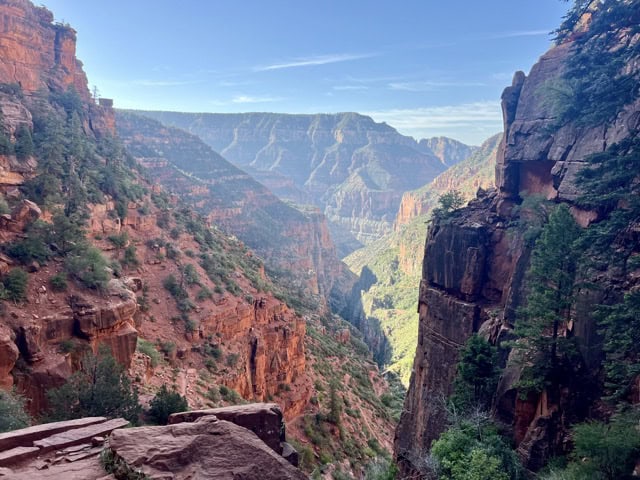
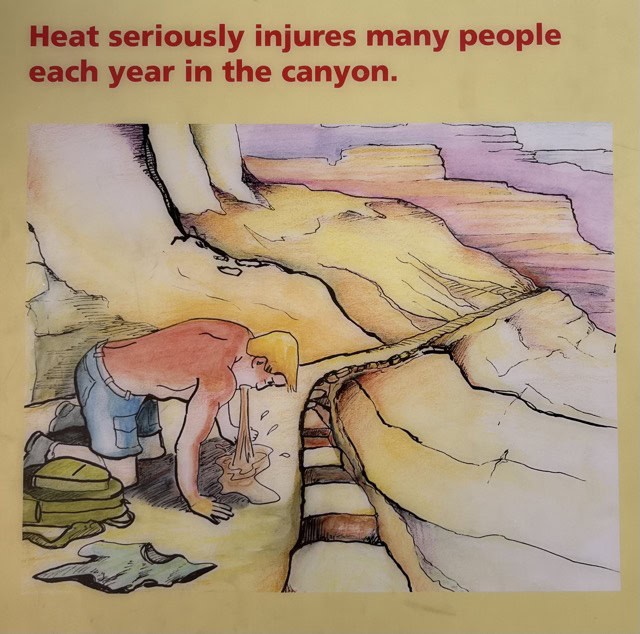
Not all who are called, however, seem to have had any idea what it was they were being called to. As we sank lower into the canyon and the sun crested over the rim and flooded everything between the mammoth stone faces with bright, relentless sunshine, we noticed a precipitous drop in the chattiness among our fellow hikers. While in the morning everyone seemed excited and eager to talk, the people we met at mid-day had started to realize just what they had gotten themselves into, and many were very clearly unhappy about it. The park service really does go out of its way to warn people, but even I can admit that it’s hard to understand what desert hiking demands of you if you’ve never actually done it. I was in a great mood, elated just to be in that glorious palace, and happily greeted anyone whose spirits likewise seemed high, but there isn’t much you can do to cheer up someone who’s just come to understand what climbing over 5,000’ in the middle of the day without an ounce of shade really, really means. I shouldn’t assume, of course, that every person who met my glad tidings with a petulant grunt or sullen silence was a careless noob in over their heads—some people are just assholes.
We wouldn’t be climbing at all today, since our campsite would be about a quarter mile shy of the Colorado River, and after we stopped at Cottonwood Camp for lunch the downhill slope would be much less aggressive the rest of the afternoon. We had time to meander and explore. Sean Meadow took me to Ribbon Falls, a slender, moss-coated gem of a waterfall, where we cooled our fevered skin the pool at its feet, and after which, when we retrieved our packs from the shrub where’d we’d hidden them from the sun, Sean Meadow was outraged to find hers covered in ants. She cursed up a storm as she brushed them off her pack, while I, in turn, brushed them off her shirt, but soon we were back on the AZT, our soaking shoes drying quickly in the heat.

We made it to camp by mid afternoon, with plenty of time yet to lay by the creek and rest. It would only be 7 miles to the crest of the south rim, but it would be almost straight uphill the entire way. The only job we had until the morning, then, was to soak in the surroundings, and relax.
Day 41: 26 May 2024, 8.9 miles today, 775.1 miles total, Scottsdale, AZ
I first visited the Grand Canyon some 10 years before I set out to hike the AZT. That whirlwind of a vacation included just enough time for a short mile and a half hike down to Cedar Ridge, where I stared longingly past the towering faded rust rock formation growing from the steep saddle and contemplated what wonders lay in the depths beyond. It was hard to turn back, thinking as I did that this was my once in a lifetime chance to see the majesty of this place firsthand.
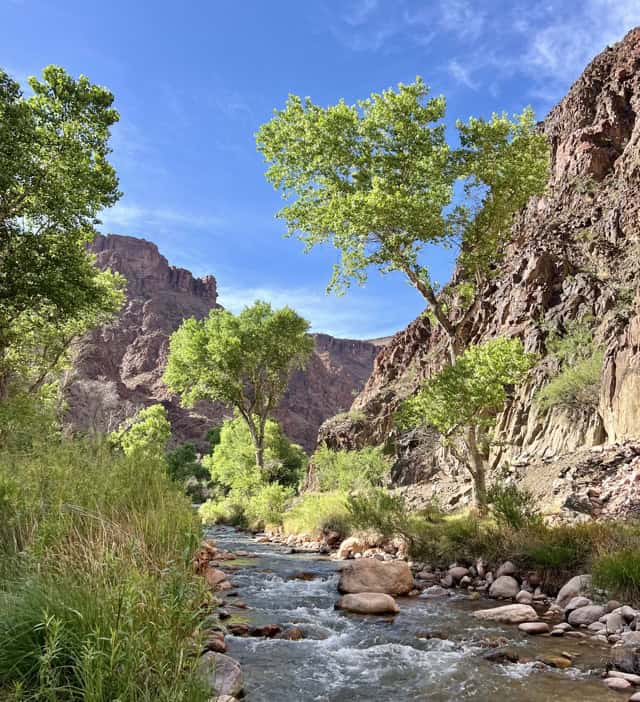
And maybe in a sense it was. Certainly that first felt as it belong to another life, one which would have to be radically upended once or twice before circumstances would carry me to the bottom of the canyon, like a flake of ash carried on the wind, miles through the twisting rock passages to a little clearing tucked between a sheer cliff face of marbled black and russet granite and the steady whoosh of Bright Angel Creek. The NPS campground nestled there is a true marvel of engineering and brute-force labor set in the heart of marvel of nature. I was struck less by the fact that the flush toilets had to be manually refilled with buckets of clean water than the fact that there were flush toilets at all—necessitating a modern-day sewage system, complete with a small waste treatment plant a quarter mile downstream. The faucets turn easily, and the soap dispensers are the sort that automatically squirt out a predetermined volume of foam. The lights in the bathroom are dim, but again, there are lights in the bathroom, and there are spigots throughout the area with as much drinking water as the itinerant population could ever need.
All of this is miles from proper civilization—and at least 4000’ down. All the materials to build and sustain these facilities (not to mention the bougie lodge five minutes upstream) have to be packed in by mule or by raft. The scale of the operation absolutely boggles the mind, and after Sean Meadow and I cleared off the trail to allow a heavily-loaded mule train to pass, we spent the first part of the climb debating how often an by what means all this cargo moved through the canyon.
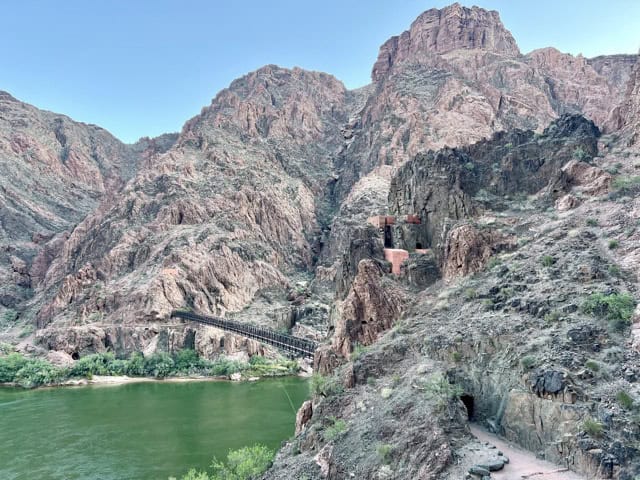
(South Kaibab Trail section)
We started the day by crossing the Colorado River over the South Kaibab Trail’s so-called “Black Bridge,”* which is by itself another small miracle. It sits only some six stories above the surface of the water (depending on the height of the river), but owing maybe to the bare-bones nature of its construction it feels much higher as you’re walking across it. The north side features a wide, comfortable staircase to the bridge neck, but the south end is anchored into a solid wall of rock, and the footpath vanishes into a pitch black tunnel 150 yards away. The effort it must have taken to put the bridge there is unimaginable, but it takes less than a minute to cross. Once on the other side, however, the hiker’s real work begins—it’s quite literally all uphill from here.
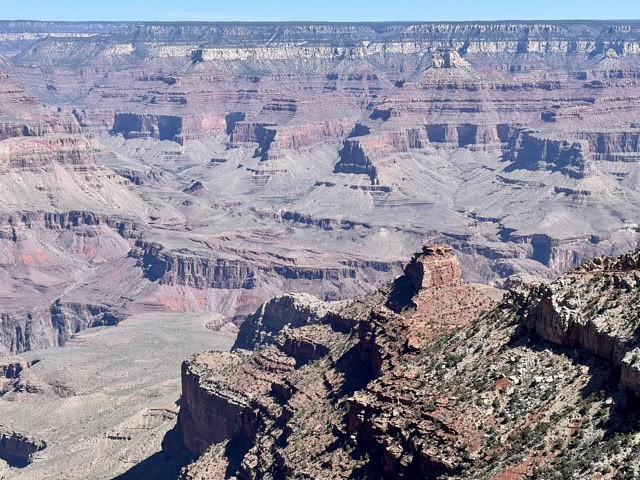
The Grand Canyon is, in reality, a massive network of interconnected canyons, set within a series of wide, yawning greater canyons, set within the vast, intricate maw of the whole. It is the matryoshka doll of natural wonders, ornate stone cathedrals nested within ornate stone cathedrals, nested within ornate stone cathedrals, and if the climb from the bottom hadn’t already taken your breath away, watching this gradual change in perspective would. It’s like like watching the layers of rock grow in front your eyes in a matter of hours. It is truly awe-inspiring, and it’s no wonder that it lures every single day hundreds of people of people completely unprepared to cope with the austerity of its climate.
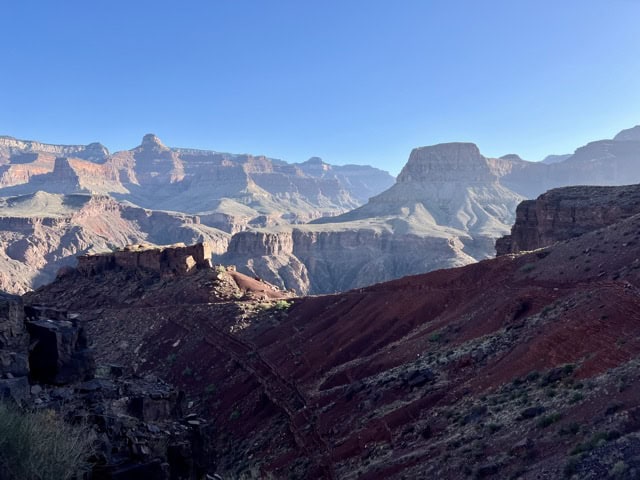
Sean Meadow and I met other people almost as soon as we were across the bridge. First the mule train, then a smattering of super hyped-up trail runners and heavily-laden backpackers. By the time we’d left the inner gorge, however, we started seeing people who seemed rather out place, like someone who could have sworn they remembered the bookstore being on this side of mall. Many already looked beaten down by the descent, notoriously much easier than the return back up to the rim, and everyone was already sweating in the unshaded sun, even though it wasn’t yet 0800hrs. The South Kaibab Trail has no water—a fact which the Park Service is very, very vocal about—but a lot of the people we saw had no more than the single 20oz bottle of water they held in their hand (or a four-pack of little 12oz gatorades held together on plastic rings). Some people had nothing at all. We speculated on how many rescues had to be performed by park staff all the way up, until the people and the wind had both picked to a truly unbearable level, and we both just put our heads down and pushed ahead.
Either would have a been difficult to cope with on its own; together they made the last couple of miles a real slog. The wind was fierce, and the gusts had a nasty habit of catching us mid-stride, knocking us off balance. For the most part, however, it blew directly into our faces, loaded with sand and grit, so that we had to stare at our feet the whole time. That was probably just as well. As we passed Cedar Ridge, the day hikers became a constant swarm, and even as the trail widened we had to contend with a crowd reeking of harsh chemical perfumes that seemed intent not to share even this generously apportioned trail with anyone headed uphill. It was with immense relief that we finally popped up over the last, steep switchback and landed at the trailhead. Our rim to rim hike was complete.
That still left a gap of about two miles to the turnoff where I’d left the AZT the previous year. This, in a way, was the perfect finish to complete my continuous footpath from Mexico to Utah. It had none of the spectacular scenery of the canyon’s interior, but the rolling terrain was gentle, and there wasn’t a soul amid the ponderosa pines but the two of us, and we chatted amiably as we plodded along. It was an easy walk, even as our bodies, so long out of thru-hiker shape, were already calcifying into the mass of stiff joints and aching muscles that would come to define our existence over the next few days. It was a peaceful walk, and a graceful end, and it was all over too quickly. But as we returned to the campground, I had no more of the AZT left to walk. I could leave this trail behind me, and start to ponder what to do with the next precious sliver of free time granted to me by God and the City of Asheville Department of Water Resources. In the meantime, there would be air conditioning, fresh pizza, and bottomless diet coke, just a shuttle ride and short drive away to the tourist trap town of Tusayan. We’d head south to a suburb 20 minutes from the Phoenix airport, staying at the budget hotel with the nicest looking pool and a soft bed. In that moment, that seemed about all anyone walking dry, hungry, and dusty under the Arizona sun could ask for.
*The bridge that spans the river on the nearby Bright Angel Trail is called the “Silver Bridge.” The only means of crossing the river by foot, the two bridges are only half a mile apart, and are named after their respective coloring.